
Proactive Fog Discovery: Bridging the Gap in Mobile IoT via Social Ad Hoc Networks
Proactive Service Discovery in Fog Computing Using Mobile Ad Hoc Social Network in Proximity
The paper introduces a decentralized framework for proactive Fog service discovery and task migration using Mobile Ad hoc Social Networks (MASN). It enables mobile devices to autonomously discover nearby Fog nodes and migrate processes without relying on distant Cloud services or continuous Internet connectivity.
TL;DR
This research tackles the "connectivity gap" in Fog computing caused by user mobility. By leveraging Mobile Ad hoc Social Networks (MASN), the proposed framework allows devices to proactively "hear" about upcoming Fog nodes from nearby peers before the current connection drops. This enables seamless task migration and service continuity without ever needing to ping a distant Cloud server.
Background: The Latency of the Distant Cloud
While Cloud computing provides massive resources, the physical distance to data centers introduces latency that is unacceptable for real-time IoT applications—like Assisted Living apps for the disabled. Fog computing brings resources to the "edge," but it faces a major hurdle: Mobility. If you are walking, you will eventually leave the range of your current Fog node. Without a central registry (which would require the Internet), how does your phone know where the next Fog node is?
The Core Insight: Socially-Sourced Discovery
The authors' core breakthrough is treating nearby mobile users as "information carriers." Instead of a centralized directory, they use a Physical-Distance-based DHT.
- Opportunistic Sharing: Your phone talks to other phones (coworkers, friends) via Bluetooth or Wi-Fi Direct.
- Information Decoupling: Information about a Fog node (its SSID, location, and even encrypted passwords) can travel further than the signal of the Fog node itself.
- Adaptive Routing: If a peer moves and breaks a routing path, the system uses a smart flooding technique based on the last known GPS coordinates to ensure response messages find their way back.
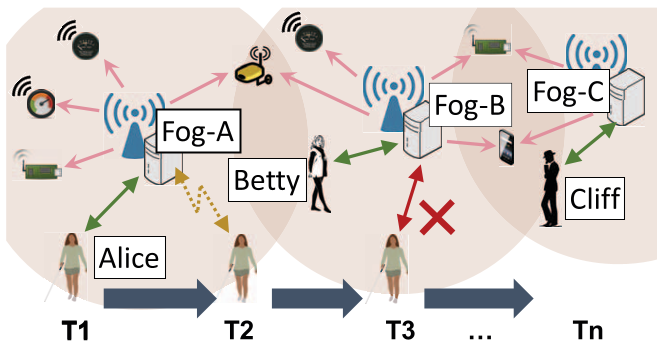 Figure 1: Alice's device learns about Fog-B from Betty's device before she even leaves Fog-A's range.
Methodology: A Better Way to Route
Unlike previous P2P systems that used rigid tree structures, this framework treats all peers as equals. The routing logic (Algorithm 1) uses a Time-To-Live (TTL) mechanism to prevent network congestion. When a device moves (T2a/T2b scenarios), the system intelligently switches from "Path-based" routing to "Directional-flooding," ensuring the discovery request doesn't disappear into a black hole.
Experimental Validation
The researchers didn't just simulate; they built a prototype using Android devices (Nexus 5, LG G4C) and Fog nodes (HP/Lenovo laptops).
- Scalability: Simulation results in Table I show that even as the number of nodes in an area grows to 200, the Hop Count remains stable at 3, and the Round Trip Time remains under 0.8 seconds. This indicates the framework is highly resistant to "message pollution."
- Migration Efficiency: They measured the time to migrate a Web Application Resource (WAR) file. While hardware variations caused some jitter (Nexus 5 was noticeably slower), the average handoff time stayed within a usable window for non-instantaneous tasks.
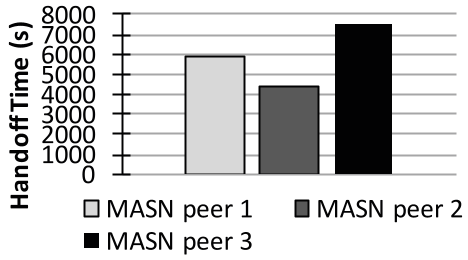 Figure 8: Real-world smartphone handoff times between Fog nodes.
Critical Analysis & Conclusion
This work provides a robust answer to the decentralization problem in Fog computing. By relying on a Social Trust Model, it sidesteps the chaos of public P2P networks while maintaining the benefits of ad hoc communication.
Limitations:
- The handoff time (up to 7.5 seconds) might still be too slow for high-speed applications like VR/AR.
- The reliance on GPS for the DHT lookup assumes accurate location data is always available, which can be problematic indoors.
Future Outlook: The next step for this technology is integrating Quality of Experience (QoE) metrics. Imagine your phone not just finding any Fog node, but using peer feedback to choose the fastest one. As we move toward 6G and ubiquitous IoT, this decentralized "social" discovery model may become the backbone of local edge networks.