
LBLP: Bridging Topology and Semantics for Overlapping Community Detection
Probabilistic Community Using Link and Content for Social Networks
The paper introduces LBLP (LDA-based Link Partition), a probabilistic graphical model for overlapping community detection in social networks. By integrating network topology (links) with User-Generated Content (UGC), the method achieves state-of-the-art accuracy on real-world datasets like Enron and DBLP.
TL;DR
Social networks aren't just sets of connections; they are rich repositories of human interaction and shared content. This paper presents LBLP (Latent Dirichlet Allocation-based Link Partition), a generative model that treats community detection as a "topic modeling" problem on links. By fusing network structure with edge-level content (like email text or paper titles), LBLP captures overlapping communities more accurately than structural-only SOTA methods.
Problem & Motivation: The "Blind Spot" in Network Analysis
Most community detection algorithms suffer from two main limitations:
- Structural Myopia: They only look at the graph "skeleton" (who follows whom), ignoring the "meat" (what they are talking about).
- Hard Partitions: They assume a user belongs to only one group, whereas in reality, a person might belong to a "Work," "Family," and "Hobby" community simultaneously.
The authors' core insight is that interactions (links) carry more semantic weight than nodes. When you send an email, the content of that specific email defines your relationship to that community at that moment.
Methodology: Communities as Latent Topics
The researchers re-imagined the community detection task using tools from Natural Language Processing.
1. The Line Graph Transformation
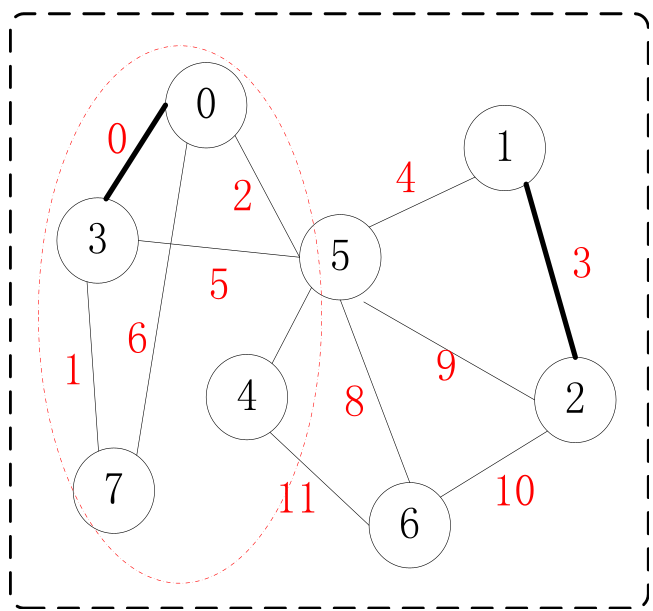
To focus on interactions, the original graph is converted into a Line Graph (LG). In this transformation, every edge in the original network becomes a node. This allows the model to cluster relationships directly, naturally leading to overlapping node communities (as a node can be part of multiple clustered edges).
2. The LBLP Model
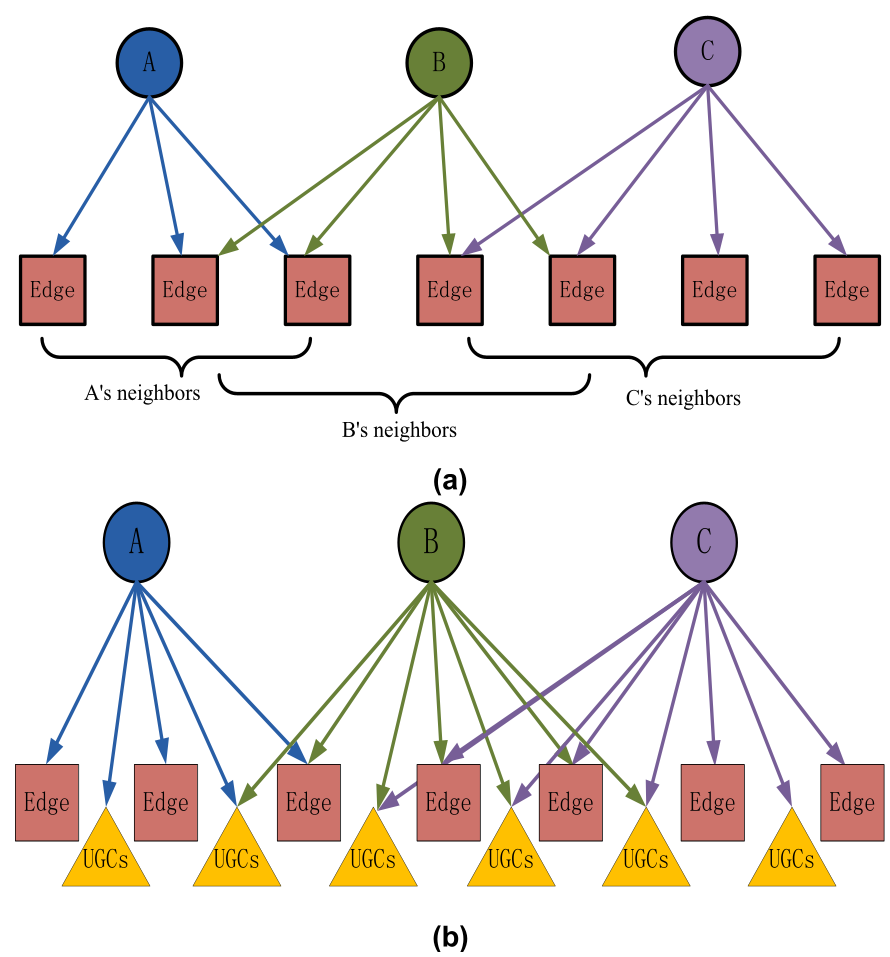
The authors adapt the Latent Dirichlet Allocation (LDA) model. In this setup:
- Documents are the links in the original network.
- Words are the neighboring links or content units.
- Topics are the latent Communities.
3. Fusing Content (LBLP-V and LBLP-W)
The paper proposes two ways to integrate text content (UGC):
- LBLP-Vector (LBLP-V): A linear fusion of structural eigenvectors and content vectors (TF-IDF).
- LBLP-Weight (LBLP-W): A more sophisticated approach using the Mahalanobis distance between content vectors to weight the importance of connections in the line graph, effectively saying: "If we talk about similar things, our connection belongs more strongly to a specific community."
Experiments & Results: Real-World Superiority
The model was tested against massive datasets including Enron emails (158 users, 200k+ emails) and DBLP citations.
Key Takeaways from the Data:
- Robustness: As networks become more "noisy" or complex (high mixing parameters in synthetic tests), LBLP-W's performance stays stable while structure-only methods collapse.
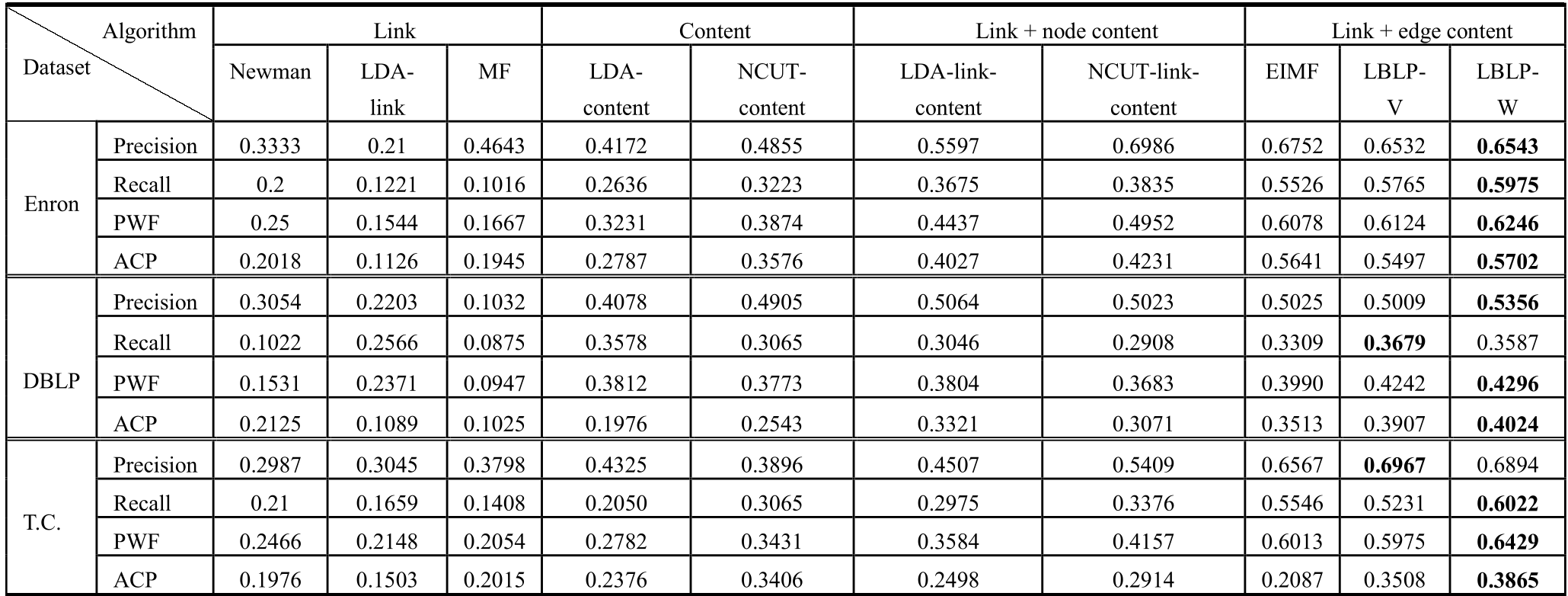
- Precision Gains: In the Enron dataset, LBLP-W achieved a PWF of 0.62, nearly quadrupling the effectiveness of structure-only LDA-link (0.15).
- Semantic Sanity: In DBLP tests, the model successfully grouped researchers not just by who they co-authored with, but by specific research domains like "Data Mining" or "Operating Systems."
Deep Insight: Why Edge-Content Matters
The most striking finding is that link content is more descriptive than node attributes. Because nodes (users) are multifaceted, their aggregate content is often a "mush" of many different interests. However, a single link usually represents a specific context. By focusing on the link-content, LBLP avoids the "averaging" effect and identifies the distinct reasons why communities form.
Future Outlook
While LBLP is powerful, the authors note that hyper-parameter tuning (like the balance parameter in LBLP-V) remains a challenge. Future work likely involves making these models dynamic to track how communities evolve as topics of conversation shift over time.
Conclusion: If you want to understand the true structure of a social network, don't just look at the map—listen to the conversation.