
LLM Reliability Solved? Probabilistic Guarantees via the Repetition-Judge Pipeline
Probabilistic Guarantees for Reducing Contextual Hallucinations in LLMs
The paper introduces a model-agnostic framework providing explicit probabilistic guarantees to reduce contextual hallucinations in LLMs for "specific tasks." By combining independent prompt repetition and an ensemble LLM-as-a-judge, the authors achieve exponentially decreasing error rates in both answer existence and identification.
TL;DR
Researchers have formulated a theoretically grounded method to drive the probability of LLM hallucinations arbitrarily low. By treating LLM outputs as independent probabilistic samples and applying an ensemble judging mechanism, they demonstrate that "correctness" isn't a roll of the dice—it's a tunable parameter that improves exponentially with repetition.
The Core Insight: From Uncertainty to Probability
We often treat LLM hallucinations as mysterious glitches. However, this paper argues that for Specific Tasks—tasks with fixed inputs and deterministic correctness (like data extraction or formatting)—we can treat the model as a stochastic process.
The authors identify two distinct hurdles:
- Existence: How do we make sure a correct answer is generated at least once?
- Identification: How do we pick the right one out of a pile of hallucinated options?
Methodology: The Power of Independence
The "Repetition-Judge Pipeline" relies on a simple but powerful assumption: Independence. By executing prompts in fresh context windows, each run is an independent "attempt" at the truth.
1. The Repetition Lemma
If an LLM has even a small chance () of being right, the probability that it fails times in a row is . This value drops exponentially. If a model is right only 30% of the time, after 10 repetitions, the chance of not having a single correct answer is roughly 2.8%.
2. The Ensemble Judge
A single "Judge LLM" might be wrong. But by using an ensemble of judges and a majority vote, the framework applies the Hoeffding bound. This provides a mathematical ceiling on the probability that a hallucination is accidentally selected as the "correct" answer.
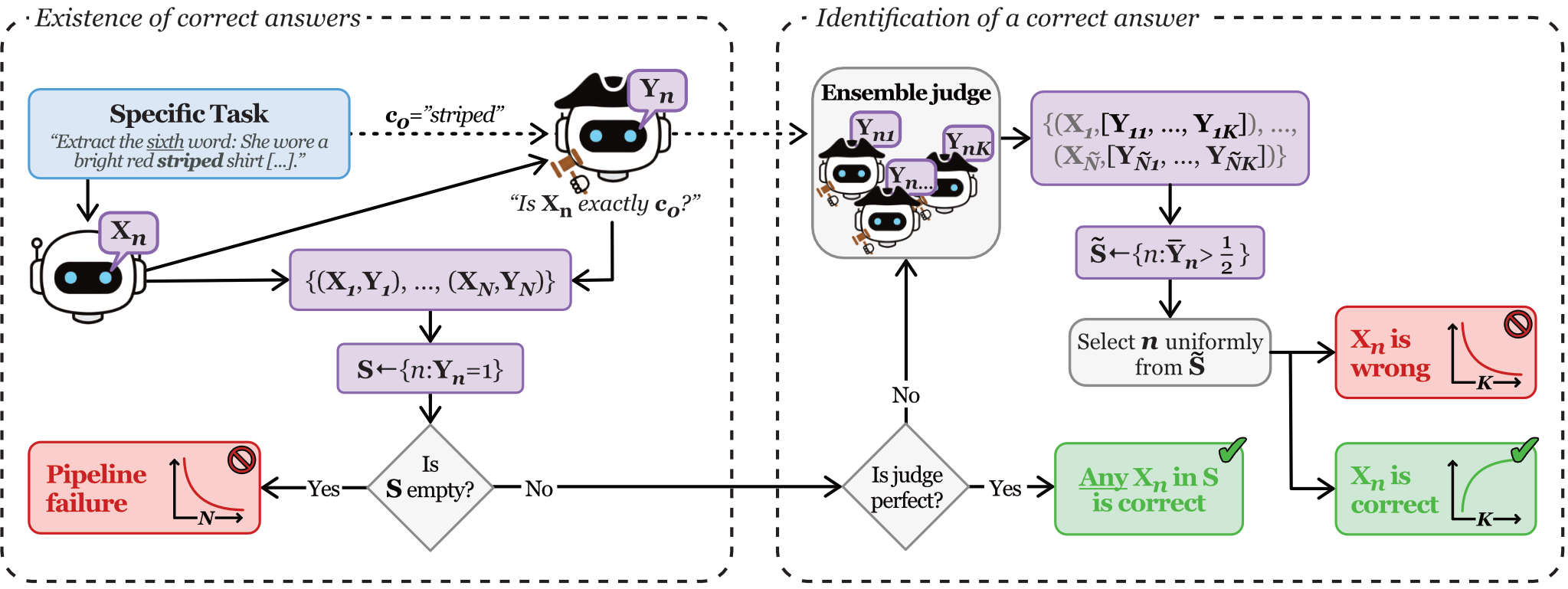 Figure 1: The dual-stage pipeline. Repetition ensures existence (Left); Ensemble judging ensures selection accuracy (Right).
Experimental Validation
Using Qwen3-4B-Instruct, the authors tested the framework on "distractor" tasks—sentences designed to confuse the model.
The results (Figure 2) are a rare sight in AI research: the empirical data points align exactly with the theoretical dashed lines.
- Pipeline Failure (the risk of getting no answer) vanished as increased.
- Hallucination Selection (the risk of getting a wrong answer) plummeted as (number of judges) increased.
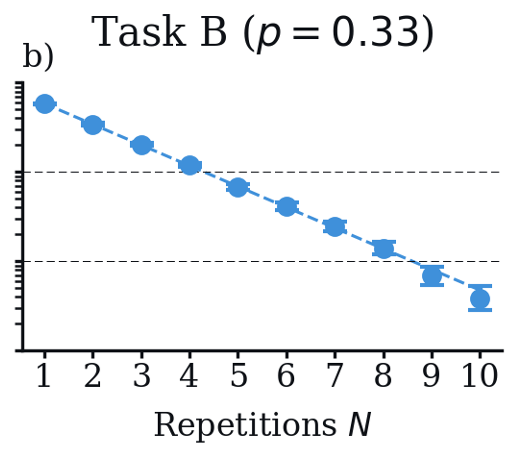 Figure 2: Empirical evidence showing exponential decay in error rates, matching the theoretical predictions of Theorem 3.1 and 3.2.
Critical Analysis & Takeaways
The beauty of this approach is its modularity. You don't need to fine-tune a model to make it 100% reliable (which may be impossible). Instead, you can use a "weaker," faster model and simply increase the number of repetitions until the mathematical risk reaches your tolerated threshold (e.g., 0.0001%).
Limitations
- Cost: Running a model times is significantly more expensive than a single call.
- Latency: Multiple iterations increase the time to the final answer.
- Scope: This currently only applies to "Specific Tasks" where a judge can clearly identify a correct answer. It may not yet work for open-ended creative writing.
Conclusion
This work shifts the hallucination conversation from "engineering prompts" to "statistical guarantees." For engineers building deterministic workflows—like automated accounting, medical coding, or legal extraction—this framework provides the blueprint for building truly dependable AI agents.