
LTM++: Mining the Hidden "Lifestyles" Behind Human Trajectories to Infer Social Strength
A Probabilistic Lifestyle-Based Trajectory Model for Social Strength Inference from Human Trajectory Data
The paper introduces LTM (Lifestyle-based Trajectory Model) and its extension LTM++, a probabilistic generative framework designed to infer social strength from human trajectory data. By modeling latent "lifestyles" as transition matrices over functionality topics, the method achieves SOTA performance in friend link prediction and social strength estimation on Foursquare and Gowalla datasets.
TL;DR
Researchers from Renmin University and HTC have developed LTM++, a probabilistic model that transcends simple GPS co-occurrences. By interpreting trajectories as sequences of "Lifestyles"—mathematically modeled as transition matrices over functional locations (like 'Dining' or 'Office')—they can predict whether two people are friends with unprecedented accuracy, even if those people have never checked into the same physical building.
Beyond the "Co-occurrence" Trap
If you and a stranger both pass through Grand Central Terminal every morning, are you friends? Probably not. If you and your best friend both love craft breweries but visit different ones in different cities, are you socially similar? Absolutely.
Traditional models fail here because they are obsessed with Explicit Co-occurrence. The authors find that:
- 30% of friends never share a single common check-in location.
- 3% of total strangers share more than 10 common locations (mostly transit hubs).
The insight of this paper is that social strength isn't about where you are, but how you live—your Lifestyle.
Methodology: The Architecture of a Lifestyle
The core of the paper is the Lifestyle-based Trajectory Model (LTM++). It views a trajectory not as a list of coordinates, but as a generative process:
- User Preference: A user has a distribution over various lifestyles (e.g., 60% "Office Life", 40% "Weekend").
- Lifestyles as Transitions: Each lifestyle is a Hidden Markov Model (HMM) style transition matrix. In "Office Life," the probability of moving from
TransportationOfficeis high. - Functionality Topics: Instead of raw locations, the model learns "Topics." A topic is a probability distribution over locations (e.g., the 'Food' topic results in 'KFC' or 'McDonald's').
- Temporal Gating (The "++" Factor): LTM++ adds an Exponential Distribution to model how long a user stays at a location. An 'Office' topic has a low emission rate (long stay), while a 'Transit' topic has a high rate (short stay).
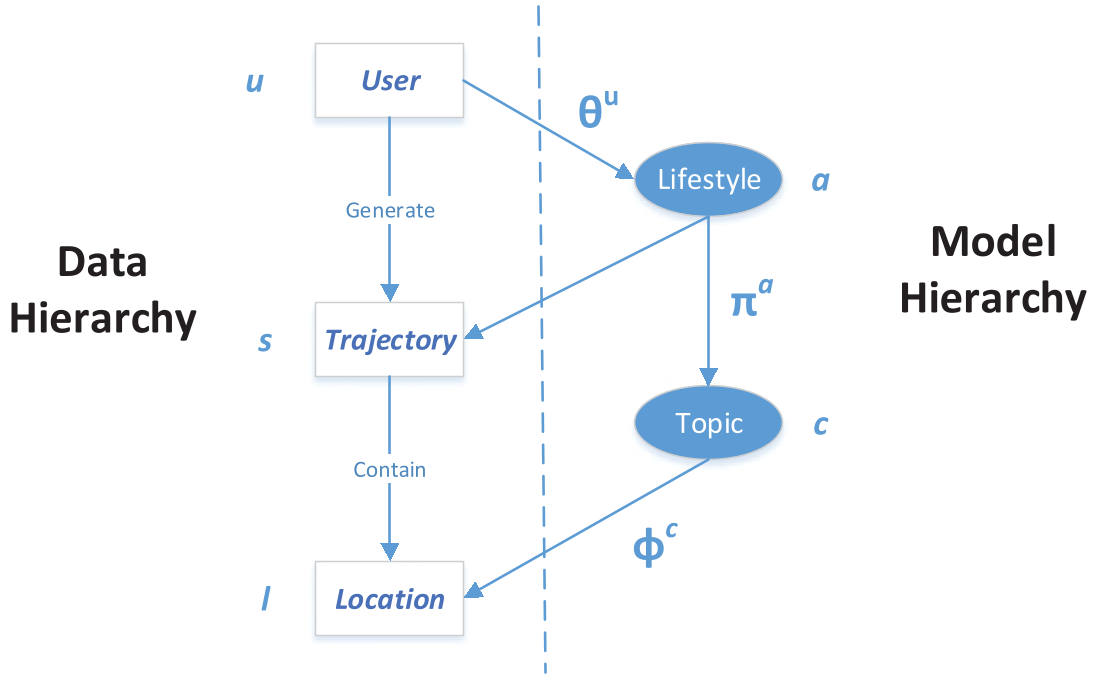 Fig 1: The generative process showing how Lifestyles influence topic transitions and service durations.
Turning Latent Patterns into Social Features
Once the model is trained using a Gibbs-EM algorithm, the authors extract three types of features for any user pair:
- Location Features: Do they visit the same spots?
- Lifestyle Preference: Do they spend similar amounts of time in "Work" vs. "Relax" modes?
- Personalized Transitions: Do they move between functional zones in a similar logical order?
These features are fed into a supervised learner (SVM/SVR) to predict social links.
Experimental Battleground
The model was tested on Foursquare and Gowalla datasets. The results were dominant:
- Link Prediction: LTM++ achieved an F1-score of 0.90, crushing the previous state-of-the-art EBM (0.71).
- Semantic Coherence: The functionality topics discovered by the model (without manual labels) perfectly aligned with real-world categories like 'Resort', 'Sports', and 'Apartment'.
 Table 1: Performance comparison showing LTM++'s superiority in Precision, Recall, and F1.
Critical Insight: Why the "Stay Time" Matters
One of the most profound takeaways is the role of time. Two locations might look similar in a sequence, but if a user stays at Location A for 10 minutes and Location B for 4 hours, their functional intent is vastly different. By modeling this using (the rate parameter), LTM++ effectively "sees" the difference between a quick coffee stop and a long work shift, leading to much more accurate lifestyle signatures.
Conclusion & Future Work
LTM++ proves that probabilistic topic modeling remains a powerful tool for semi-structured trajectory data. While modern Deep Learning might offer more "black-box" power, the LTM++ framework provides interpretability—we can actually see the transition matrices that define a "College Life" vs. "Office Life."
The authors suggest future directions including the use of trajectory patterns for travel routine generation and integrating user demographics (age, income) to further refine lifestyle definitions.