
Probabilistic Linguistic Term Sets: Mastering Interval Uncertainty in Hybrid Decision-Making
14926_Probabilistic Linguistic Term Set With Interval Uncertainty.
The paper introduces an enhanced Probabilistic Linguistic Term Set (PLTS) framework incorporating interval probabilities to better represent high-dimensional uncertainty. Key contributions include a utility-based translation method for unifying qualitative and quantitative data, a dominance method for comparing PLTSs, and an optimization-based aggregation model rooted in Dempster–Shafer theory, achieving SOTA results in Multi-Criteria Decision-Making (MCDM).
TL;DR
Decision-makers often struggle with "messy" data—mixing qualitative expert opinions (e.g., "Good" with 70% certainty) and quantitative sensor data. This paper pioneers the PLTS with Interval Probabilities, a framework that uses interval uncertainty and Dempster–Shafer theory to unify hybrid data without losing the nuances of human hesitation. It moves beyond "point probabilities" to "probability ranges," providing more robust outcomes for critical tasks like disaster shelter selection.
Background: Beyond Precise Numbers
In the real world, saying "there is a 70% chance this is a good site" is often an oversimplification. An expert might feel the probability lies somewhere between 60% and 80%. Previous models, like the standard Probabilistic Linguistic Term Set (PLTS), forced these into precise values, leading to "information distortion." This research fills that gap by allowing both the linguistic terms and their associated weights (probabilities) to exist as intervals.
The Core Innovation: A Unified Translation Bridge
The most significant technical hurdle in Multi-Criteria Decision-Making (MCDM) is comparing apples (numerical distances) to oranges (expert satisfaction levels).
The authors propose a Utility-Based Translation Method. By mapping both linguistic terms and numerical ranges onto a utility scale, they create a bridge:
- Quantitative to PLTS: Distance data (e.g., 570m from a hospital) is transformed into a distribution across linguistic terms like "Good" and "Very Good" using piecewise linear functions.
- Interval Handling: If a value spans multiple utility thresholds, it is distributed across those terms, capturing the "fuzziness" of the boundary.
 Fig 1: Mathematical representation of translating interval utilities to linguistic probabilities.
Methodology: Aggregation via Optimization
How do you merge conflicting opinions? The authors leverage the Dempster–Shafer (D-S) Theory but solve its rigid "conflict" problem by introducing a Risk Coefficient ().
Instead of purely multiplying probabilities (where a single zero would nullify a result), the model uses a nonlinear optimization approach:
- Model 3 & 4: These models calculate the Maximum and Minimum collective performance.
- Compensation Control: The risk coefficient determines how much a "Good" rating on one criterion can compensate for a "Bad" rating on another.
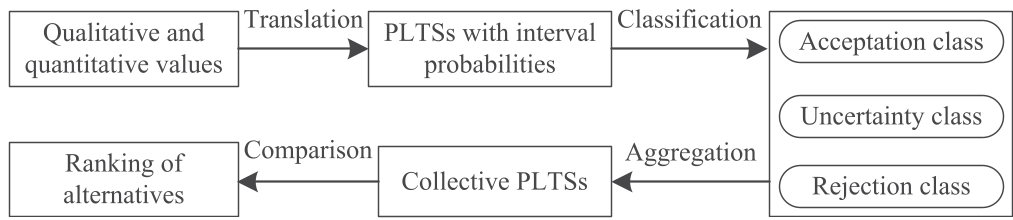 Fig 2: The complete MCDM workflow, from information collection to final ranking.
Experimental Results: The Shelter Selection Case
The study applied this method to select disaster shelters in Sichuan, China—a high-stakes environment prone to earthquakes.
Key Findings:
- Classification Power: The model doesn't just rank; it categorizes. Shelter 1 was designated "Acceptation," while Shelter 2 was "Rejection" because it failed the minimum safety threshold ("Toleration Value") on key criteria, despite having decent scores elsewhere.
- Sensitivity Analysis: The rankings remained stable even when changing the risk coefficient from to . This suggests the method is robust against the subjective bias of the decision-maker.
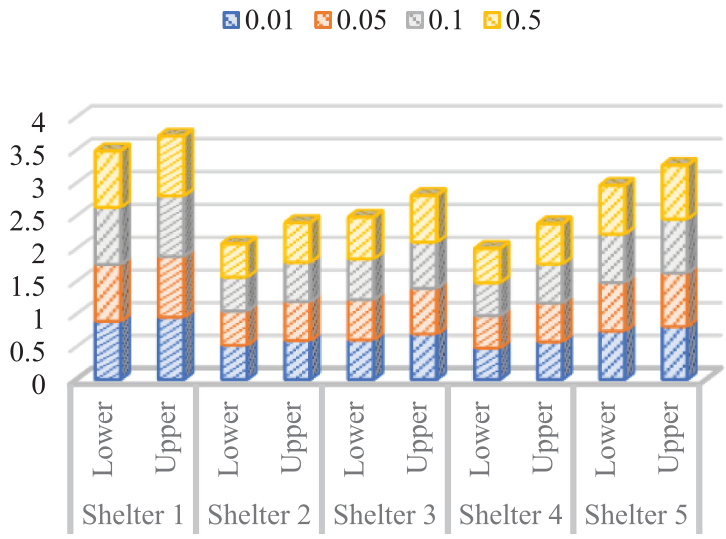 Fig 3: Cumulative utilities across different shelters. Note the clear gap between top-tier and bottom-tier candidates.
Critical Insight & Conclusion
The true value of this work lies in its Academic Professionalism—it treats uncertainty not as noise to be filtered out, but as a dimension of data to be modeled.
Takeaway: For industries like Insurance, Emergency Management, and Urban Planning, the ability to process "interval belief degrees" allows for a more honest representation of risk. While the computational complexity of the nonlinear optimization models is higher than traditional TOPSIS or AHP, the reliability of the resulting "Accept/Reject" classification is far superior for high-risk human safety applications.