
PL-TODIM: Bridging Big Data Reviews and Human Psychology for Smart Product Selection
Probabilistic linguistic TODIM method for selecting products through online product reviews
The paper introduces the Probabilistic Linguistic TODIM (PL-TODIM) method, a novel Multiple Attribute Decision Making (MADM) framework designed to rank products using Online Product Reviews (OPRs). By integrating Probabilistic Linguistic Term Sets (PLTSs) with the psychological behavior-oriented TODIM approach, the method successfully ranks alternative SUVs, outperforming traditional models by accounting for customer risk preferences.
TL;DR
Choosing the right product among thousands of online reviews is a "Big Data" headache. This paper introduces the PL-TODIM method, which transforms qualitative customer reviews into Probabilistic Linguistic Term Sets (PLTSs) and applies a psychologically-aware ranking algorithm. Unlike standard models, it accounts for "loss aversion"—the fact that we hate a bad feature more than we love a good one.
Problem & Motivation: The "Rationality" Trap
When you buy an SUV, you look at OPRs. One review says "great space," another says "low power." Traditional decision-making models (like TOPSIS or VIKOR) usually convert these into average scores. This is flawed for two reasons:
- Information Loss: Averaging "Excellent" and "Poor" ignores the distribution of opinions.
- The Rationality Myth: Humans aren't perfectly rational. As established in Prospect Theory, our decision-making is influenced by how we perceive potential "losses" compared to "gains."
Authors Peide Liu and Fei Teng argue that to truly model consumer behavior, we need a method that respects the vague, uncertain, and probabilistic nature of reviews while acknowledging the psychological biases of the buyer.
Methodology: The Core of PL-TODIM
The proposed framework consists of a three-stage pipeline: Preprocessing, Weight Calculation, and the TODIM Ranking.
1. From Text to Probabilities (PLTS)
The system uses web crawlers and sentiment classifiers to map reviews to a linguistic scale ( to ). For example, if an SUV's fuel consumption is described as "low" by 80% of users and "medium" by 20%, it is represented as a PLTS: .
2. Objective Weighting via Entropy
Instead of asking a user to manually weigh "Space" vs. "Power," the paper develops a cross-entropy and entropy measure. This calculates how much "information" or "consensus" exists within each attribute across different products, assigning higher importance to features that clearly distinguish one product from another.
3. The Prospect Function (TODIM)
The heart of the method is the dominance degree calculation. It measures how much alternative "dominates" alternative .
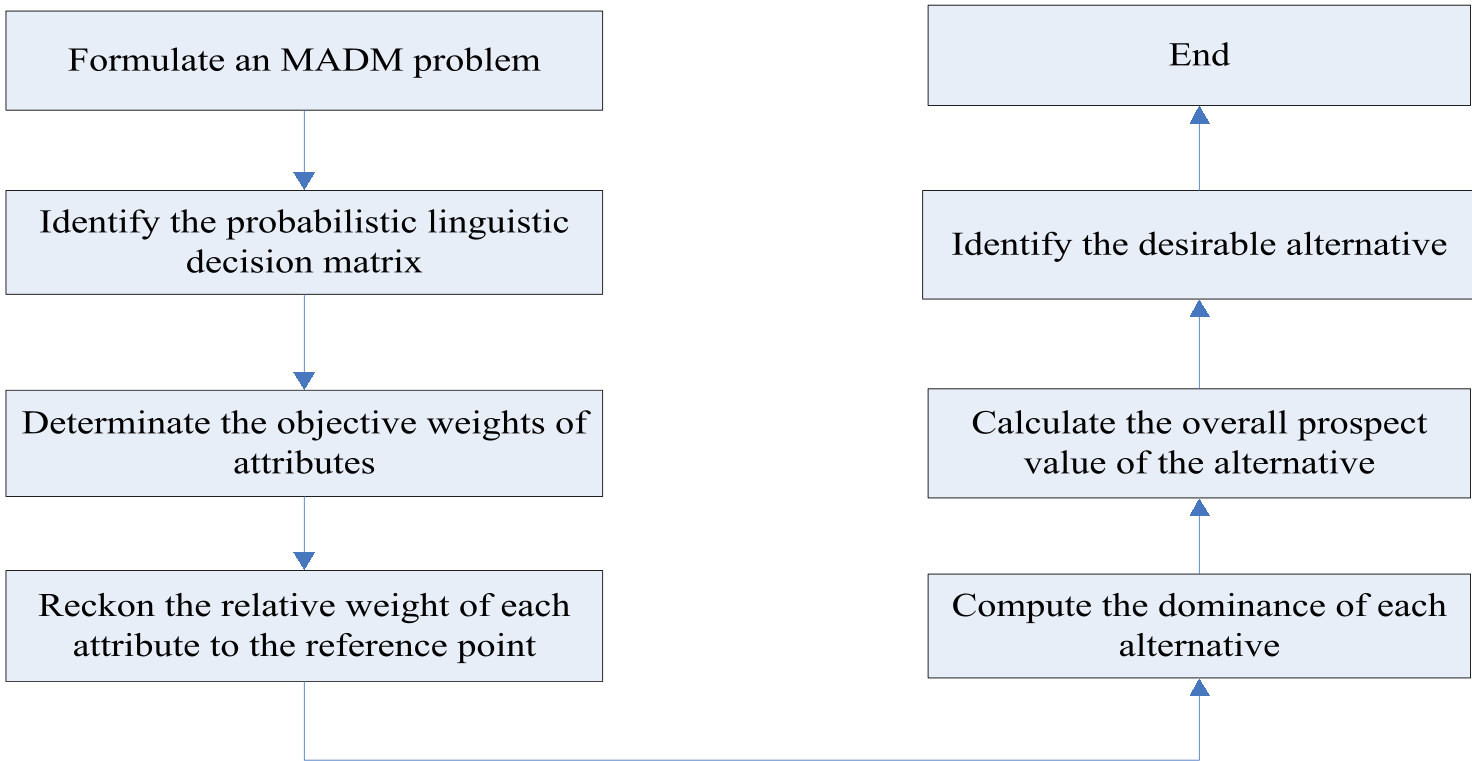 The schematic structure of the extended PL-TODIM approach.
The formula for (the dominance degree) handles gains and losses differently. If a product is worse in one attribute, the "loss" is amplified by a factor (loss attenuation), simulating the consumer's fear of making a bad purchase.
Case Study: Ranking the Best SUV
The authors tested the model on four real SUVs: Honda UR-V, Tiguan L, Highlander, and Everest, evaluated across eight criteria like "Controllability" and "Cost Performance."
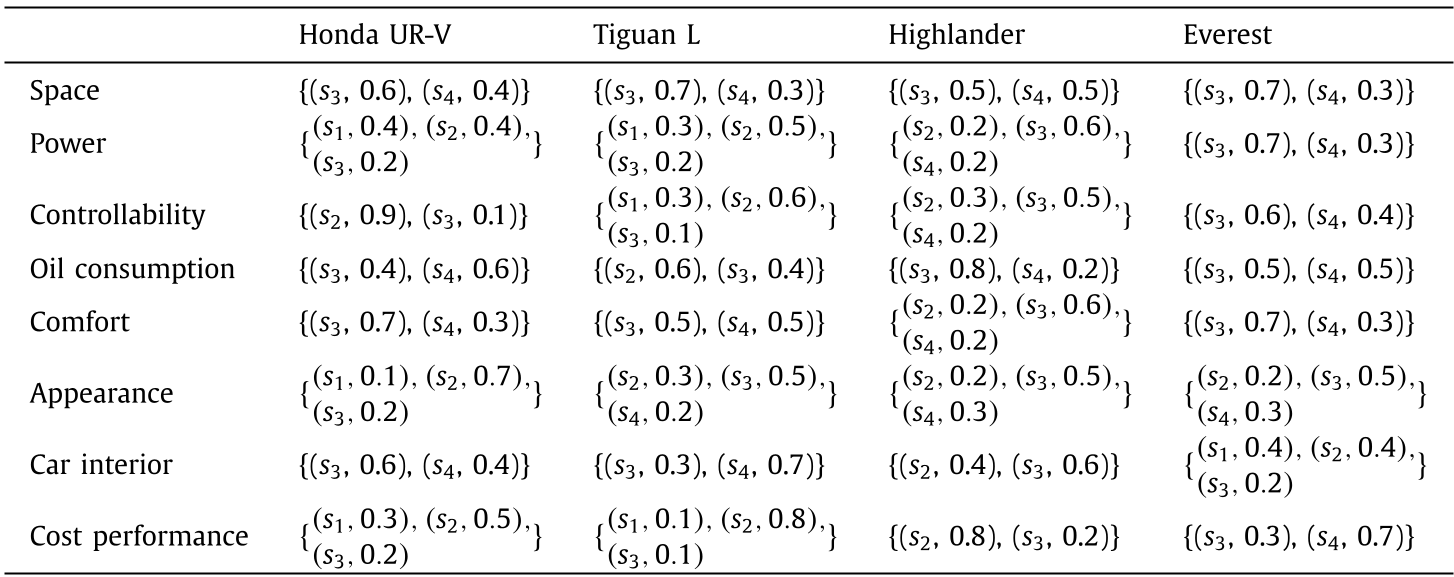 The Probabilistic Linguistic Decision Matrix derived from actual online reviews.
Key Findings:
- Winning Product: The Everest emerged as the most desirable choice based on its overall prospect value ().
- Sensitivity to Risk: By adjusting the parameter , the researchers showed that for highly risk-averse consumers (), the Tiguan L becomes more attractive than the Highlander because its "losses" in certain categories are less severe than the Highlander's weaknesses.
Critical Analysis & Conclusion
The PL-TODIM method is a significant step forward because it:
- Reduces "Inverse Sequence" Problems: Unlike the PL-VIKOR method, this approach is less likely to flip the ranking if one alternative is removed.
- Reflects Real Behavior: Most e-commerce systems use simple stars; this uses the "weight of words" and the "fear of regret."
Limitations: The current model assumes attributes (like Power and Oil Consumption) are independent. In reality, they are often correlated. Future work involving Choquet Integrals could address these interrelationships to provide even more robust results.
Takeaway
For product designers and e-commerce platforms, the message is clear: Distribution matters more than averages. A product with a 50/50 split of "Love/Hate" is perceived differently than one that is "Mediocre" for everyone. PL-TODIM provides the mathematical rigor to navigate this nuance.