
PMF for Signed Networks: Beyond Simple Friendship Prediction
A Probabilistic Matrix Factorization Method for Link Sign Prediction in Social Networks
This paper introduces a Probabilistic Matrix Factorization (PMF) approach for link sign prediction in social networks featuring friend/foe (positive/negative) relationships. By treating sign prediction as a user-to-user recommendation task, the model integrates social structural balance, status theories, and individual trustworthiness to achieve SOTA performance on datasets like Epinions and Slashdot.
TL;DR
Most social network analysis focuses on positive links (likes, follows), but "foe" relationships are equally critical. This paper presents a Probabilistic Matrix Factorization (PMF) method that treats signed link prediction as a recommendation problem. By blending individual user traits with Social Structural Balance and Status Theories, the model achieves superior accuracy and robustness against noise compared to traditional feature-based classifiers.
Background: The Complexity of "Foes"
In platforms like Epinions or Slashdot, users don't just "follow"; they actively "distrust" or mark others as "foes." Predicting these signs is harder than standard link prediction because:
- Asymmetry: Trusting someone doesn't mean they trust you back.
- Transitivity Rules: In signed networks, "the enemy of my enemy is my friend" (Structural Balance) matters more than simple proximity.
- Latent Traits: Some users are naturally skeptical (hard to trust), while others are naturally controversial (easy to be distrusted).
Methodology: High-Dimensional Trust
The authors move away from binary classification. Instead, they factorize the signed adjacency matrix into latent user vectors and .
The Core Intuition
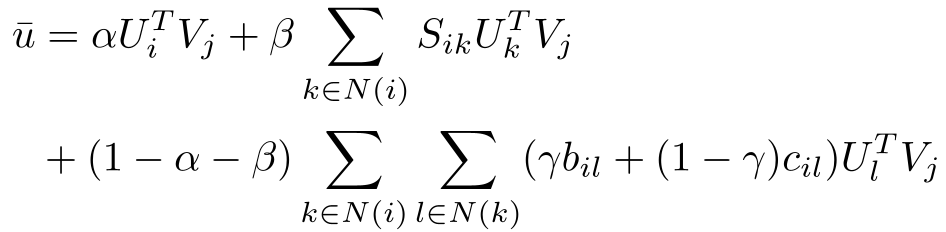
The "predicted link" is not just a dot product. It's a weighted sum of three social layers:
- Self-Influence (): The user's inherent tendency to trust/distrust.
- Direct Neighbors (): Influence from immediate friends and foes.
- Structural Context (): Long-range social psychological factors (Balance & Status theories).
Model Architecture
The following equation represents how the latent features are averaged to predict the sign :
The model then uses a Gaussian noise model to define the likelihood of observed signs and optimizes the posterior via gradient descent.
Experiments & Results
The researchers tested their approach on two major signed networks: Epinions and Slashdot.
1. Accuracy Superiority
The PMF method outperformed the previous SOTA (Leskovec et al., 2010) across all settings. Notably, on unbalanced real-world data, it showed a clear lead over "All23" (a model using 23 hand-crafted topological features).
| Dataset | 16Triads (Baseline) | All23 (Baseline) | Ours (PMF) |
|---|---|---|---|
| Epinions | 92.02% | 92.54% | 94.06% |
| Slashdot | 88.95% | 89.95% | 91.28% |
2. Robustness to Uncertainty
A critical contribution of this work is the simulation of "user doubt." By adding a noise threshold , the authors showed that as decisions become less certain, PMF maintains a lower Root Mean Square Error (RMSE) than standard logistic regression.
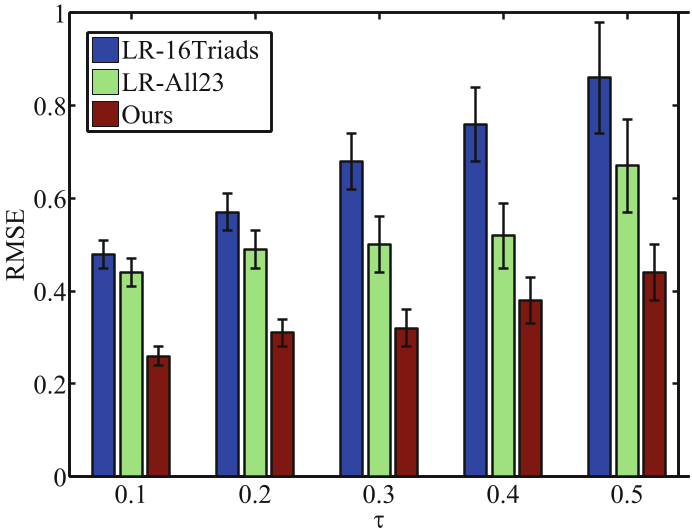 (Example: RMSE stability on the Slashdot dataset as noise increases)
Critical Insight & Future Outlook
While the paper proves that Matrix Factorization is a powerful tool for signed networks, it also highlights a limitation: the hyperparameters and (weighting individual vs. social influence) were kept static. In reality, these should be personalized. Some users are "lone wolves" (high ), while others are "herd followers" (high ).
Takeaway: The transition from hand-coded topological features to latent representation learning (Matrix Factorization) marks a significant step in capturing the hidden "social pulse" of signed communities. Future work integrating this with Deep Learning (specifically Signed GNNs) is the logical next step.