
Social Working Memory: Designing a Bayesian Brain for Wearable Social Assistants
10379_A Probabilistic Model of Social Working Memory for Information Retrieval in Social Interactions.
This paper proposes a probabilistic model of Social Working Memory (SWM) for personal Information Retrieval (IR) in social interactions. By integrating architectural insights from psychology and Bayesian computing, the authors developed a semantic hierarchy for long-term memory and a Bayesian network that simulates human social intelligence, outperforming traditional Bayesian cognitive baselines.
TL;DR
Recall failure during social encounters is a common human frustration. Researchers have now developed a Social Working Memory (SWM) model that uses a Semantic Bayesian Network to predict which biographical information is most relevant in a given social context. Implemented on Google Glass, the model successfully simulates "Social Intelligence" by ranking personal data based on social consensus and individual personality.
The "Name on the Tip of Your Tongue" Problem
Navigating social interactions is a high-bandwidth cognitive task. We must maintain and manipulate characteristics, profiles, and relationships in real-time. However, human work memory is a limited-capacity system. Prior Artificial Intelligence (AI) efforts viewed Information Retrieval (IR) as a document-matching problem, neglecting the dynamic, adaptive nature of how humans prioritize information based on whether they are at a formal board meeting or a casual party.
The authors argue that social memory isn't just a database; it’s an active inference engine.
Methodology: The Architecture of Social Memory
The proposed framework splits social memory into two distinct but interacting components:
1. Social Long-Term Memory (SLTM)
Information is stored in a Semantic Hierarchy. Using "card-sorting" psychological techniques, the team clustered 28 biographical items into five core types: Personal, Professional, Education, Leisure, and Family. This provides the "static" knowledge base.
2. Social Working Memory (SWM)
The SWM is the "mental workspace." It uses a Bayesian network to calculate a Potentiality Score (PS) for an information item :
- Accessibility: Represents the "Wisdom of the Crowd." What does society generally find important in this context?
- Self-Regulation: Represents the "User's Personality." Does the user prefer to follow social norms or stand out by focusing on unconventional details?
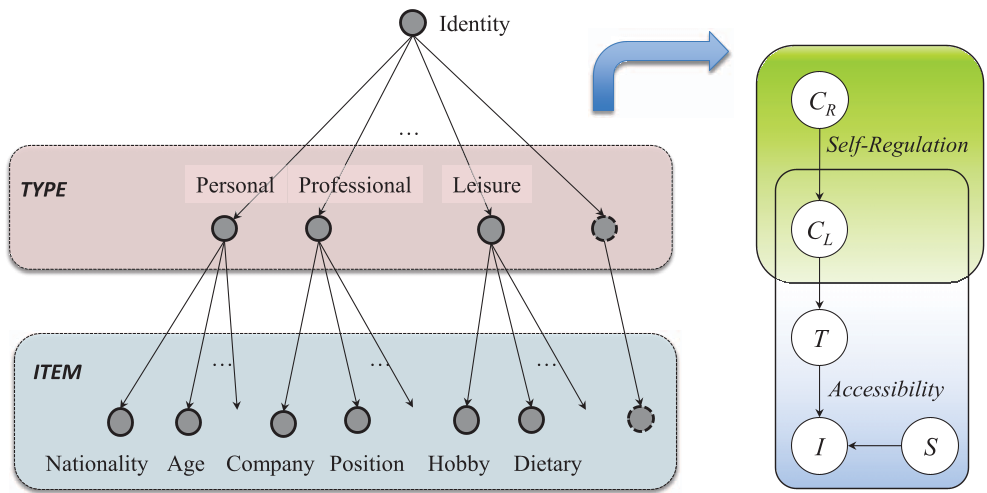 Figure 1: The dual-structure of the model: Long-term semantic hierarchy (left) and the SWM Bayesian network (right).
The model assesses the Similarity between the user and the guest (using text, numeric, and binary measures) to provide a "noise-adder" effect—finding common ground that facilitates smoother conversation.
Experimental Validation: Outperforming the Baseline
The researchers compared their model against the Bayesian Cognitive Model (BCM) using data from 55 participants.
- Personality Profiling: The model successfully categorized participants into three patterns: Agreeable (67.3%), Reversed (23.6%), and Other (9.1%).
- Ranking Performance: Using Spearman’s Rho (), the SWM model achieved a score of 0.607, significantly outperforming the BCM baseline (0.435) and human-to-human rank consistency (approx 0.2).
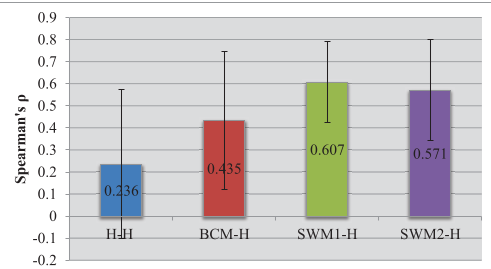 Figure 2: Superiority of SWM1 and SWM2 over the BCM baseline in Spearman’s Rho metrics.
Real-World Application: Google Glass Integration
The team didn't stop at theory. They built a prototype for Google Glass.
- Face Recognition: Detects the guest's identity.
- Retrieval: SWM triggers and ranks the person's data.
- UI Display: The top 6 most relevant "social icebreakers" appear on the Glass HUD.
 Figure 3: Real-time interface showing ranked biographical items during a social encounter.
Critical Insight & Future Outlook
The SWM model proves that human-like social intelligence is not just about "having data," but about probabilistic relevance. By mimicking the brain's medial frontoparietal system, this AI can act as a "cognitive crutch" for those with memory impairments or professionals in high-stakes networking environments.
Limitations: The current system relies on a pre-existing database. The next frontier for Artificial Social Intelligence (ASI) is the automated mining of such personal data from social media footprints (Facebook/LinkedIn) to populate the long-term memory automatically.
Conclusion
This work bridges the gap between symbol-based cognitive psychology and statistical machine learning. It provides a blueprint for wearable devices that don't just "record" our worlds, but help us interact with them more intelligently.