
TURCM: Decoding Social Communities through Topics and Interaction Dynamics
Probabilistic model for discovering topic based communities in social networks
The paper introduces the Topic User Recipient Community Model (TURCM), a generative Bayesian framework designed to extract latent communities from social networks. It uniquely integrates three key dimensions: topical content, social graph topology, and the nature of user interactions (interaction types) to achieve a more nuanced discovery of community structures.
TL;DR
The Topic User Recipient Community Model (TURCM) is a generative Bayesian approach that redefines community detection by looking beyond simple "who-knows-who" links. By synthesizing topical interests, network topology, and interaction types (the "how" of communication), it outperforms classic models like CART and CUT. It essentially proves that the strength and context of a digital handshake are vital for identifying the true clusters we belong to.
Context: Why Graph Topology Isn't Enough
In the early 2010s, community detection was largely a game of graph partitioning. However, the authors of this paper identify a critical flaw in this approach: it neglects the reason for the connection.
In a real social network:
- Passive vs. Active: Not everyone connected in a graph is an active participant in that community.
- Semantic Nuance: Two people might be connected but only talk about "Work" (Topic A), while being part of separate "Hobby" groups (Topic B).
- Interaction Depth: A single "forwarded" email is a weaker social signal than a 20-message back-and-forth "reply" chain.
Previous works like CUT (Community-User-Topic) focused on semantics but ignored the graph. SSN-LDA focused on the graph but oversimplified user interests. TURCM bridges these worlds.
Methodology: The Generative Logic of TURCM
At its core, TURCM assumes that every communication event (a "post") is generated by a sequence of latent choices. Unlike traditional LDA which treats documents as bags of words, TURCM sees a post as a bridge between a Sender () and a Recipient ().
Key Breakthroughs in the Model:
- The Triple Constraint: It is the first model to combine topics, social graph topology, and nature of interactions.
- Mathematical Factorization: The joint likelihood is factorized to ensure that topics are a mutual interest of both parties.
- Scalability: By using a mixture of unigrams (assuming one post = one topic), the model reduces the training time bottleneck that plagued earlier Bayesian models like CART.
Note: The model depicts communities () as distributions over interaction profiles and topics () as distributions over vocabulary ().
Experimental Results: Proving the Insight
The researchers tested TURCM against the ENRON corpus, a standard benchmark for organizational social analysis.
1. Fuzzy Modularity
Since users in the real world belong to multiple groups (Work, Family, Friends), the authors used Fuzzy Modularity to measure the "tightness" of discovered communities.
| Model | Modularity (C=10) |
|---|---|
| TURCM | 0.339 |
| CART | 0.302 |
| CUT | 0.266 |
The higher modularity confirms that TURCM finds communities where members are both inter-connected and share significantly higher-than-expected thematic overlap.
2. Perplexity and Topic Quality
The model successfully identified distinct topics within the ENRON data, such as "California Power," "Gas Transportation," and "Legal Deals." More importantly, the Perplexity Analysis (measuring how well the model predicts a test set) showed TURCM consistently outperforming baselines across different numbers of topics.
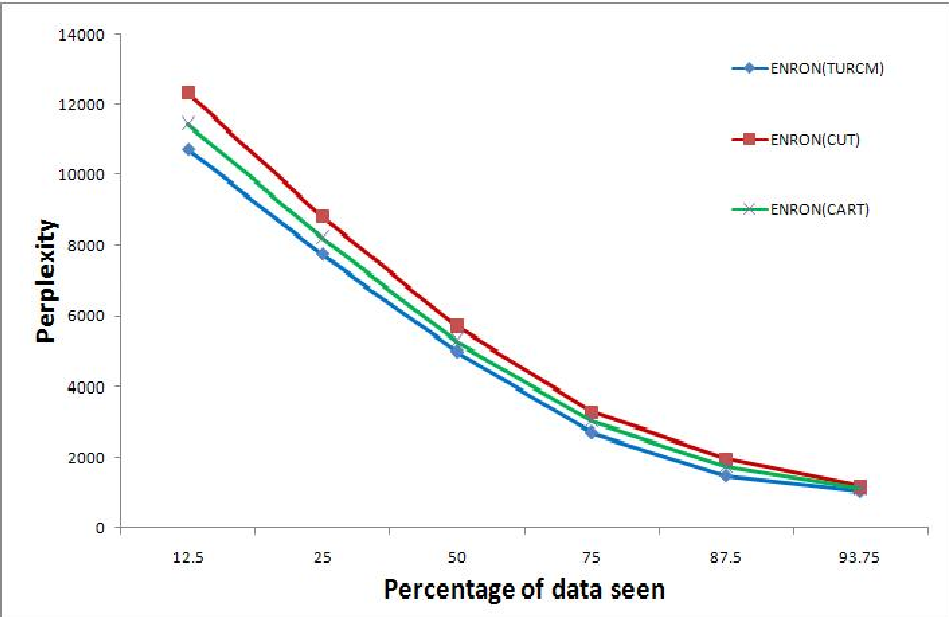 Figure 1: Perplexity comparison on the ENRON dataset, showing TURCM's lower (better) scores.
Critical Insight & Takeaways
The brilliance of TURCM lies in its Inductive Bias: it assumes that the interaction type () is a latent signal generated by the community itself. In modern terms, this is equivalent to saying that "retweets" and "direct messages" represent different social strata.
Limitations: While powerful, the model relies on the "mixture of unigrams" assumption. In short-form social media (like X/Twitter), this holds up well; however, for long-form community platforms (like Reddit), a single post might span multiple topics, which might require a more complex Dirichlet process.
The Future: This work set the stage for modern Graph Representation Learning. Today's GNNs often use "Edge Features" to represent interaction types—a direct descendant of the logic proposed here in 2011.