
PSM: Bridging Data Islands via Hybrid Reconciliation and Probabilistic Semantics
Learning a Probabilistic Semantic Model from Heterogeneous Social Networks for Relationship Identification
This paper introduces an ontology-based framework for integrating heterogeneous social networks (e.g., LinkedIn and DBLP) using an extended FOAF (Friend-Of-A-Friend) mediation schema. It proposes a Hybrid Entity Reconciliation method and a Probabilistic Semantic Model (PSM) to identify complex "collaborative friend" relationships by learning from cross-domain semantic data.
TL;DR
Researchers from Zhejiang University have developed a framework to break the "Data Island" effect in social networks. By combining a logic-driven ontology (Extended FOAF) with a Probabilistic Semantic Model (PSM), they successfully integrated LinkedIn and DBLP data to predict "collaborative friendships" with 71% precision—a task impossible for either platform alone.
Background: The Crisis of "Data Isolated Islands"
In the modern digital landscape, our professional lives (LinkedIn), academic contributions (DBLP), and social interactions (Facebook) are fragmented across different platforms. For research and data analysis, this creates two major hurdles:
- Entity Resolution: Is "Chuny Zhou" on LinkedIn the same person as "Chunying Zhou" on DBLP?
- Structural Semantics: How do we perform statistical learning on complex, graph-like semantic data without "flattening" it and losing the underlying context?
The Core Innovation: Hybrid Entity Reconciliation
Most prior works choose a side: either Logic (using strict rules like "same email = same person") or Numeric (calculating string similarity between names).
- Logic-based methods are perfect in precision (100%) but fail to capture variations in spelling or missing fields, leading to abysmal recall.
- Numeric methods find many matches but are prone to false positives (e.g., different people with similar names).
The authors proposed a pipeline approach. They first use SWRL (Semantic Web Rule Language) to find "sure" matches. The remaining ambiguous pairs are then passed to a numeric engine that utilizes a Dependency Graph to propagate similarity scores based on neighboring nodes (e.g., shared friends or affiliations).
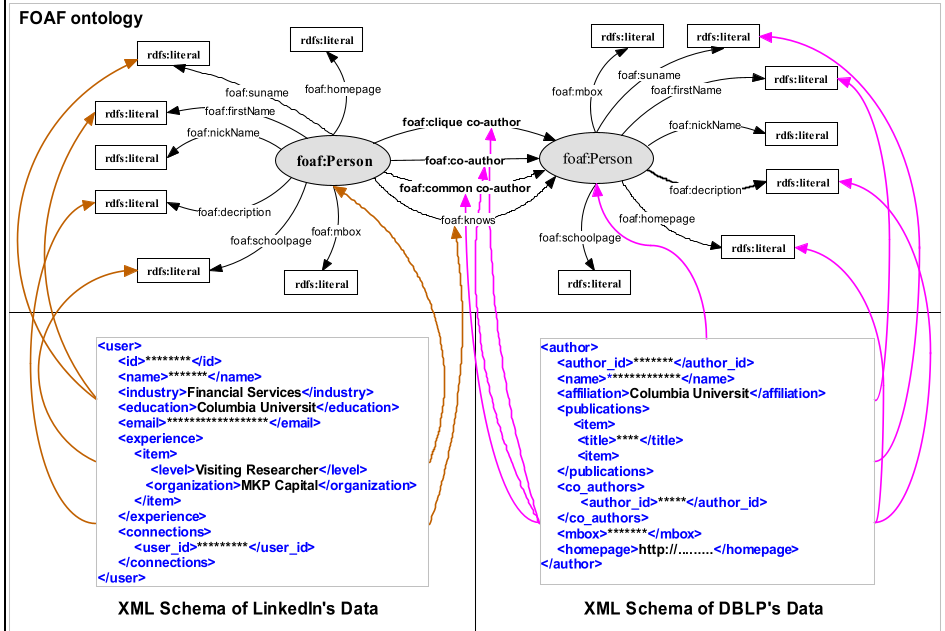 Fig 1: Mapping LinkedIn and DBLP data to a unified, extended FOAF ontology.
Methodology: From Bayesian Networks to PSM
Once the data is integrated into a unified RDF graph, the challenge shifts to analysis. Standard Bayesian networks usually require "flat" feature vectors. The proposed Probabilistic Semantic Model (PSM) allows the dependency structure to exist directly over the semantic schema.
The model defines a Conditional Probability Distribution (CPD) for descriptive properties. For instance, the existence of a "collaborative friend" relationship (R.Exists) depends on 7 distinct parents, including "co-author clique" and "industry segment."
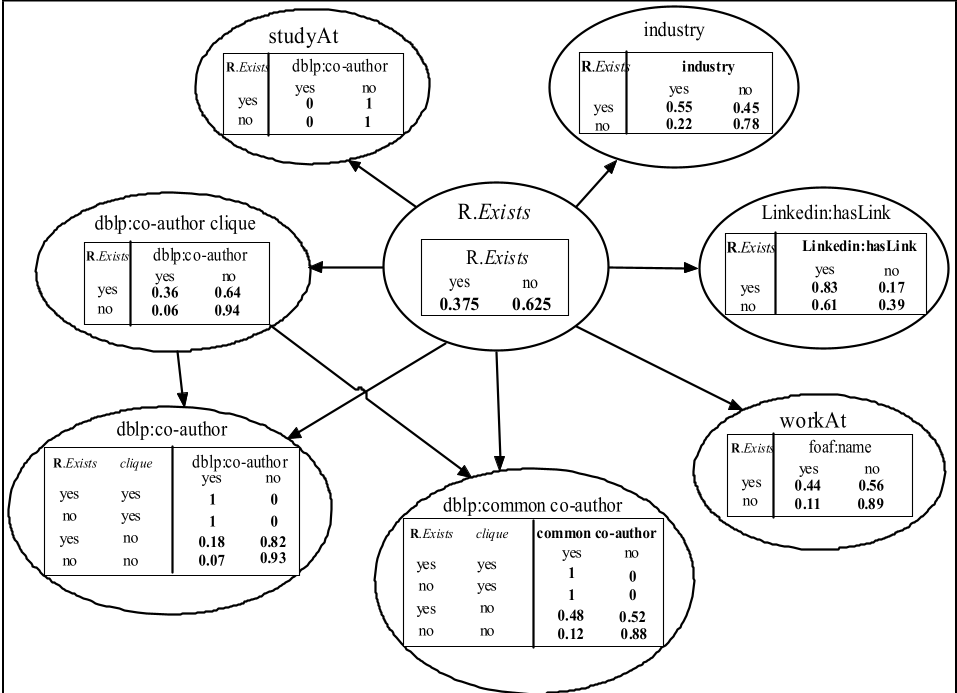 Fig 2: The dependency structure of the PSM for relationship identification.
Experimental Results: Better Together
The authors validated their approach by identifying "Collaborative Friendships"—people who are both social connections and academic co-authors.
- Reconciliation Performance: The hybrid method hit a 87.6% precision and 100% recall.
- Identification Performance: The PSM achieved 71% precision. Crucially, the experiment showed that using only LinkedIn data (social) or only DBLP data (collaboration) resulted in much lower accuracy, proving that integrating "Data Islands" provides a holistic view necessary for complex relationship mining.
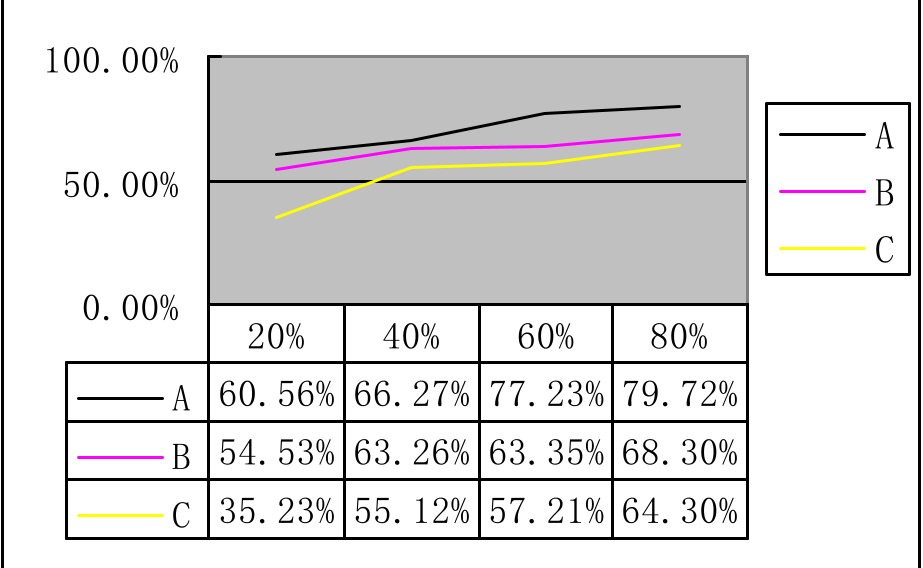 Fig 3: Precision results showing integrated data (A) outperforming single-source data (B and C).
Critical Insight & Future Outlook
The beauty of this research lies in its respect for structure. Instead of forcing semantic data into a table, it adapts the statistical model to the graph.
However, the authors note a potential bottleneck: as semantic structures grow more complex, the current Bayesian-based PSM might become computationally inefficient. Future research directions point toward Markov Networks or more scalable probabilistic graphical models to handle the next generation of the "web of data."
Takeaway for Architects
When building cross-platform identity systems, don't rely on string matching alone. A logic-first, numeric-second pipeline is significantly more robust, and preserving the semantic relationships in your learning model is key to uncovering hidden insights.