
Probabilistic Solutions: Breaking the Efficiency Bottleneck of Influence Maximization
Probabilistic solutions of influence propagation on social networks
This paper introduces a probabilistic framework for solving influence propagation in social networks modeled by the Independent Cascade (IC) model. It proposes a novel "Inclusion-Exclusion Principle" to compute influence spread exactly for Directed Acyclic Graphs (DAGs) and approximately for general networks, achieving massive speedups over traditional Monte Carlo methods.
TL;DR
Researchers have developed a way to bypass the slow Monte Carlo simulations usually required for viral marketing analysis. By applying an Inclusion-Exclusion Principle, they can calculate how information spreads through a social network with near-perfect accuracy but at speeds up to 13,000 times faster than traditional methods.
The Scalability Crisis in Viral Marketing
Viral marketing aims to find a small set of "seed" individuals who can trigger a massive cascade of information. In the academic world, this is modeled as Influence Maximization.
The industry standard for over a decade has been the Independent Cascade (IC) Model. However, it had a fatal flaw: calculating the expected "spread" required simulating the process thousands of times (Monte Carlo Simulations) because the path of influence is stochastic. For a network with thousands of nodes, a single optimization run could take hours or even days, making it useless for real-time applications.
The Insight: Inclusion-Exclusion
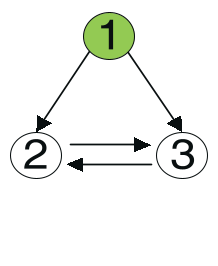
The authors observed that influence propagation isn't just a random walk—it's a probabilistic event where paths collide. If node A and node B both try to influence node C, we cannot simply add their probabilities because they might both succeed simultaneously.
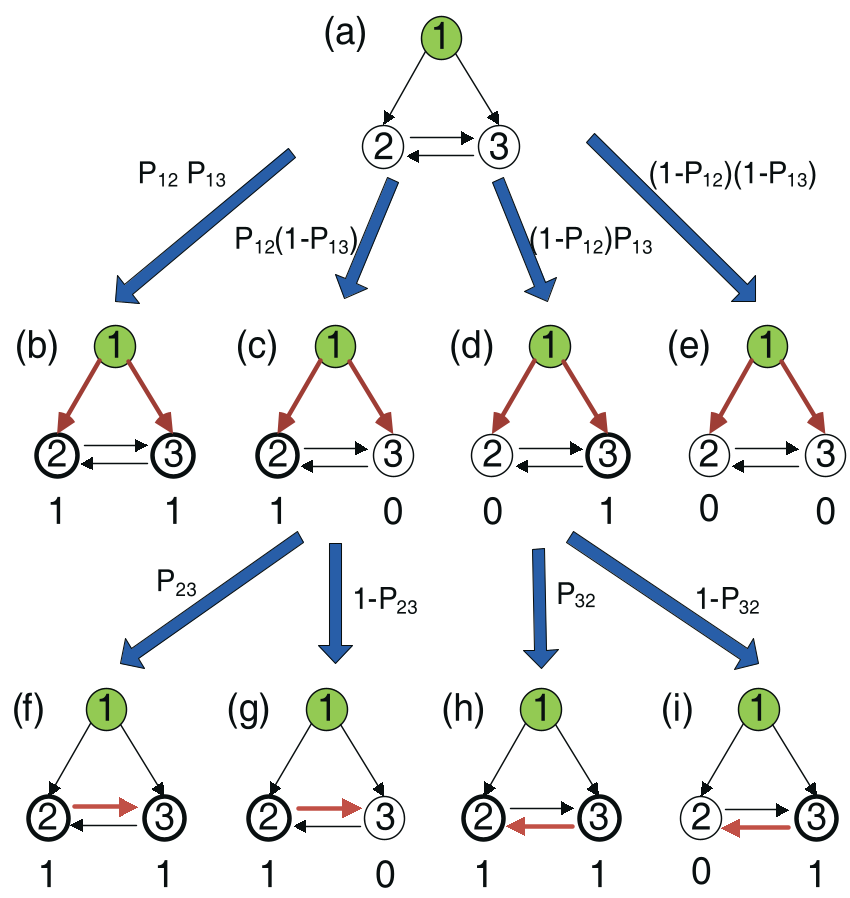
The core breakthrough is treating the activation of a node as a union of events. The Inclusion-Exclusion Theorem specifically corrects for the "over-counting" that happens when multiple neighbors influence the same target. For Directed Acyclic Graphs (DAGs), this provides an exact solution; for general graphs with cycles, it serves as a high-precision approximation.
Methodology: Beyond Simulation
The paper introduces two major algorithmic innovations:
- Iterative Probabilistic Updates: Instead of "flipping coins" in a simulation, the model updates a probability vector across the network until it reaches a stationary state.
- Probabilistic Additive Strategy: When evaluating a new seed set , the authors don't start from scratch. They use a "Probabilistic Additive" formula——to initialize the computation, drastically reducing the iterations needed for convergence.
Experiments: Performance that Defies Logic
The researchers tested their approach on real-world datasets like Wiki-Vote and p2p-Gnutella. The results were staggering:
- Accuracy: The activation probability curves for individual nodes almost perfectly overlapped with the results of 20,000 Monte Carlo simulations.
- Speed: On the P2P dataset, the time dropped from 10 hours (Monte Carlo) to under 3 seconds (Probabilistic).
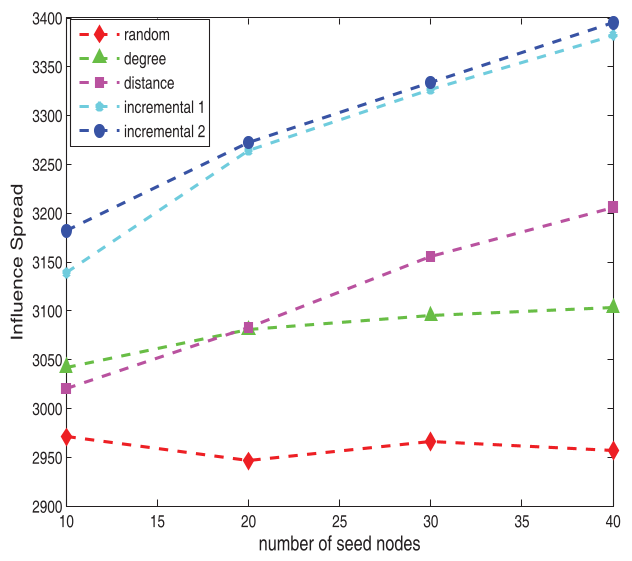
- Coverage: Their incremental search strategy significantly outperformed standard heuristics like "Highest Degree" or "Random Selection."
Critical Analysis & Future Outlook
While the method is a game-changer for speed, the authors honestly note its limitations: it tends to slightly over-count influence in networks with many short cycles (non-DAG structures). However, the error remains within a manageable range for practical viral marketing.
Takeaway: This work proves that we don't need to "roll the dice" to understand social influence. By treating social networks as probabilistic systems rather than stochastic simulations, we can solve one of the hardest problems in network science in the blink of an eye.