
Probabilistic Recommendation Spreading: Why Your Proximity to a 'Hub' Matters More Than Your Degree
Probabilistic spreading of recommendations in social networks
This paper presents a probabilistic model to analyze how product recommendations propagate through scale-free social networks. By categorizing nodes into dynamic layers based on their hop-count from an origin node, the authors derive a mathematical framework combining outward, inward, and same-layer spreading probabilities to predict the total reach of a recommendation.
TL;DR
In the world of social commerce, a recommendation's success is a game of geometry. This paper develops a probabilistic model that predicts how information moves through scale-free networks. By breaking down the network into "dynamic layers" centered on an origin node, the research proves that the location of the starting node—specifically its distance from high-connectivity "hubs"—is the primary determinant of recommendation saturation.
Background: The Scale-Free Reality
Most social networks aren't random; they are scale-free, meaning they follow a power-law degree distribution (). This structure results in a few "hubs" with massive connectivity and many "leaf" nodes with very few links. While prior work focused on either memory-based or model-based recommendation, this paper focuses on the physicality of the spread—how hop-count and clustering coefficients dictate whether a product goes viral.
Methodology: The Dynamic Layering Approach
The core innovation is the decomposition of influence into three directional vectors. Instead of treating the network as a monolith, the authors label nodes by their distance (layers) from the origin node .
1. The Three Directions of Influence
- Outward (): Recommendation moving from the origin toward the periphery.
- Inward (): Feedback or recommendations flowing back from more distant nodes to those closer to the center.
- Same-layer (): "Triangle of friends" effect, governed by the network's Clustering Coefficient.
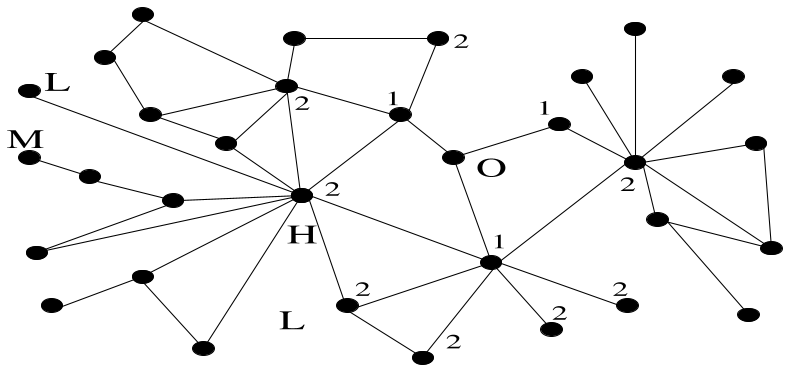 Fig 1: The dynamic layering strategy where nodes are categorized by hop-counts from origin O.
2. Mathematical Intuition
The authors assume that a node recommends a product to neighbors with a probability . For any node in layer , the probability of not being recommended is the product of not being reached by any of the three directions. Thus, the total probability is:
Critical Insight: The Hub Dominance Effect
The researchers tested four distinct cases using Facebook data (4,039 nodes, 88,234 edges):
- Origin as a Hub: Rapid saturation across layers.
- Neighbor of a Hub: Extremely similar to case 1; the hub does the "heavy lifting."
- Leaf node near a Hub: The spread is delayed by one layer but eventually reaches the same volume.
- Leaf node far from Hub: Drastically lower total probability, with the "peak" reach occurring much later (Layer 6).
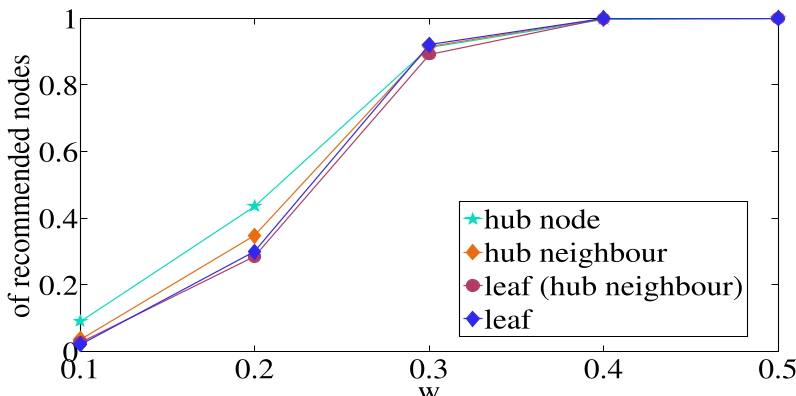 Fig 2: Comparison of total recommendation probabilities based on the origin type.
Why This Matters (Academic Professionalism)
The study moves beyond simple Centrality Measures. It demonstrates that the Same-layer probability is directly related to the density of nodes in that layer, whereas Inward/Outward probabilities are independent of layer size but decay with distance.
The most significant takeaway for marketers and researchers is the redundancy of high-degree origins. If your "Origin" is just one hop away from a Hub, the efficiency of the spread is nearly identical to starting at the Hub itself. This suggests that "micro-influencers" directly connected to "mega-influencers" are almost as valuable as the mega-influencers themselves for information diffusion.
Conclusion and Future Outlook
This work provides a robust mathematical foundation for understanding recommendation cascades. However, it holds a simplifying assumption that nodes recommend only once. In real-world scenarios, temporal dynamics and "message fatigue" (where receiving the same recommendation multiple times reduces its efficacy) offer a fertile ground for future research.
Takeaway for the Industry: Don't just hunt for Hubs; hunt for the neighborhoods of Hubs. The geometry of the network will handle the rest.