
PTRM: Tiny Models Outsmarting Giant LLMs through Stochastic Exploration
Probabilistic Tiny Recursive Model
This paper introduces Probabilistic Tiny Recursive Model (PTRM), a task-agnostic framework that enables test-time compute scaling for Tiny Recursive Models (TRMs). By injecting Gaussian noise into latent trajectories and using a learned Q head for answer selection, PTRM achieves SOTA performance on reasoning benchmarks like Sudoku-Extreme (98.75% accuracy) and Pencil Puzzle Bench.
TL;DR
Researchers have developed Probabilistic Tiny Recursive Model (PTRM), a method that allows 7-million-parameter models to crush frontier LLMs (like GPT-4/5 class models) on complex logic puzzles. By adding simple Gaussian noise during the reasoning process and running multiple "parallel thoughts," PTRM escapes the logic traps that catch deterministic models, achieving a staggering 91.2% accuracy on the Pencil Puzzle Bench at 0.0001x the cost of top-tier LLMs.
The Problem: The Deterministic Trap
Tiny Recursive Models (TRMs) are elegant. Instead of predicting the next token, they iteratively refine a "thought" (latent state) until an answer emerges. However, they suffer from a fatal flaw: determinism. If a TRM starts its reasoning on the wrong foot, it gets stuck in a "bad basin"—a region of its internal logic where it confidently produces the wrong answer.
Traditional scaling laws suggest making models bigger to solve this. But the authors of PTRM asked a different question: What if we just let the small model try multiple times with a bit of randomness?
Methodology: High-Speed Parallel "Brainstorming"
PTRM introduces Width Scaling. Instead of one deterministic path, the model executes parallel trajectories.
- Injecting Stochasticity: At every deep recursion step, the model adds Gaussian noise to its latent state. This acts as a "nudge," allowing some trajectories to jump out of bad basins and find the correct solution.
- The Q Head Verifier: Most models require an external "ORC" or verifier to pick the best answer. PTRM uses the model’s own Q head—a component usually used to decide when to stop thinking during training—as a highly accurate judge of its own success.
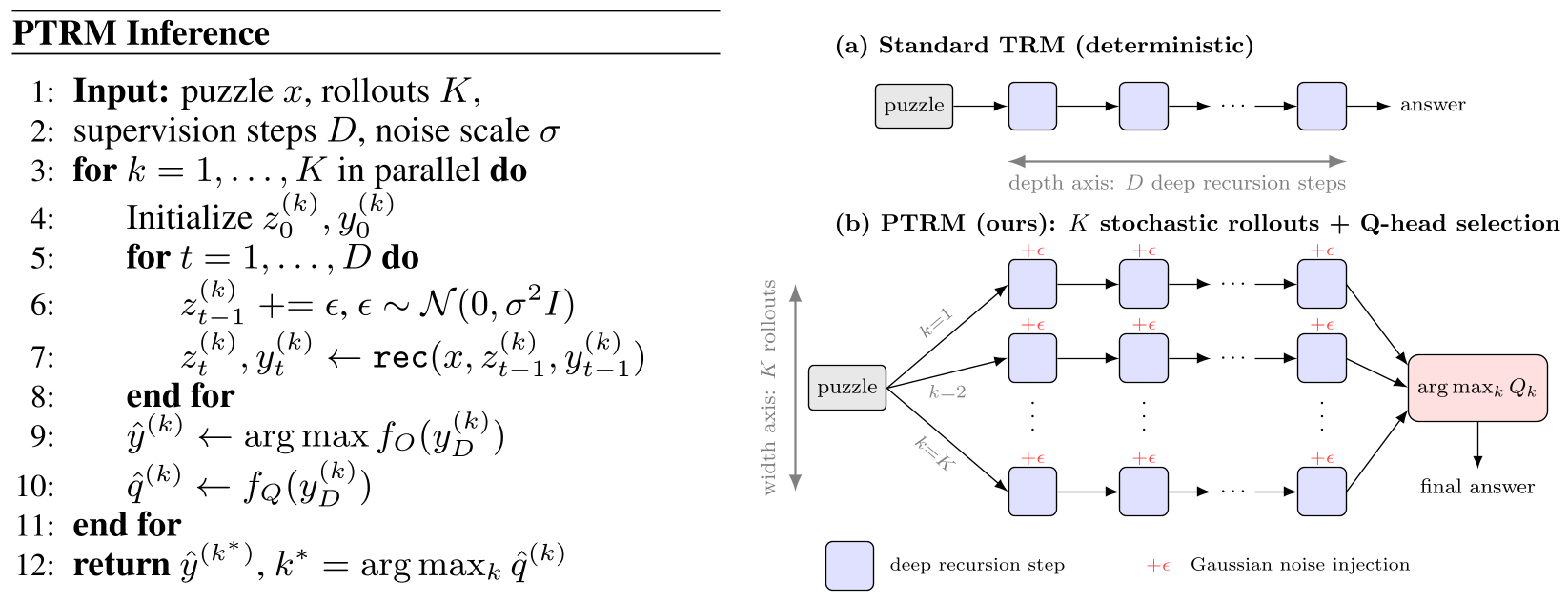 Figure 1: (Left) The PTRM inference procedure. (Right) Contrast between standard deterministic TRM and the stochastic parallel rollouts of PTRM.
Why It Works: Visualizing the Latent Escape
The authors used PCA to visualize the "mind" of the model. In failed deterministic runs, the trajectory stays in a red zone (incorrect). Under PTRM, while most paths might still fail, a small percentage (e.g., 8%) find the "escape hatch" to the green zone (correct solutions). Because the Q head tracks accuracy so closely (Figure 3 in the paper), the model can discard the 92 failures and pick the 8 successes with near-perfect reliability.
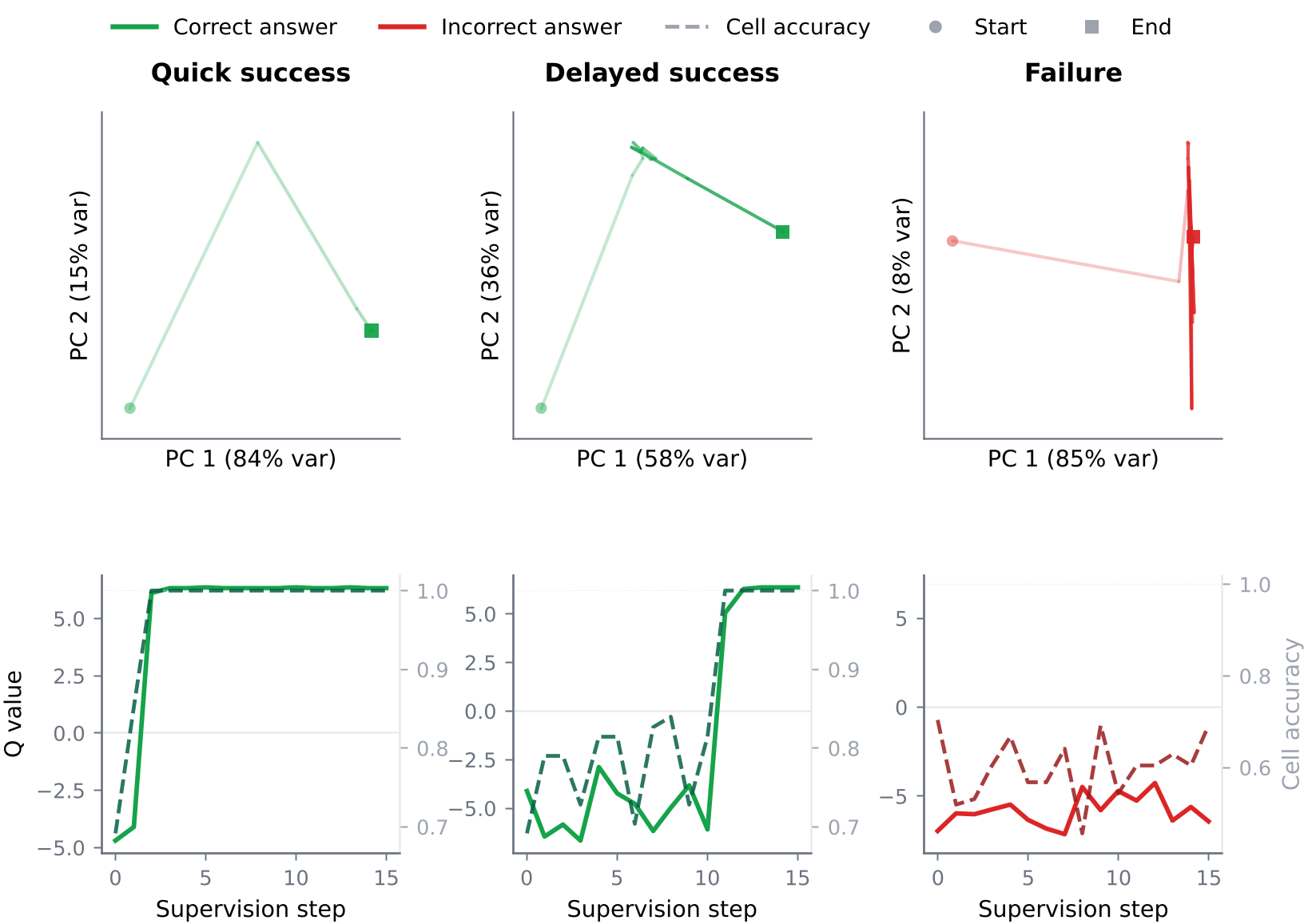 Figure 2: Trajectory modes showing how the Q value (blue line) spikes exactly when the model transitions from an incorrect state to a correct basin.
Results: David vs. Goliath
The performance metrics are nothing short of disruptive:
- Sudoku-Extreme: Jumped from 87.4% to 98.75%, setting a new SOTA.
- PPBench: PTRM reached 91.2%, while an ensemble of the 7 strongest LLMs (modeled with a perfect verifier) only managed 55.1%.
- Efficiency: To solve a golden set of puzzles, the LLM ensemble cost roughly 0.001.
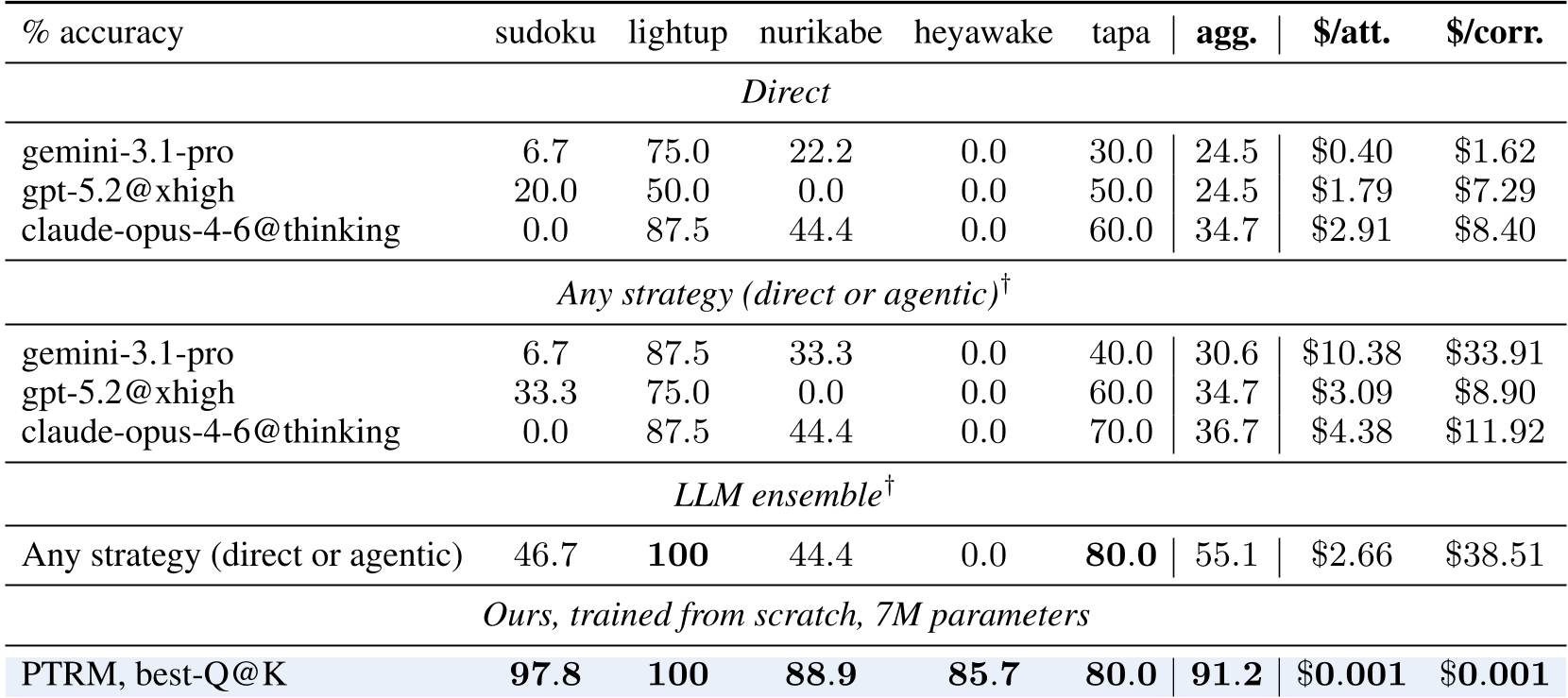
Deep Insight: The Value of "Width"
The paper reveals a critical insight for the AI industry: Width scaling is often more efficient than depth scaling. Simply letting a model think longer (more steps) often leads to diminishing returns as it stays trapped in the same basin. Letting it think "wider" (parallel paths with noise) allows it to explore the entire solution landscape.
Conclusion & Limitations
PTRM is a masterclass in efficiency. It proves that specialized, recursive architectures can outperform general-purpose LLMs by several orders of magnitude in reasoning tasks if given the right inference-time "budget."
Constraint: The main limitation is verifiability. On tasks like ARC-AGI-2, the accuracy gains were smaller (7.3% to 8.4%). This is because the Q head—the internal judge—is only as good as its training. If the model can't recognize a correct answer when it sees one, no amount of stochastic exploration will help. The future of this field lies in building better internal verifiers.