
TBE/TBEP: Bridging Bursty Words and Hidden Topics for Social Media Event Detection
Probabilistic topic model based approach for detecting bursty events from social media data
This paper introduces TBE and TBEP, two probabilistic generative models designed to detect bursty events in social media text streams. By integrating LDA-style topic modeling with Gaussian-based bursty word detection, the authors achieve SOTA performance in identifying coherent events across both long-form blogs and short-form microblogs (Weibo/Twitter).
TL;DR
Detecting "breaking news" in the chaotic stream of social media is a needle-in-a-haystack problem. This paper presents TBE (Topic-based Bursty Event) and TBEP (for Posts), two generative models that don't just look for spikes in word frequency, but model the underlying probability distributions that link bursty words to coherent topics. The result is a system that filters out the noise of normal posts and uncovers the semantic relationships that define a real-world event.
Problem & Motivation: The Gap Between Spikes and Semantics
Why is event detection so hard? In platforms like Twitter or Weibo, a "burst" is often buried under millions of "normal" posts.
Existing methods generally fall into two camps:
- Topic Modeling (LDA-based): Good at finding themes but often ignores the temporal "burstiness," letting common words drown out rare breaking news.
- Feature-Pivot Clustering: Good at finding word spikes but ignores the semantic "why," often grouping unrelated bursty words together or splitting a single event into fragments.
The authors' key insight is that bursty words do not appear in a vacuum; they are generated by a specific hidden topic. By modeling this relationship, we can distinguish between random noise and a cohesive event like an earthquake or a political shift.
Methodology: TBE and TBEP
The paper proposes two variations to handle different data densities:
1. TBE (For Long Text)
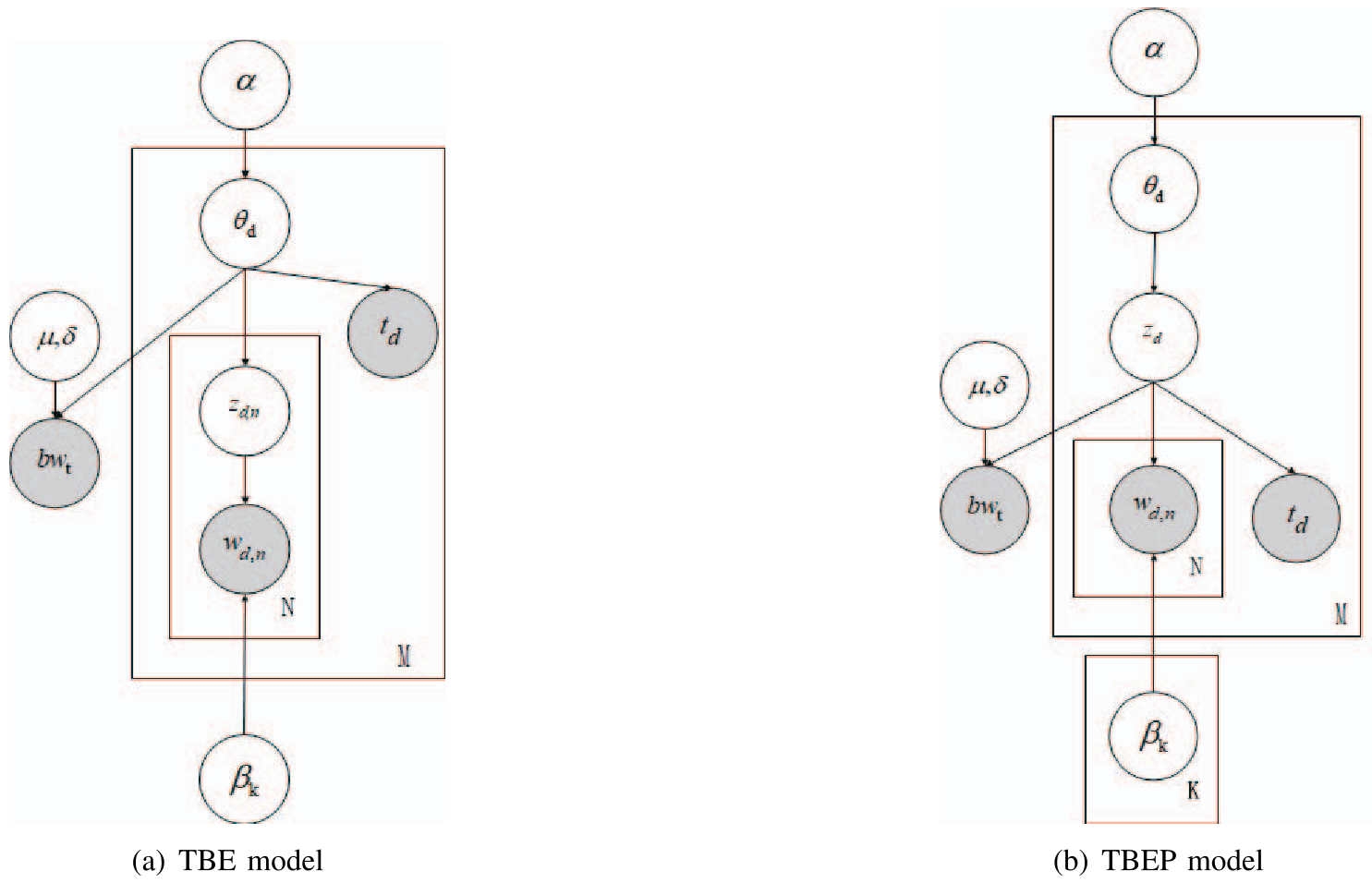
Designed for news and blogs, TBE treats each document as a mixture of topics. It extracts bursty words by modeling word frequency as a Gaussian Distribution. If a word's frequency exceeds , it is flagged as bursty.
2. TBEP (For Short Text/Posts)
Short texts like Tweets are too brief for complex topic mixtures. TBEP adopts a "one-post-one-topic" constraint (similar to LDA-Lite), ensuring that the sparse signal of a single post isn't diluted by attempting to find multiple themes.
The Math of Connection
The model calculates the posterior probability to find the most likely event. This involves summing over the frequency of bursty words, the document-topic distribution (), and the topic-word distribution (). This ensures that an "event" is both statistically significant (bursty) and semantically logical (topical).
Experiments & Results: Cohesion and Logic
The models were tested against the HBE (Hot-Bursty-Event) algorithm across three datasets: Reuters (News), Blogs, and Weibo (Short text).
Quantitative Superiority
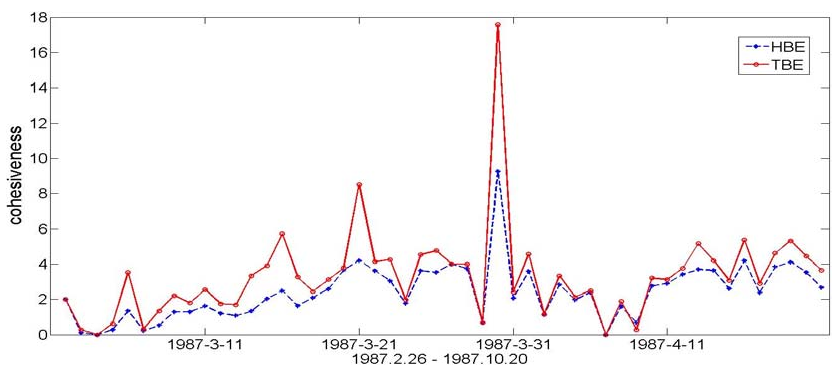
- Bursty Cohesiveness: TBE showed consistently higher cohesiveness. While HBE might only find segment tags (e.g., "Greek, Aegean"), TBE captured the full context (e.g., "Greek, Aegean, NATO, Turkey") for the same clash event.
- Event Entropy: TBE achieved lower entropy on the Reuters dataset, indicating cleaner, more accurate clusters compared to the baseline.
Deep Insight: Event Evolution
One of the most impressive results is TBE's ability to track subsequent events. For instance, in the "Ecuador Earthquake" case, TBE didn't just find the word "earthquake"; it linked it to "oil pipelines" and "OPEC raising prices." This semantic pathing allows users to understand the consequences of an event, not just its occurrence.

Critical Analysis & Conclusion
Takeaway: The integration of temporal burstiness into a probabilistic topic framework is highly effective for noisy data. TBEP's specific adaptation for short-text sparsity addresses a major pain point in social media mining.
Limitations:
- The reliance on Gaussian distributions assumes a relatively stable background frequency, which might be violated during massive global shifts (e.g., a multi-month pandemic).
- Gibbs sampling, while accurate, can be computationally expensive for true "real-time" sub-second processing compared to simpler heuristic-based methods.
Future Outlook: This work paves the way for "Causal Event Tracking," where we don't just see a burst of keywords, but understand the ripple effect of one topic (Natural Disaster) triggering another (Economic Shift).