
TRM: Bridging the Gap Between Who You Are and What You Like in Social Diffusion
Probabilistic Topic and Role Model for Information Diffusion in Social Network
The paper introduces the Topic and Role Model (TRM), a unified probabilistic generative framework for social network information diffusion. It captures users' topical interests, social roles (based on structural attributes), and reposting behaviors to provide a role-aware, topic-level diffusion representation.
TL;DR
Information diffusion is often modeled as a simple virus-like spread, but in reality, it is a complex intersection of user interests and social status. The Topic and Role Model (TRM) is a unified probabilistic framework that simultaneously extracts topics, recognizes social roles, and models diffusion. By shifting from individual-level influence to role-topic pairwise influence, TRM achieves state-of-the-art performance in predicting reposts on Weibo and citations in academic networks.
Problem & Motivation
Why do some posts go viral while others die in obscurity? Most prior works suffer from a narrow perspective:
- Structure-centric models (like IC and LT) focus on the "pipes" (links) but ignore the "water" (content).
- Content-centric models (like LDA-based diffusion) focus on interests but ignore that an "Influencer" and a "Lurker" spread the same topic differently.
- Pipeline approaches extract topics and roles separately, missing the crucial mutual influence between a user's role and the topics they specialize in.
The authors argue that social influence is not just about the person or the topic , but the specific combination of 's role and topic .
Methodology: The Unified Generative Framework
TRM is built on the intuition that your structural attributes (like PageRank) define your Role, and your content history defines your Topics.
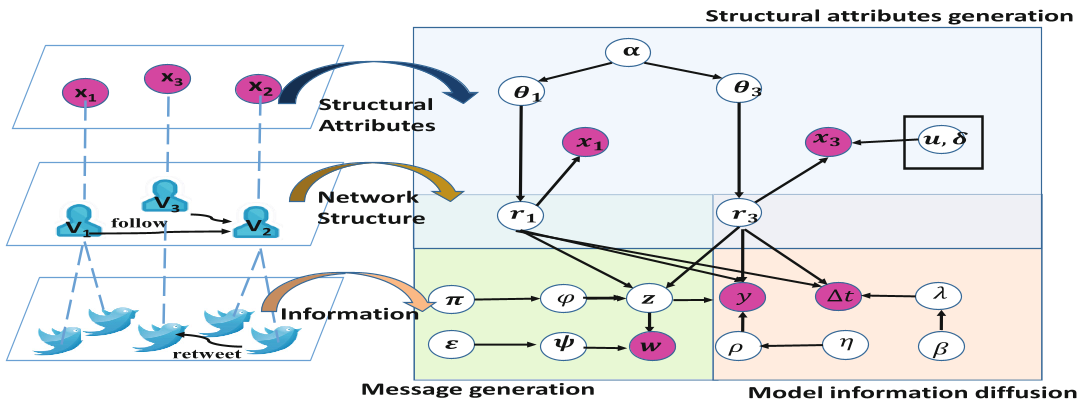
1. The Architecture
The model consists of three interconnected generative processes:
- Topic Extraction: A standard LDA-like process where messages are generated from latent topics.
- Role Recognition: User attributes (PageRank, In-degree, Network Constraint) are modeled as Gaussian distributions conditioned on latent roles.
- Diffusion Modeling: This is the "glue." Whether user reposts 's message depends on the probability —the influence strength of role on topic .
2. Role-Topic Pairwise Influence
Instead of calculating , which is sparse and hard to compute for millions of pairs, TRM computes . This coarse-grained approach significantly reduces parameter space and captures the "general wisdom" of how certain types of people influence others on specific subjects.
Experiments & Results
The model was tested on two massive datasets: Weibo (13M actions) and CND (Citation Network).
SOTA Comparison
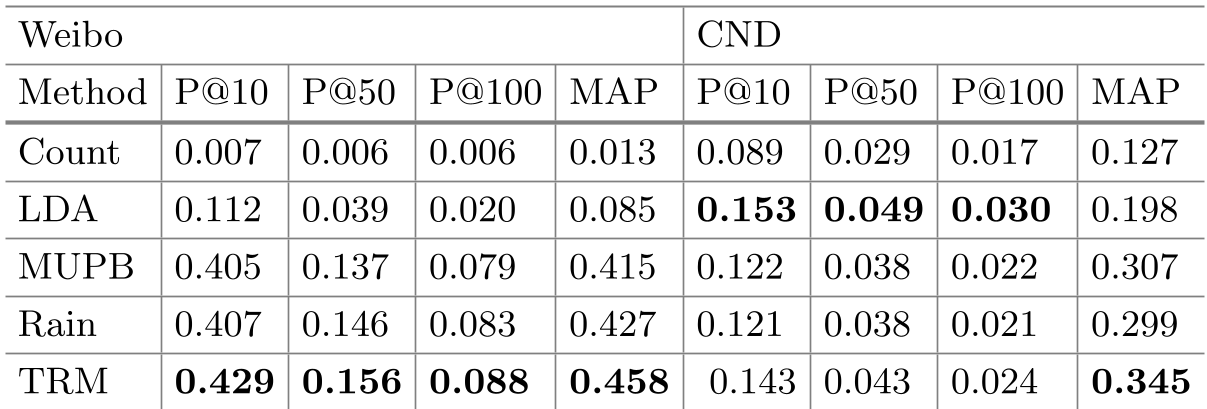
TRM consistently outperformed baselines (Count, LDA, MUPB, Rain) across all metrics (P@10, MAP).
- On Weibo, TRM achieved a MAP of 0.458, compared to Rain's 0.427.
- On CND, it reached a MAP of 0.345, significantly higher than simple topic models.
Deep Insight: Social Role Analysis
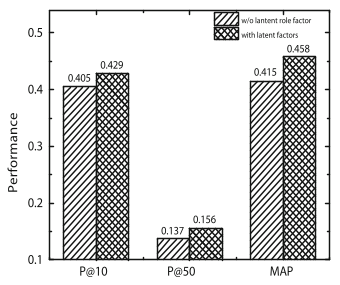
The authors discovered a logarithmic correlation between a role's social attribute (like PageRank) and its influence strength. They also found that "Opinion Leaders" (high PageRank) tend to have lower entropy in their topic distributions (focusing on expertise), while "Structural Spanners" (connecting different groups) have higher entropy (broader interests).
Critical Analysis & Conclusion
Takeaway: TRM proves that the "Source" and "Subject" are inseparable in social dynamics. By reducing the granularity of influence from individuals to "Role-Topic pairs," the model gains both robustness and interpretability.
Limitations:
- The model relies on manual structural features (PageRank, etc.). In the era of Deep Learning, these could potentially be replaced by Graph Neural Network (GNN) embeddings for even richer role representations.
- The use of the Independent Cascade (IC) model as the base diffusion function assumes a single chance for activation, which may not capture the "nagging effect" of multiple exposures in modern social media.
Future Outlook: This work opens the door for Role-Aware Content Recommendation, where systems don't just recommend what you like, but what is "influential" within your specific social niche.