
From Agents to Algebra: Formalizing Social Dynamics with Pi-Calculus
A Process Algebraic Approach to Modeling Collective Behaviors in Social Networks
This paper introduces a formal framework for modeling and verifying collective behaviors in social networks using Pi-calculus process algebra. By mapping social agents to pi-calculus processes and simplifying collective interactions through "core agents," the authors enable the formal verification of social dynamics using the Mobility Workbench (MWB).
TL;DR
Collective behaviors—like social movements or viral fads—are notoriously difficult to simulate due to their fluid and distributed nature. This paper proposes a formal solution by treating social agents as Pi-calculus processes. By abstracting collectives into "core agents" (Doers and Getters), the authors provide a pathway to verify the safety and liveness of social systems using professional model-checking tools like the Mobility Workbench (MWB).
The Challenge: Concurrency in the Human Mesh
Computational sociology has long struggled with the "MESS" of social networks: Mobility, Evolution, Spontaneity, and Scale. Traditional agent-based models (ABM) are great for simulation but often lack the mathematical rigor required for formal verification. We can't easily prove that a simulated social system won't hit a "deadlock" or that a specific protocol for collective action is structurally sound.
The authors identify a critical gap: the lack of a formal language that can describe the interaction logic of collectives while accounting for the dynamic shifting of social links.
Methodology: The Social-Algebraic Mapping
The core of this work is the mapping of social entities to algebraic constructs. The authors argue that since social agents exchange messages, perform actions, and change affiliations, they behave exactly like mobile processes in Pi-calculus.
1. The Core Agent Abstraction
To prevent a state-space explosion, the paper introduces a hierarchical simplification:
- The Collective: A set of agents.
- The Core Agent: A representative who acts as a Doer (initiator) or Getter (responder).
- The Coordinator: An intermediary agent that facilitates complex interactions.
2. Formal Mapping Table
The bridge between sociology and computer science is built on these equivalencies:
| Social Agent Attribute | Pi-Calculus Process Component |
|---|---|
| Agent | Process |
| Message | Data/Name |
| Operation | Action () |
| Communication | Interaction (Channel Sync) |
3. System Architecture
The model translates a physical network of connections into a logical overlay of channels. Below is the conceptual shift from a physical node mesh to a formal process interaction.
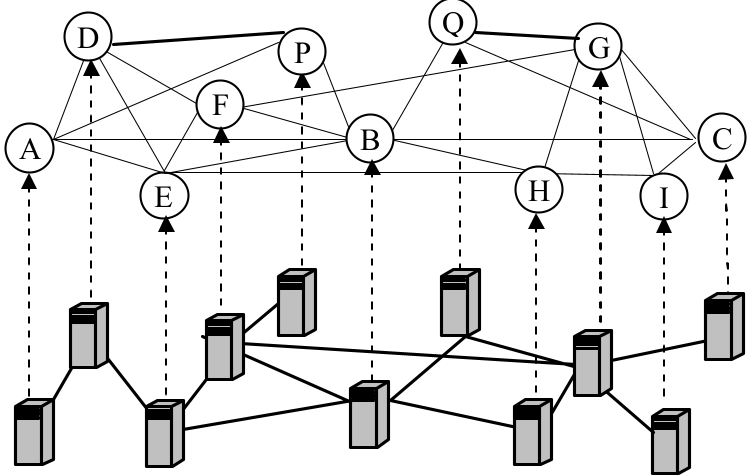 Figure 1: Visualizing the translation of physical network nodes into logical social collectives.
Formal Specification: Modeling the "Doer"
In the Pi-calculus notation used by the authors, a collective behavior subject () is defined by the parallel composition of its agents. For example:
This represents the total interaction between the Subject and the Object of a behavior. The paper defines rigorous message sets, including ExtIntReq (External Interaction Request) and SelCooPla (Self Coordination Plan), to govern how these processes synchronize.
Verification: Is the Social System "Safe"?
The authors use the Mobility Workbench (MWB) to put their model to the test. They focus on three key properties:
- Syntax & Semantic Correctness: Ensuring the "social protocol" is logically complete.
- Activeness (Liveness): Ensuring the collective doesn't enter an infinite loop or a state where no further actions can be taken (deadlock).
- Weak Equivalence: Proving that the external behavior of the collective matches the intended social protocol, regardless of its internal complexity.
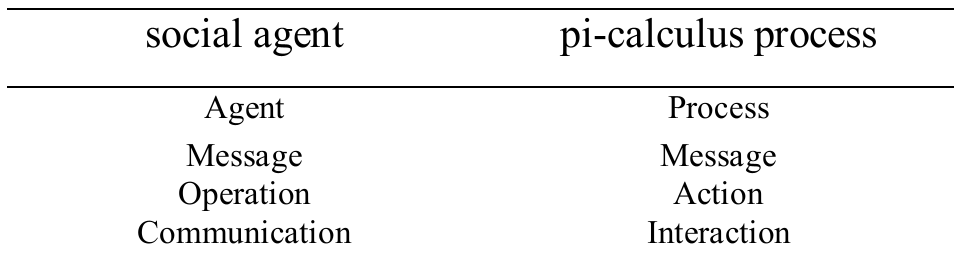 Table 1: The foundational mapping between human behavior and algebraic process.
Critical Insight & Future Directions
The true value of this work lies in its compositional nature. Because Pi-calculus allows processes to be composed into bigger ones (Rule 3 in the paper), we can model a tiny group of three people or a massive social movement using the same algebraic rules.
Limitations:
- Deterministic Simplification: Real human behavior is often stochastic or irrational; the current model treats it as a logical protocol.
- Scalability of Core Agents: In massive networks, having a single "core agent" may become a bottleneck or an oversimplification.
Future Work: The authors aim to explore "emergence phenomena"—situations where simple algebraic rules lead to unintended, large-scale social patterns. This could eventually allow us to "debug" social protocols before they are deployed in digital platforms or organizational structures.
Takeaway: By treating social interactions as a "calculus," we move from merely observing social networks to formally engineering and verifying them.