
Decoding the Digital Labor Market: A Benchmarking Study on Job Offer Classification
Challenge: Processing web texts for classifying job offers
This paper evaluates and compares diverse text processing techniques—specifically Explicit Rules, Machine Learning (SVM, Perceptron), and LDA-based algorithms—to classify job offers from heterogeneous web sources into the standard ISTAT CP2011 international occupation framework. The study demonstrates that while ML-based methods excel with high numbers of samples, LDA offers superior robustness for infrequent job categories.
TL;DR
Modern labor markets rely on web portals, but the data is a mess of unstructured text. This paper benchmarks three classical AI approaches—Explicit Rules, Machine Learning, and LDA—to map messy web job ads to formal international occupation codes (CP2011). While Linear SVMs win on raw accuracy for common jobs, LDA-based approaches prove much more effective at handling rare or specialized professions.
Context & Motivation: The Language Gap in Recruitment
The "lingua franca" of the global labor market is the occupation classifier—standardized categories like the Italian ISTAT (CP2011). However, employers don't write job ads using government codes; they use creative, industry-specific, or localized language.
The core challenge identified by authors like Flora Amato and her team is Heterogeneity. Unlike CVs/Resumes, which are lengthy and structured, job offers are often short, making it harder to extract enough context for a high-confidence classification.
Methodology: Three Paths to Classification
The researchers didn't just pick one model; they pitted three distinct paradigms against each other:
- Rule-Based (Commercial Tool): This relies on "Hard Logic." Experts define taxonomies and specific keywords. If "A" and "B" appear, it's a "Software Engineer."
- Machine Learning (Linear SVC & Perceptron): A supervised approach. The system was trained on 412 manually labeled samples using a Bag-of-Words representation. This is excellent for recognizing patterns that are well-represented in the training data.
- Probabilistic LDA (Latent Dirichlet Allocation): This is the "hidden gem" of the paper. Instead of simple word counts, it uses Weighted Word Pairs (WWP) to capture the probabilistic relationship between words. It measures the "distance" between a job title and the latent topics of an occupation category.
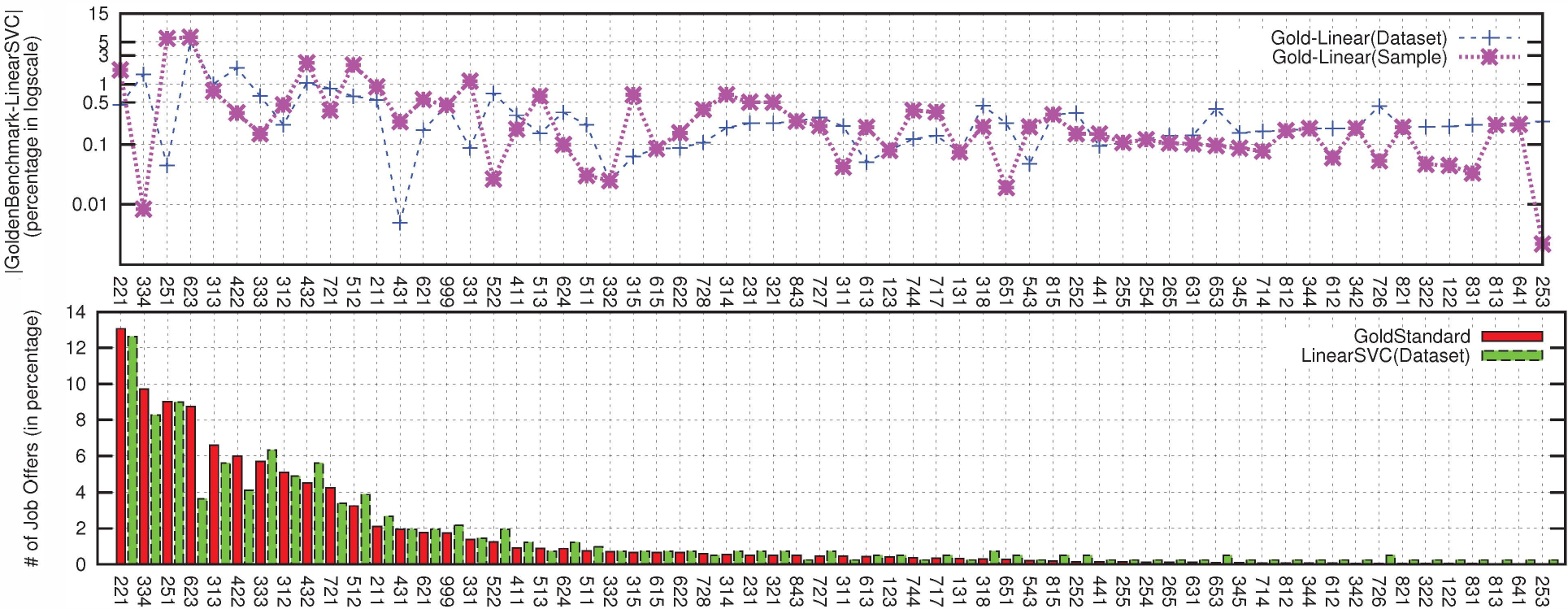 Fig 1. Distribution of job offers over occupation codes, comparing the Gold Benchmark to the Linear SVC results.
Experimental Performance: The Battle of Accuracy vs. Robustness
The team tested these methods on a sample of 40,000 job vacancies from 12 heterogeneous web sources.
| Metric | LDA | Rules | Linear SVC | Perceptron |
|---|---|---|---|---|
| Accuracy | 0.51 | 0.469 | 0.633 | 0.543 |
| Avg. Precision | 0.587 | 0.432 | 0.576 | 0.503 |
Table 1. The numbers in parentheses represent performance excluding the "infrequent" classes.
Key Insights from Results:
- The SOTA Paradox: The Linear SVC (SVM) had the highest overall accuracy (63.3%). However, its performance plummeted when dealing with "rare" jobs (those appearing less than 5 times).
- LDA’s Robustness: The LDA-based approach was the most consistent. While its peak accuracy was lower than SVM, its precision didn't collapse on infrequent codes. This is vital for government analysts who need to track emerging or niche professions.
- Title vs. Description: A critical finding—30% of job titles do not contain enough information to classify the job alone. You need the full description to distinguish between, say, a "Technical Manager" and a "General Manager."
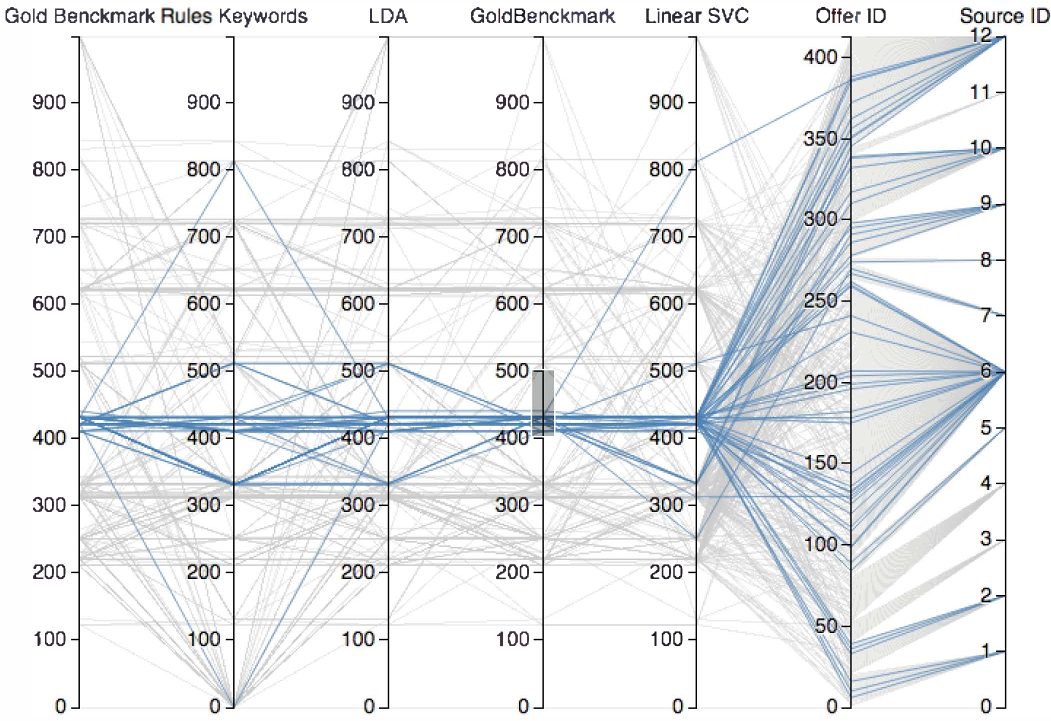 Fig 2. Multidimensional visualization using Parallel Coordinates to identify misclassification clusters between Technical and Intellectual professions.
Critical Insight: Why Does This Matter?
The value of this paper isn't just in the accuracy numbers—it's in the analysis of failure. By using Parallel Coordinates (Fig 2 and 3), the authors visualized exactly where models fail—typically at the boundary between highly specialized (Level 2) and technical (Level 3) roles.
The study suggests that for real-world labor market monitoring, we cannot rely on a single supervised model because the "long tail" of occupations is simply too diverse.
Future Outlook
The authors identify two major frontiers:
- Computational Linguistics for Long Texts: Moving beyond job titles to process the full descriptions to resolve the 30% "ambiguity" gap.
- Multidimensional Extraction: Moving beyond just the "Job Title" to extract skills, contract types, and education levels simultaneously.
In an era of rapid AI evolution, this work serves as a foundational benchmark for how we might eventually use LLMs or Large Labor Models to map the global workforce in real-time.