
Product Attributes vs. Social Influence: Why Random Garbage Often Wins in Social Markets
Do the attributes of products matter for success in social network markets?
The paper investigates the dynamics of consumer choice in social network markets using an evolutionary model. It demonstrates that highly right-skewed popularity distributions (superstars) and constant ranking turnover emerge naturally even when products have no inherent quality differences, purely driven by social imitation and network topology.
TL;DR
Does a viral video succeed because it is "good," or simply because it is "viral"? This paper argues the latter. Using evolutionary simulations on diverse social networks, the authors prove that "winner-take-all" markets and constant popularity shifts are inevitable features of network structure itself. Even when all products are identical in quality, social imitation ensures a few "superstars" emerge while most others fail.
Background: The Death of the Rational Consumer
Classical economics assumes we are rational agents with fixed tastes. However, in modern markets—where a single Walmart stocks 100,000 items and YouTube hosts billions of videos—we suffer from "Decision Fatigue" or "Decision Quicksand." When faced with too many similar options, we stop evaluating attributes and start copying others. This paper positions itself at the intersection of cultural evolution and network science, moving away from "Rational Addiction" toward a model of undirected social imitation.
The Problem: The Mystery of the Right-Skewed Curve
In social network markets, outcomes are rarely Gaussian (the normal "bell curve"). Instead, they are highly right-skewed.
- The 50:1 Ratio: In experiments where people see others' downloads, the gap between the best and worst products jumps from 3:1 (isolated choice) to 50:1 (social choice).
- Attribute Irrelevance: Why do viral videos of cats playing keyboards get 25 million views? The "quality" is indistinguishable from millions of other cat videos.
- Ranking Turnover: Why do cities or pop songs rise and fall in popularity despite no change in their "utility"?
Methodology: Simulating Success in a Vacuum
The authors tested whether these patterns emerge in a world where quality does not exist.
The Model
- Fixed Networks: 475 nodes across three topologies: Erdos-Renyi (random), Barabasi-Albert (scale-free), and Watts-Strogatz (small-world).
- Imitation (1 - μ): Agents look at their connected neighbors and choose what they chose last period.
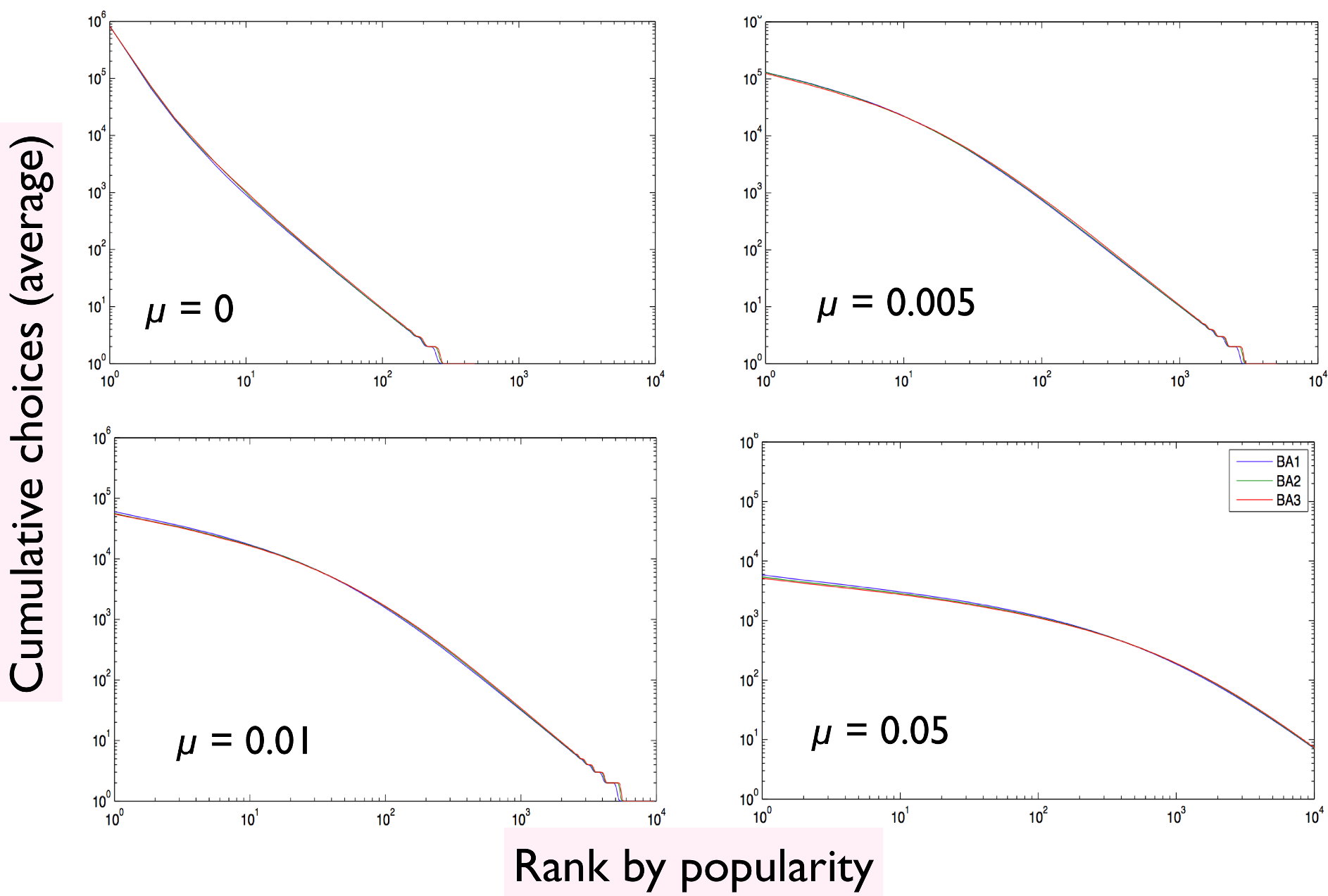
- Innovation (μ): A tiny fraction of agents (usually < 1%) choose something entirely new.
Architecture & Network Properties
The researchers examined how the "Mean Degree" and "Skewness" of the network itself dictated the market outcome.

Experiments & Results: The Rise of the Superstars
The results confirm that the "Meso-level" (the network structure) determines the "Macro-level" (market share).
1. Winner-Take-All
Even with no quality difference, the "Top Ranked" items captured the lions' share of the market. As the innovation rate (μ) dropped toward zero, the market moved toward a pure monopoly.

2. Rank-Size Distribution
The visualization below (for the Barabasi-Albert network) shows the classic power-law tail. Success is not a gradient; it is a cliff. If you are not in the top percentage of the network's "attention," you effectively do not exist.
3. Turnover and Lifespans
The model accurately replicated the "Rank Clock" phenomenon. Just as no city in the top 50 in 430 BC remains there today, the simulation showed that new innovations eventually disrupt the "superstars," creating a cycle of creative destruction that mirrors the UK Top 100 charts or YouTube trending lists.
Critical Insight: The Network is the Message
This research provides a sobering takeaway for marketers and creators: The attributes of your product may not matter for its success.
If you are operating in a social network market (apps, fashion, music, ideas), success is a function of:
- Network Topology: Are you in a "Scale-Free" environment where a few influencers control the flow?
- Initial Conditions: Being lucky enough to be copied by the first few "imitators."
- Path Dependence: Popularity is its own reward, creating a feedback loop that has nothing to do with merit.
Limitations
The model uses fixed networks, whereas real social networks are dynamic—people "unfriend" those with boring tastes. Furthermore, the model assumes zero quality difference as a baseline; in reality, a minimum threshold of quality is usually required to enter the network, even if it doesn't determine the final winner.
Conclusion
The study concludes that right-skewed distributions and turnover are fundamental, structural properties of network-linked markets. If everyone is copying everyone else, "meritocracy" is replaced by "network-ocracy." For developers and researchers, this highlights the need to focus on seeding strategies and connectivity rather than just iterative product optimization.