
Social-Union: Harmonizing Multi-modal Social Networks for Superior Recommendations
Product recommendation and rating prediction based on multi-modal social networks
The paper introduces Social-Union, a multi-modal recommendation framework that integrates heterogeneous social networks (unipartite friendship graphs and bipartite user-item rating graphs). By employing a novel weighting strategy based on local and global graph densities, the method achieves SOTA performance in rating prediction and product recommendation on Epinions and Flixter datasets.
TL;DR
The researchers from Aristotle University of Thessaloniki have introduced Social-Union, an algorithm that bridges the gap between explicit friendship networks and implicit rating behaviors. By automatically weighting the influence of different "social modes" based on their data density, it slashes prediction errors (RMSE) by over 10% compared to existing path-based hybrid methods like tKatz.
Breaking the Data Silo: Why Cross-Modal Social Data?
In the era of Social Rating Networks (SRNs) like Epinions or Flixter, users don't just rate movies; they build "Webs of Trust."
Traditional Collaborative Filtering (CF) suffers from "rating myopia"—it only looks at the user-item matrix. Conversely, Link Prediction methods often ignore the actual preference values (ratings). The challenge lies in integration: How do we combine a friendship graph (unipartite) with a rating matrix (bipartite) without one overwhelming the other?
The authors identify that previous attempts failed because they used static weights or ignored "local density"—the fact that some users are "hyper-active" in friendships but "lurkers" in ratings, or vice versa.
Methodology: The Logic of Density Weighting
The core innovation of Social-Union is its Density-based Weighting Strategy. Instead of a user-defined parameter , the system calculates an automatic balance between networks.
1. Unified Similarity
The similarity between two users and is a weighted sum of similarities across different networks:
2. The Weighting "Insight"
The weight is derived from the Local to Global Density Coefficient ():
- Local Density: How active is the target user in this specific network?
- Global Density: How sparse is the overall network?
By dividing local density by global density, the algorithm identifies which network provides the most "surprising" or "rich" information for a specific user.
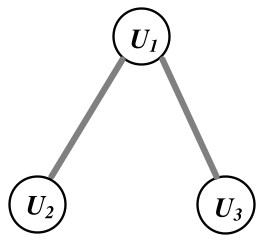
Experimental Showdown
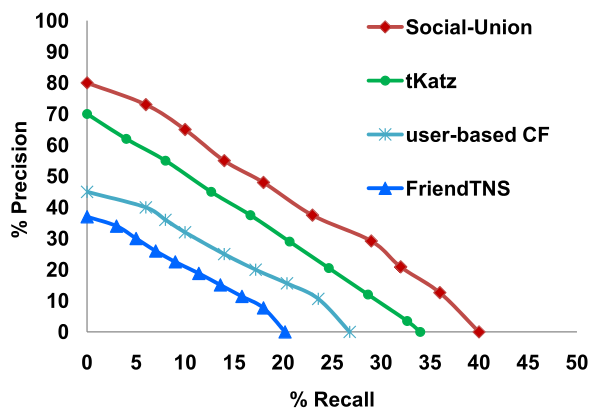
The authors pitted Social-Union against tKatz (a path-counting method) and FriendTNS (a graph-based method).
Key Findings:
- Superior Accuracy: In the RMSE metric (where lower is better), Social-Union recorded 0.765 on Epinions, beating tKatz (0.844) and User-based CF (1.013).
- Sparsity Resilience: As shown in the sensitivity analysis, Social-Union maintains high precision even when the friendship network is sparse, as it can "fallback" to the information-rich rating network automatically.
Critical Analysis & Future Directions
Social-Union proves that contextual weighting is superior to global weighting. By looking at the "Structured Density," the algorithm respects the unique footprint of each user.
Limitations:
- The method relies on calculating similarity matrices, which can be computationally expensive as for massive networks.
- It assumes a linear combination of similarities, which might not capture complex non-linear interactions between social ties and preferences.
Future Work: The authors suggest extending this to Tri-partite graphs (Users-Items-Tags). In the modern context, this work lays the theoretical groundwork for modern GNN-based recommendation systems that use attention mechanisms to "weight" different edge types in a heterogeneous graph.
Reference: Symeonidis, P., Tiakas, E., & Manolopoulos, Y. (2011). Product recommendation and rating prediction based on multi-modal social networks. RecSys '11.