
From Passive Listening to Active Producing: Transforming HCI Education with Interactive Videos
Production and Evaluation of an Educational Process for Human–Computer Interaction (HCI) Courses
The paper proposes a mixed pedagogical approach for Human-Computer Interaction (HCI) courses, integrating Traditional Lecture-Based Classroom (TLBC), Active Learning (AL), and Project-Based Learning (PBL). The method centers on the production of Learning Objects based on Interactive Videos (LOBIVs) to bridge the gap between abstract theory and practical application.
TL;DR
Teaching Human-Computer Interaction (HCI) often feels like a balancing act between dry theory and unattainable practice. This paper presents a novel educational process that turns students into "producers" of Learning Objects based on Interactive Videos (LOBIVs). By moving beyond traditional lectures to a Project-Based Learning (PBL) model, the researchers achieved a massive performance boost, reducing failure rates from 7.6% to a mere 1.8%.
The "Abstract Gap" in HCI Education
In many Computer Science curricula, HCI is treated as a theoretical discipline. Students learn about Affordance, Usability, and Heuristic Evaluation through slides and textbooks. The problem? Without applying these concepts to real interfaces, the knowledge remains "immaterial." Traditional Lecture-Based Classrooms (TLBC) often result in low student retention because learners lack the "Inductive Bias" that comes from building something tangible.
The Architecture of the Proposed Method (PM)
The authors' method isn't just about "watching videos"; it’s about making them. The workflow is split into three strategic stages:
- Instructional Foundation: The teacher delivers core concepts while conducting a 90-minute workshop on LOBIV production.
- Active Learning (AL): Students choose between oral presentations or creating a LOBIV to explain subtopics like "Interface Evaluation."
- The PBL Climax: Students evaluate real-world university systems (like the Helpdesk or SISPLAD) and build an interactive prototype using IDTV protocols.
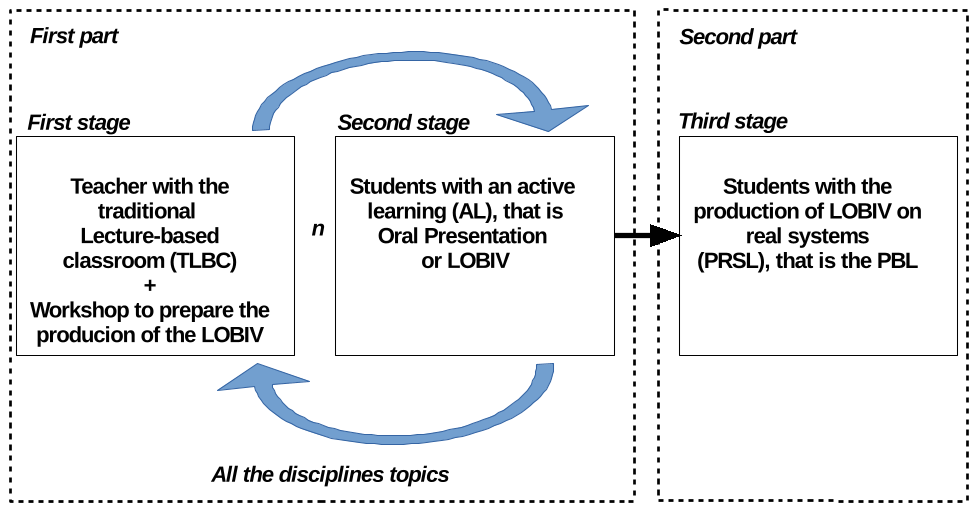 Figure 1: The three-stage pedagogical workflow combining TLBC, AL, and PBL.
The Secret Sauce: LOBIVs and IDTV
The tech stack is unique. Instead of basic linear videos (YouTube style), they use Interactive Digital TV (IDTV) concepts through the Ginga middleware. Using authoring tools like Cacuria, students manipulate media objects to create non-linear experiences where viewers choose their own path—simulating an actual software interface.
Proving the Impact: Data Analysis
The researchers compared 131 students from the traditional track with 113 students in the new PM track. The results were statistically overwhelming.
1. Shift in Performance Distribution
The PM successfully pushed students from the "Regular" and "Insufficient" categories into "Good" and "Excellent."
- Excellent (EXC) Grades: Rose from 7.63% (TLBC) to 23.01% (PM).
- Failure Rate (INS): Dropped from 7.63% to 1.77%.
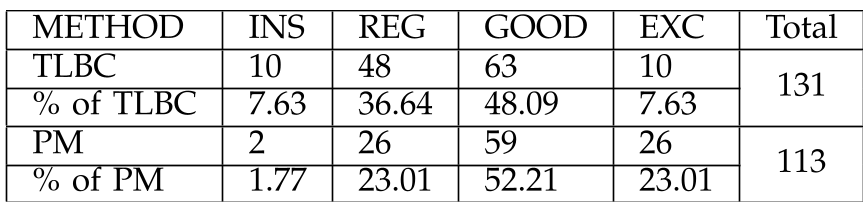 Table 1: Grade distribution comparison between the Traditional Method and the Proposed Method.
2. The Superiority of "Making" over "Testing"
Perhaps the most telling metric is the comparison of evaluation tools. In both Information Systems (IS) and Computer Engineering (CE) classes, the grades for LOBIV production were consistently higher than Written Tests (WT).
| Cycle | Method | Grade (IS) | Grade (CE) |
|---|---|---|---|
| 1st | Written Test (WT) | 4.6 | 5.4 |
| 1st | LOBIV Production | 8.8 | 7.0 |
This suggests that students are not just "having more fun," but are demonstrating a deeper mastery of the material when they have to translate theory into an interactive medium.
Critical Insight & Conclusion
The brilliance of this work lies in its use of T-learning (Television-based learning). While web-based learning is common, using IDTV protocols forces students to think about media synchronization and user-controlled menus—core HCI concepts—in a way that a standard essay never could.
Takeaway: If you want students to master theory, stop making them memorize definitions. Make them build the explanation. The LOBIV approach proves that interactivity isn't just a feature of the software we study; it should be a feature of the way we learn.
Limitations: The study relies on high-quality authoring tools (like Cacuria) which require a learning curve, and the results might vary if the instructor is not proficient in multimedia production.
Future Perspectives
The authors suggest this method could easily migrate to other abstract fields like Software Engineering or Scientific Methodology. As IPTV and streaming tech continue to dominate, the "student-as-producer" model is likely the future of technical pedagogy.