
Beyond the VLE: Bridging the Professional Communication Gap with Slack
Professional Communication Tools in Higher Education: A Case Study in Implementing Slack in the Curriculum
This paper examines the integration of Slack, a professional communication tool, into the computing curriculum at two Scottish universities. Using a case study involving 243 students, the research evaluates how transitioning from social apps to professional platforms affects a student's "Community of Practice" and technical readiness for the industry.
TL;DR
Higher education often relies on clunky Virtual Learning Environments (VLEs) that students despise. This study moves the classroom to Slack, demonstrating that while students are "pro" at social media, they need structured environments to develop professional communication identities. The results? Higher engagement, faster staff response times, and a stronger sense of community.
Contextual Positioning
This paper serves as a bridge between Pedagogy and Professional Practice. It acknowledges that "Software Engineering" isn't just about code—it's about the communication infrastructure that supports it.
The "Six-Click" Burden: Why Motivation Dies in the VLE
The authors highlight a critical friction point: traditional VLEs (like Blackboard or Moodle) are often usability nightmares. Requiring a minimum of six clicks to reach a forum guarantees that students will instead move to private WhatsApp groups. This "shadow IT" in education excludes lecturers and prevents the formation of a monitored, professional Community of Practice.
Methodology: Implementing a Professional Standard
The researchers didn't just tell students to "use Slack." They created a formal framework:
- The Code of Conduct: Defining staff response times and professional etiquette.
- Channel Architecture: Using
#generalfor the whole class,#randomfor culture, and private channels for group projects. - The Transition: Moving away from the "asynchronous" feel of email toward the "agile" feel of industry.
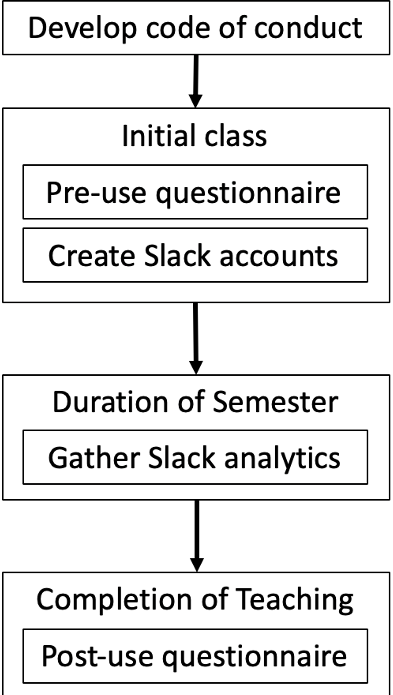 Fig 1: The systematic approach to integrating Slack across the semester.
Key Results: Slack vs. The Old Guard
The data suggests a landslide victory for Slack in terms of peer-to-peer engagement. When students were asked where they would prefer to share ideas or build relationships, Slack overwhelmingly beat out both Email and the VLE.
| Scenario | VLE | Slack | |
|---|---|---|---|
| Asking peers about topics | 49 | 4 | 170 |
| Sharing ideas with peers | 40 | 10 | 173 |
| Building relationships | 40 | 3 | 179 |
Source: Table I - Comparison of Communication Scenario Preferences.
The Staff Perspective: Agile Teaching
Lecturers reported that Slack allowed them to be more "agile." Instead of answering 50 individual emails about a bug, a single response in a public channel resolved the issue for everyone. The use of GIFs and informal reactions also lowered the "intimidation barrier," making students more likely to reach out about personal issues before they became academic crises.
Critical Insight: The "Fear of Scrutiny"
Interestingly, the study found that first-year students were more hesitant than seniors. This suggests that professional communication is a skill that requires confidence. Younger students feared "looking stupid" in public channels—a nuance that educators must address by fostering a "safe-to-fail" environment.
Takeaways for the Future
- Tooling Matters: We must train students on the tools they will actually use in the industry (Slack, Teams, Discord).
- Infrastructure Integration: Single Sign-On (SSO) and institutional support are mandatory to prevent "app fatigue."
- The "Always-On" Risk: Future work must address the mental health implications of being constantly connected to a professional workspace.
Conclusion
This study proves that moving away from legacy systems into professional tools doesn't just improve communication—it aligns the student experience with the realities of the modern computing industry.
Professional Tip: If you implement Slack in your course, watch out for the 10,000-message limit on free tiers. As this study noted, a high-engagement class can hit that ceiling quickly, causing valuable "code snippets" to disappear into the archive!