
Data Feminism: Re-Engineering High School Data Science Education
Professional Development for High School Computer Science Teachers on Data Science through a Feminist Lens
This paper introduces a week-long professional development program for high school Computer Science teachers, focusing on Data Science through the framework of "Data Feminism." The methodology integrates a data analytical pipeline with three core feminist principles to address algorithmic bias and socio-economic disparities in data modeling.
TL;DR
This research tackles the "neutrality myth" in Data Science by training high school teachers to use a Data Feminist lens. Over a five-day intensive workshop, educators moved beyond simple coding to analyze how socio-economic bias and missing data affect real-world outcomes, such as earthquake emergency response.
Background: Why Data Isn't Neutral
As algorithms increasingly govern everything from healthcare to the court system, the "garbage in, garbage out" problem becomes a matter of social justice. If the data used to train a model is biased, the output will inevitably be discriminatory. This paper argues that the solution begins in the high school classroom, where the next generation of engineers is formed.
The Problem & Motivation
Current K-12 CS curriculum is often burdened with technical syntax—binary trees, loops, and sorting—while ignoring the sociotechnical context. Teachers are often not equipped to discuss why a dataset might be missing reports from low-income neighborhoods or who benefits from a specific data visualization. This gap leads to a lack of "Culturally Responsive Pedagogy," which is a primary reason why girls and underrepresented groups opt out of CS tracks.
Methodology: The Data Feminist Framework
The researchers utilized three pillars of Data Feminism to structure the teachers' learning:
- Representing Data Unknowns: Acknowledging that what is missing from a dataset is as important as what is present.
- Referencing Material Economy: Understanding the stakeholders, the data collectors, and the power structures behind the numbers.
- Making Dissent Possible: Designing visualizations that allow users to challenge the "facts" and see alternative realities.
The Technical Pipeline
Teachers were introduced to Trifacta Wrangler, a sophisticated data-wrangling tool, to handle an 80,000-row dataset regarding a fictional earthquake scenario.

Experiments & Results
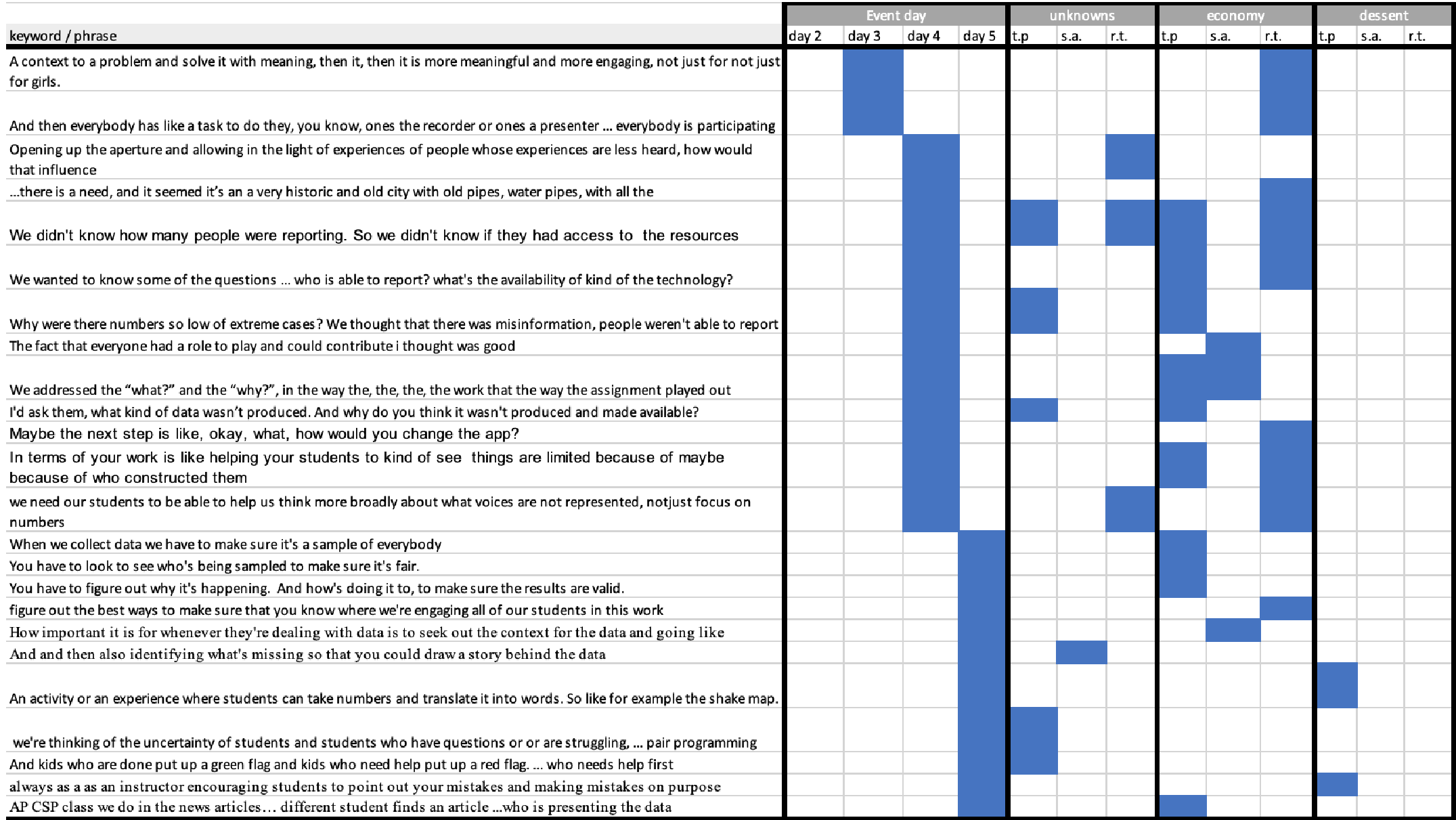
The study analyzed the "evolution of thought" among the teachers by tracking their vocabulary and discussion topics across the week.
Shift in Perspective
Initially, the Research Team led the discussions. However, by Day 4, the teachers (indicated as "t.p" in the data) were actively questioning the source of the data. One teacher observed that low reporting numbers in certain areas might not mean "no damage," but rather a "lack of access to reporting technology"—a classic example of identifying data unknowns.
Findings
- Success: Teachers became adept at spotting socio-economic disparities within the data.
- Challenge: The principle of "Making Dissent Possible" was least utilized, as it requires a higher level of critical design thinking that was difficult to master in a single week.
Critical Analysis & Conclusion
Takeaway
The study proves that Data Science can be taught as a human-centric discipline rather than just a mathematical one. By framing data challenges through a feminist lens, teachers can make the subject more engaging and meaningful, potentially closing the gender gap in CS.
Limitations
The sample size (8 teachers) is small, and the study does not yet show how these teachers will implement these lessons in their actual classrooms.
Future Outlook
The next frontier is measuring the "classroom impact"—do students who learn data science through this lens show a higher interest in ethical AI? This work sets the stage for a curriculum where "coding with a conscience" is the standard, not the exception.