
Fighting the Shadows: Advanced Methods for Profile Cloning Detection in Social Networks
Profile Cloning Detection in Social Networks
This paper introduces two novel methods, ASPCD and NSPCD, for detecting profile cloning in social networks like Facebook. By leveraging attribute similarity and relationship network analysis, the research achieves superior accuracy in identifying fraudulent accounts compared to existing state-of-the-art baselines.
TL;DR
Social network security is under siege by Profile Cloning—an identity theft tactic where attackers mimic legitimate profiles to defraud "friends." This paper introduces two high-precision detection methods: ASPCD (Attribute-based) and NSPCD (Network-based). These methods drastically reduce false alarms (False Positives) by over 90% compared to previous SOTA, making manual verification by users significantly more manageable.
The "Invisible" Threat: Why Cloning is Easy
The research reveals a sobering reality: Facebook and similar platforms make cloning trivial. There is no requirement for unique display names, and profile photos are often public by default. Attackers don't just copy data; they exploit the social heuristic of trust. When a user receives a friend request from someone they "know," they rarely check if a second profile already exists.
The authors argue that prior work failed because it was either too rigid (requiring exact string matches) or too broad (accusing anyone with a similar hometown of being a clone).
Methodology: Precision through Intelligence
The authors propose a dual-track strategy to identify clones:
1. Attribute Similarity based Profile Cloning Detection (ASPCD)
Instead of simple equality checks, ASPCD uses a weighted average of similarities across five key attributes: First Name, Last Name, Gender, Location, and Education.
- The Insight: Clones often use variations of names (e.g., "G.W. Bush" vs "George Walker Bush").
- The Solution: By applying Dice's Coefficient, the system measures the similarity of "unigrams" (letter sets), allowing it to catch fuzzy matches that traditional filters miss.
 Fig 1. High-level architecture showing the flow from Potential Victim selection to Manual Verification.
2. Network Similarity based Profile Cloning Detection (NSPCD)
The real breakthrough comes from the social graph. The authors define Network Similarity () using a flexible parameter : Where is the set of mutual friends.
- Crucial Discovery: The experiments proved that is optimal. This means the most a clone is most effectively detected when we prioritize how much of the clone's network consists of the victim's friends. A legitimate "Far Friend" will have many other connections, but a clone's primary goal is to replicate the victim's circle, making their mutual-friend ratio unusually high.
Experiments & SOTA Comparison
The methods were tested on real Facebook data. The results show a clear victory for the proposed algorithms:
- In Attribute Matching: The baseline (ASM) required a threshold so low to catch all clones that it flagged 86 innocent users. ASPCD caught all clones while only flagging 7 innocents.
- In Network Matching: The baseline (FNSM) was similarly noisy. The NSPCD approach reduced false positives from 13.9% to a mere 1.9%.
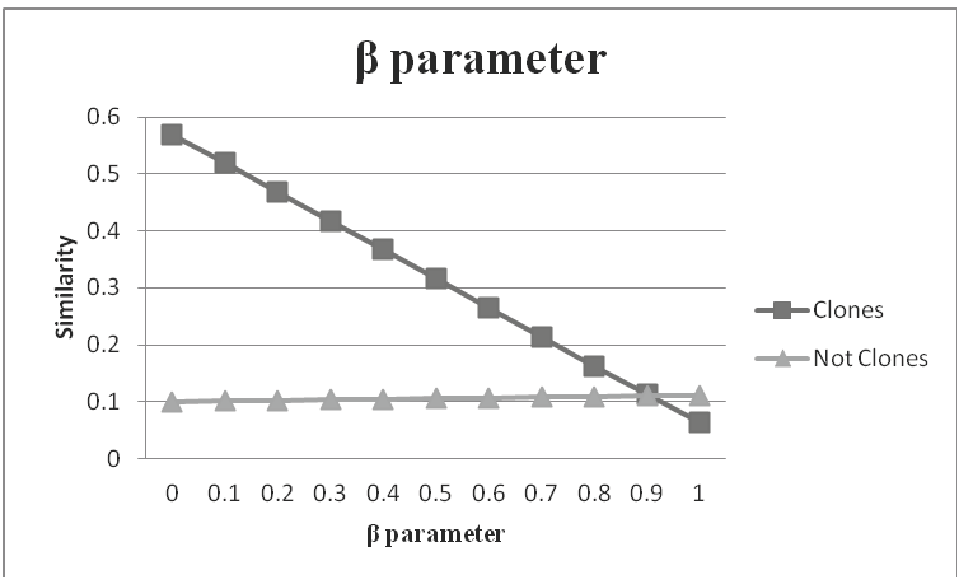 Fig 2. The impact of the parameter. Note how the similarity gap between Clones and Non-Clones is widest when is low.
Critical Insight & Conclusion
The most striking takeaway isn't technical—it's behavioral. The authors noted that created clones received friend requests from the victim’s circle almost immediately, often aided by Facebook's own "People You May Know" algorithm.
Conclusion: Current social networks are inadvertently aiding attackers. While the proposed ASPCD and NSPCD methods provide a robust technological shield, the paper serves as a call to action for platform providers to integrate these anomaly detection triggers into their core APIs to protect users before the first fraudulent message is ever sent.
Limitations: The dataset used for evaluation was small (609 friends). Future work must validate these thresholds across millions of profiles to ensure the "Dice's Coefficient" approach scales without increasing computational latency.