
DNA as a Living Storage Device: Profiling Environmental History from Code
Profiling Environmental Conditions from DNA
This paper introduces a novel framework using Genomic Information Systems (GenISs) and deep neural networks to profile environmental habitat features from genomic DNA. The authors demonstrated that noncrosshybridizing (nxh) DNA chips can extract low-dimensional "genomic signatures" capable of predicting location (latitude/longitude) and temperature with significant accuracy.
TL;DR
For decades, we viewed DNA as the blueprint for what an organism is (phenotype). This research challenges that boundary, proving that DNA also encodes where an organism has been. By using Genomic Information Systems (GenISs) and deep learning, researchers successfully predicted habitat latitude, longitude, and temperature from DNA alone, revealing that our genome acts as a cryptic ledger of ecological history.
The "Randomness" Fallacy
In evolutionary biology, the environment is often treated as the "selector"—a filter that decides which mutations survive. However, the specific details of that environment (e.g., precise coordinates or annual rainfall) were long considered too ephemeral to be hardcoded into the genome.
The authors argue that if an organism must adapt to survive, natural selection inevitably leaves a "fingerprint" of the environment within the DNA. The difficulty lies not in the absence of information, but in its high dimensionality and cryptic nature.
Methodology: Compressing the Blueprint
The technical core of this paper is the Genomic Information System (GenIS). Processing an entire genome is computationally expensive and noisy. The authors use a technique to extract Genomic Signatures.
- nxh Bases: They use noncrosshybridizing (nxh) DNA probes—short sequences designed to hybridize with specific parts of the target genome without interfering with each other.
- h-distance: A metric used to measure the hybridization energy between DNA strands, providing a physical-chemical foundation for the data reduction.
- Signature Extraction: These probes reduce a sequence of hundreds of thousands of nucleotides into a 3D or 4D feature vector.
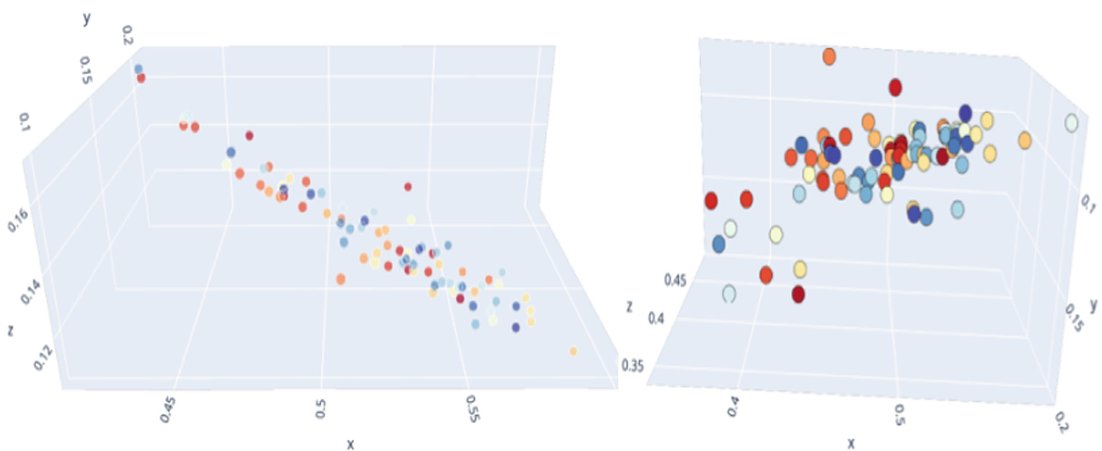 Fig 1: Genomic signatures of A. thaliana reduced to low-dimensional vectors using nxh bases.
Turning Code into Coordinates
The authors fed these signatures into Deep Neural Networks (DNNs). Unlike traditional models that require manual feature engineering, these networks learned the non-linear relationships between the genomic "n-mers" and environmental variables.
Key Findings:
- Geographic Accuracy: For Arabidopsis thaliana (a common model plant), the model predicted latitude and longitude with a relative error of ~10%.
- Temperature Sensitivity: Annual mean temperature was successfully predicted, suggesting that thermal adaptation is deeply rooted in the genetic sequence.
- The Precipitation Exception: Interestingly, the models failed to predict Annual Precipitation accurately. This suggests that while thermal and spatial data are "fixed" in the genome, some factors remain too volatile or lack a specific genetic response to be decoded by current methods.
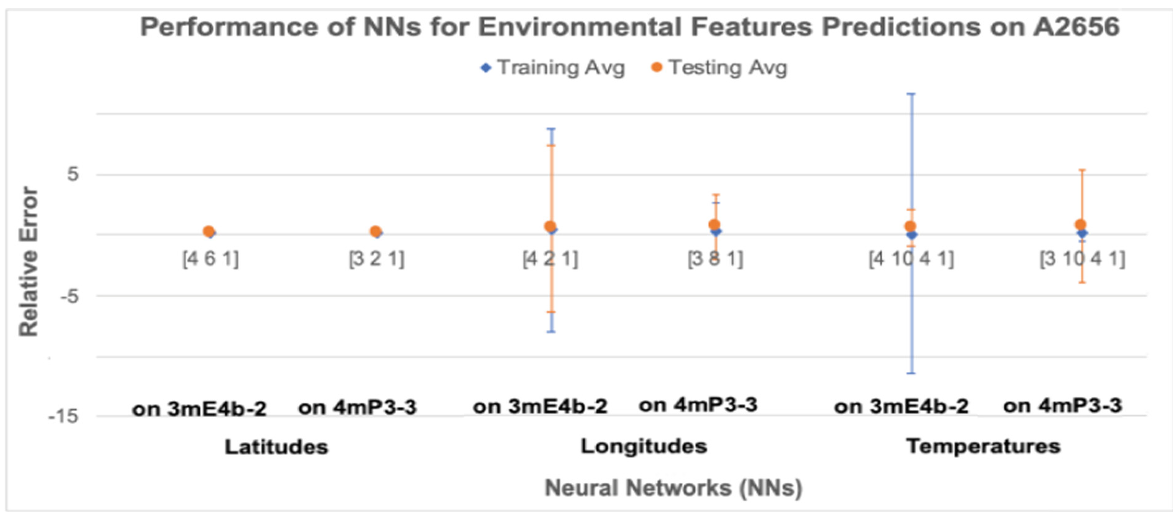 Fig 2: Prediction performance for Latitude, Longitude, and Temperature across different genomic samples.
Critical Insight: DNA as an Autopoietic Record
The conclusion of this study shifts from technical to philosophical. By demonstrating that DNA captures environmental traits, the authors align their work with the concept of autopoiesis (self-creation). DNA does not just build an organism; it records the context of its construction.
Just as layers of ice in the Arctic record Earth's atmospheric history, DNA sequences record the ecological pressures faced by a lineage over millions of years.
Limitations and Future Work
While the results are striking, the study notes that:
- Not all features are equal: As seen with precipitation, some environmental signals are missing or "too cryptic."
- Data Scarcity: The initial sample size (83 specimens) required mutation-based data augmentation to ensure robustness.
Future research will likely focus on identifying the specific "environmental genes" or non-coding regions where this ecological information is stored. This could revolutionize how we track invasive species or predict how life will adapt to the modern climate crisis.