
Profiling the Invisible: Inferring Social Roles via Relationship Topology
Profiling Online Social Network Users via Relationships and Network Characteristics
This paper introduces attribute inference models to profile Online Social Network (OSN) users using social relations and network characteristics. By testing on a Google employee dataset, the authors demonstrate that relational data, such as Dyadic and Triadic patterns, outperforms traditional topological metrics in inferring social roles.
TL;DR
In the age of heightened privacy, online social network profiles are increasingly "dark"—lacking explicit textual data like job titles or demographics. This paper presents a robust framework for profiling users by looking at their neighborhood structure rather than their self-reported bio. By analyzing a real-world Google employee dataset from Google+, the authors prove that Dyadic (pair-based) relations are the most accurate predictors of a user's professional role, often outperforming complex network centrality metrics.
The Motivation: When Texts and "Reach" Fail
Traditional user profiling relies on information extraction from posts or "about me" sections. However, when users hide these details, we are left with only the network graph. Previous research suggested that "network reach" (how many people you can influence) was the primary indicator of status.
The authors of this paper challenge this. They observed that on platforms like Google+, the "reach" distribution between an engineer and a salesperson is surprisingly similar. Therefore, they shifted the focus from how many connections a user has to who those connections are, leveraging the sociological principle of Homophily (the "birds of a feather" effect).
Methodology: From Dyads to Triads
The researchers proposed two main approaches to tackle the labeling problem:
1. Naïve Bayes Neighborhood Models
These models look at the "labels" of the people surrounding an unlabeled user:
- Two-hop Label Model: Uses the distribution of labels in your friends' friend circles.
- Dyadic Label Model: Focuses on the frequency of labels within your immediate neighbors.
- Triadic Pattern Model: Analyzes the "label pairs" of edges between your friends, capturing the density of the social "clique."
2. Feature-Based Models
These models treat the problem as a standard machine learning task, feeding features like Local Clustering Coefficient (LCC), Degree Centrality (DC), and Average Neighbor Degree (AND) into classifiers like Logistic Regression and Decision Trees.
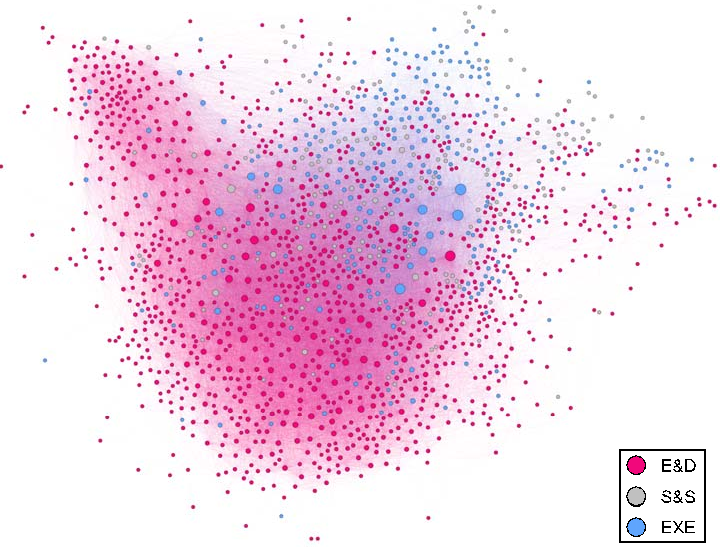 Figure 1: Visualization of the Google Employee Network, where node color represents social roles (Engineering, Sales, Executive).
Experimental Insights: Relations Weight More than Metrics
The team tested their models on a dataset of 1,638 Google employees. Their findings were revealing:
- The Winner: The Dyadic Label Model performed best, particularly for the "Engineering & Design" (E&D) group, achieving an F1-score of nearly 84%.
- The Homophily Effect: Engineers tend to follow engineers. Because this group is the majority and exhibits high homophily, the model identifies them with high precision.
- Network Metrics vs. Relations: Interestingly, the feature-based models (using DC, LCC, etc.) were less effective. This confirms the author's hypothesis: in modern OSNs, who you are connected to provides a better fingerprint than your position in the hierarchy.
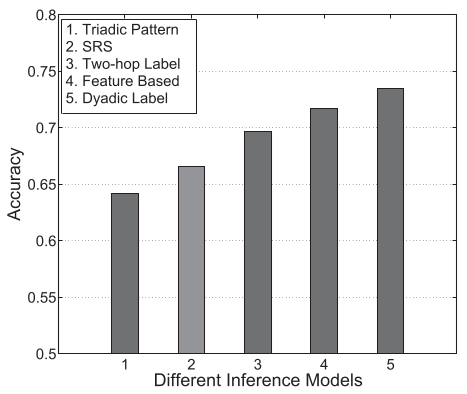 Figure 2: The Dyadic Label and Feature-based models significantly outperform the SRS (Social Role/Status) baseline across most labeling densities.
Critical Analysis & Conclusion
The value of this work lies in its empirical refutation of "reach" as a universal feature. It demonstrates that social structures are platform-dependent; what works for LinkedIn (a formal professional network) does not necessarily work for Google+ (a more interest-based, fluid network).
Limitations:
- Imbalanced Data: The models struggle with minority classes (Sales and Executives) because the "majority" bias of Naïve Bayes tends to label ambiguous nodes as Engineers.
- Static Graph: The study assumes a snapshot of the network, ignoring how these relationships evolve over time.
Future Outlook: This research paves the way for "Zero-knowledge" profiling. As privacy regulations (like GDPR) tighten, the ability to infer necessary demographics for academic or marketing research using only connection metadata—without ever reading a user's private post—will become a cornerstone of social data science.