
GPM: Rethinking Social Influence through Group Dynamics and Non-Submodular Optimization
Profit Maximization Under Group Influence Model in Social Networks
The paper introduces the Group Profit Maximization (GPM) problem, which aims to select k seed users in an Online Social Network (OSN) to maximize revenue from activated groups under the Independent Cascade (IC) model. It defines a group as activated only if a specific percentage (β) of its members are influenced, significantly shifting focus from individual to collective influence outcomes.
TL;DR
Social influence isn't just about how many individuals you reach; it's about whether you can trigger collective action. This paper introduces the Group Profit Maximization (GPM) problem, where groups (families, companies, political blocks) only "activate" if a certain threshold of their members are influenced. Because this threshold breaks the mathematical "niceness" (submodularity) of the problem, the authors deploy a sophisticated Sandwich Approximation Framework to reclaim efficiency and theoretical rigor.
Motivation: Why Individual Influence is Not Enough
Most existing studies on Influence Maximization (IM) assume that every person influenced is a "win." However, in the real world:
- Group Buying: A family might only buy a product if both parents and children are convinced.
- Voting: In many systems, a candidate wins a state only if they cross a majority threshold.
- Corporate Purchasing: A company might switch to a new software only if a threshold of department heads agrees.
The authors point out that current models fail here because they ignore Group Influence. Once you introduce a threshold for group activation, the objective function loses its "submodularity" (the property where adding seeds has diminishing returns). This makes the problem vastly harder to solve than standard IM.
Methodology: Taming the Non-Submodular Beast
The core challenge is that the profit function —defined as Group Benefits minus Diffusion Costs—is neither submodular nor supermodular.
1. The Mathematical Workaround
To handle this, the authors decompose the problem into the difference of two submodular functions. They create:
- An Upper Bound: A relaxed version of the problem where a group activates if at least one node is influenced (standard WIM).
- A Lower Bound: A stricter version requiring direct super-node connections.
2. The Submodular-Modular Algorithm (SMA)
The paper utilizes the fact that any non-submodular function can potentially be represented as a difference of two submodular functions. They design the SMA, which iteratively replaces the "subtracted" submodular part with a modular bound. This transforms a difficult optimization into a series of easier submodular maximizations.
 Figure 1: Conceptual visualization of social groups and the complexity of activation thresholds.
3. Sandwich Approximation Framework (SAF)
By calculating both the upper and lower bounds and selecting the best performing seed set among different strategies (Lower-bound optimal, Upper-bound optimal, and Weighted Group Coverage), the authors ensure the algorithm stays within a "sandwich" of theoretical performance.
Experiments and Results
The authors tested their methods on a Facebook-like Forum Network dataset, where topics represent "groups" and users liking those topics represent "members."
Key Findings:
- The β-Impact: As the activation threshold increases, total profit drops sharply. This quantifies the "difficulty of consensus"—it is much harder to influence a stubborn group than a loose one.
- Algorithm Performance: The proposed SAF outperforms "Maximum Outdegree" heuristics significantly. While the standard Greedy Strategy (GS) is slightly more accurate, SAF provides a better balance of efficiency in larger networks.
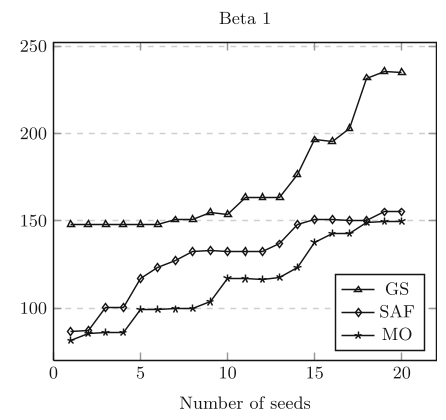 Figure 2: Comparison of different strategies. The SAF (Sandwich) approach effectively bridges the gap between simple heuristics and expensive greedy searches.
Critical Insight & Conclusion
The transition from individual nodes to group-based thresholds turns a standard optimization problem into a non-submodular one. This paper successfully demonstrates that we don't have to fly blind in non-submodular territory. By using Reverse Influence Set (RIS) sampling and Difference of Submodular (DS) optimization, we can still achieve high-profit viral marketing results.
Future Outlook: The next step for this research is scaling these non-submodular solvers to "billion-scale" networks, where even calculating the lower bound becomes a massive computational burden.