
PMIS: Optimizing the Multi-Product Portfolio in Modern Social Networks
Profit maximization for multiple products in online social networks
This paper introduces the Profit Maximization with Multiple Adoptions (PM2A) problem, moving beyond single-product influence maximization to a scenario where a company must allocate a shared budget across multiple products. The authors propose two main algorithms: PMCE (Profit Maximization with Cost Effectiveness) and PMIS (Profit Maximization with Intelligent Selection), achieving a State-of-the-Art (SOTA) approximation ratio of (1 - 1/e) for maximizing total profit in online social networks.
TL;DR
While most "Viral Marketing" research focuses on making a single product go viral, real-world companies like Samsung or Apple need to promote multiple products (e.g., Phones, Tablets, Laptops) simultaneously with a shared budget. This paper introduces a robust framework for Profit Maximization with Multiple Adoptions (PM2A), providing the PMIS algorithm which achieves a (1 - 1/e) performance guarantee using a novel combination of social diffusion models and Knapsack optimization.
Contextual Positioning
Influence Maximization (IM) has been a SOTA topic since Kempe et al. (2003). However, the jump from "Influence" (counting heads) to "Profit" (accounting for unit costs and margins) for multiple products complicates the mathematical landscape. This paper is a significant "Pathfinder" work that bridges the gap between social network propagation and classical combinatorial optimization (the Knapsack problem).
The Core Problem: Why "Greedy" Fails
In the standard IM problem, we pick nodes with the highest marginal gain. However, when products have different seeding costs () and potential profits (), a naive greedy approach can be "tricked" into picking low-cost, low-profit nodes early on, exhausting the budget before high-value "Super-spreaders" can be reached.
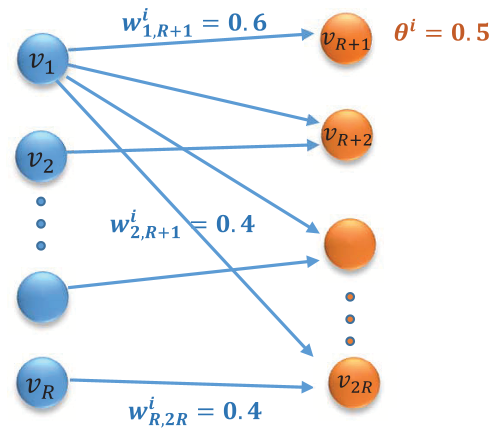
The authors present a compelling counterexample (Fig. 1) where a greedy approach results in a total profit of only , while the optimal strategy yields —a massive disparity that proves the need for more intelligent selection mechanisms.
Methodology: The PMIS Framework
The researchers proposed the Multiple Thresholds (MT) Model, allowing an individual node to adopt multiple products if the cumulative influence for each specific product exceeds its unique threshold.
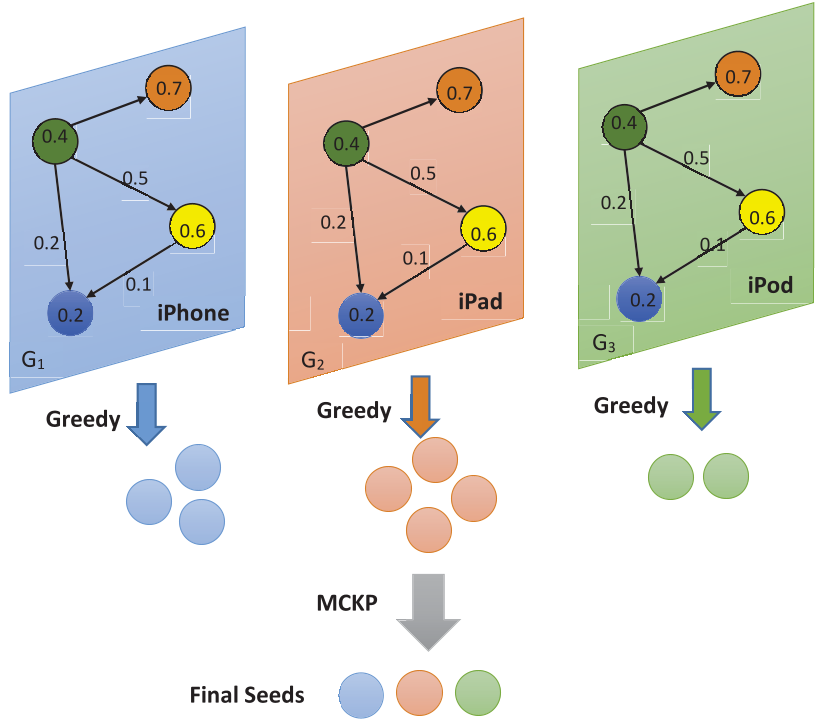
The PMIS (Profit Maximization with Intelligent Selection) algorithm follows a two-stage logic:
- Layered Decomposition: The network is treated as separate influence layers (one for each product). Potential seed sets are generated for each layer independently.
- Knapsack Orchestration: The problem is transformed into a Multiple-Choice Knapsack Problem (MCKP). The goal is to choose the optimal number of seeds for each product category to maximize total profit without exceeding the global budget.
Experimental Insights & Results
The authors tested their algorithms on NetS, BlogCatalog, and Facebook datasets.
1. Superior Profit Extraction
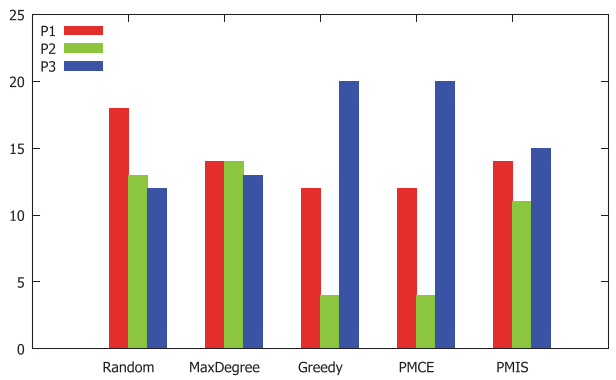
In the BlogCatalog experiment, PMIS significantly outperformed both "MaxDegree" and standard "Greedy" heuristics. As the budget increases, the gap widens because PMIS avoids the "diminishing returns" trap of over-investing in a single product.
2. Balanced Budget Allocation
One of the most striking findings is the "Distribution of Budget." Heuristics often dump all resources into the most "profitable" product on paper. PMIS, however, recognizes when a product has reached its "saturation point" in the network and begins reallocating the budget to other products where the marginal "cascading effect" is higher.
Critical Analysis & Takeaways
- Scalability: By decomposing the problem into products, PMIS allows for parallel processing. Any SOTA improvement in single-product IM (like sketches or sampling) can be plugged directly into the first stage of PMIS.
- The "Complementary" Insight: This work assumes adoptions are complementary (I can buy both an iPhone and an iPad). However, the authors correctly identify that for "Competitive" products (iPhone 15 vs iPhone 15 Pro), the submodularity of the profit function breaks down, making it a non-trivial future research direction.
- Industry Value: For digital marketers, this provides a rigorous template for "Portfolio Optimization" in viral campaigns, moving away from "influencer reach" towards "bottom-line profitability."
Conclusion
PMIS represents a robust advancement in viral marketing theory. By treating influence as a resource-allocation problem across multiple layers, it provides a practical yet theoretically sound framework for modern companies managing complex product ecosystems.