
Beyond Reach: Maximizing Profit for Social Network Providers via Iterative Pruning
Towards Profit Maximization for Online Social Network Providers
The paper introduces a novel "Profit Maximization" problem for Online Social Network (OSN) providers that balances revenue from influence spread against costs of influence propagation. It proposes a general two-phase framework combining an iterative pruning technique with specialized heuristics, outperforming state-of-the-art Influence Maximization (IM) algorithms on large-scale datasets while providing high approximation guarantees.
TL;DR
While high engagement is the holy grail of social media, for the providers themselves, "going viral" isn't free—it consumes bandwidth and infrastructure. This paper moves beyond traditional Influence Maximization (IM) to solve the Profit Maximization problem: finding the optimal set of influencers to maximize the gap between commission revenue and propagation costs. By utilizing a novel iterative pruning framework, the authors handle a challenging non-submodular objective and scale it to networks with millions of edges.
The Hidden Cost of Virality
For years, the research community treated Influence Maximization as a pure reach problem. If you pick the right "seeds," you get the most eyeballs. But from the perspective of an OSN provider (like Meta or X), every video click and every shared ad costs money in terms of data traffic and cloud computing.
The technical challenge lies in the math:
- Revenue (Benefit) is submodular (diminishing returns on reach).
- Propagation Cost is also submodular.
- Profit (Benefit - Cost) is the difference between two submodular functions.
This subtraction destroys the "submodularity" and "monotonicity" properties that greedy algorithms rely on. In simple terms, adding more seeds might actually decrease your total profit, making the search for the optimal set a needle-in-a-haystack problem.
Methodology: The Two-Phase Framework
The authors tackle this with a clever "Prune-then-Search" strategy.
1. The Pruning Phase (IterativePrune)
Instead of searching the entire power set of nodes, the authors iteratively narrow the search space to a specific lattice .
- A*: Nodes that are so beneficial they must be included.
- B*: The largest possible set of candidates worth considering.
This relies on a physical intuition: if a node's minimum possible benefit outweighs its maximum possible cost, it's a guaranteed winner. By iterating this logic, they can discard over 98% of nodes in some datasets.
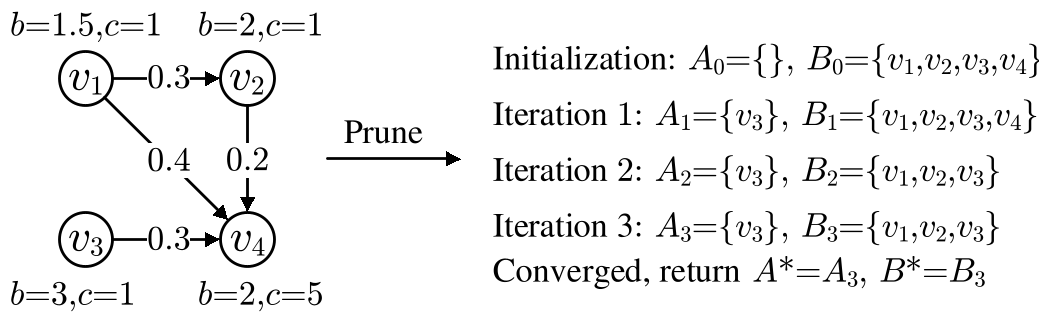 Figure 1: Example showing how the lattice shrinks as the algorithm calculates marginal gains.
2. The Search Phase
Once the search space is small, they apply a Greedy approach or a Modular-Modular (ModMod) algorithm. ModMod works by approximating the submodular functions with modular "bounds" that are easier to optimize, iteratively improving the result.
Experiments and Results
The framework was tested on the LiveJournal (5M nodes) and Google+ datasets. The results were striking:
- Efficiency: The pruning phase is so effective that the search phase runs up to 1,000x faster than on the unpruned graph.
- Effectiveness: Standard IM algorithms (like BenefitMax) often fail to maximize profit because they pick too many seeds, incurring runaway costs. The proposed framework consistently found the "sweet spot."
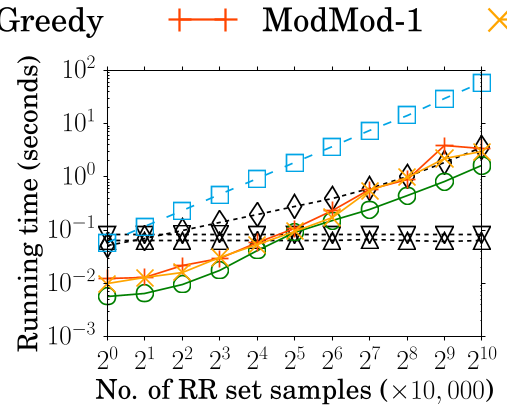 Figure 2: Profit comparison across different algorithms. Our methods (Greedy, ModMod) significantly outperform baselines as the number of reverse reachable (RR) sets increases.
Critical Insight: The Power of Normalization
A subtle but brilliant contribution is the Weight Normalization. By setting , the authors filter out "intrinsically unprofitable" nodes before the process even starts. This doesn't just simplify the math; it improves the sampling accuracy of the Reverse Influence Sampling (RIS) method used to estimate reach.
Conclusion
This paper provides a robust theoretical and practical bridge between the marketing value of social networks and the operational reality of OSN providers. The IterativePrune technique is a versatile tool that could likely be applied to any problem where one must optimize the difference between two submodular forces—be it in network security, resource allocation, or sensor placement.
Takeaway: In the world of social networks, reach is vanity, but profit is sanity. Efficiency doesn't come from a faster search, but from knowing what to ignore.