
Program-as-Weights: Turning LLMs into Compilers for the Small Model Future
Program-as-Weights: A Programming Paradigm for Fuzzy Functions
This paper introduces Program-as-Weights (PAW), a paradigm that compiles natural-language descriptions of "fuzzy functions" into compact neural binaries (LoRA adapters). These "programs" are executed locally by a frozen, lightweight 0.6B Qwen3 interpreter, matching the performance of a 32B model while being 50x more memory-efficient.
TL;DR
The "Program-as-Weights" (PAW) framework introduces a breakthrough in how we deploy AI: instead of calling an expensive API for every single request, we use a large model once to "compile" a task description into a tiny 23MB neural binary. This binary (a LoRA adapter) is then plugged into a tiny, local 0.6B model that runs on your laptop as fast as standard code, outperforming models 50x its size.
From API Logic to Neural Binaries
For years, developers have been stuck in a "fuzzy" dilemma. Tasks like “alert me if this log line is urgent” or “fix this broken JSON” are nightmare to write in Python or Regex. The easy fix has been calling gpt-4o, but this creates a dependency on black-box APIs that are expensive, slow, and prone to "model drift" (where the API's behavior changes without notice).
The authors of PAW argue that we should treat Foundation Models as Compilers, not just chat bots.
The Core Insight
A "Fuzzy Function" shouldn't require a 175B parameter brain for every execution. It just needs a small brain that has been perfectly tuned for that one specific task. PAW achieves this by splitting the "program" into two parts:
- The Discrete Half: A cleaned-up natural language restatement of the task (the pseudo-program).
- The Continuous Half: A custom-generated LoRA adapter that literally re-wires the small model's brain for that task.
Methodology: How the Neural Compiler Works
The magic happens in the Hypernetwork. The system uses a 4B "Compiler" model. When you give it a prompt like "Extract dates from messy emails," the compiler doesn't answer the prompt. Instead, its internal "hidden states" are processed by a Mapper to generate the and matrices of a LoRA adapter.
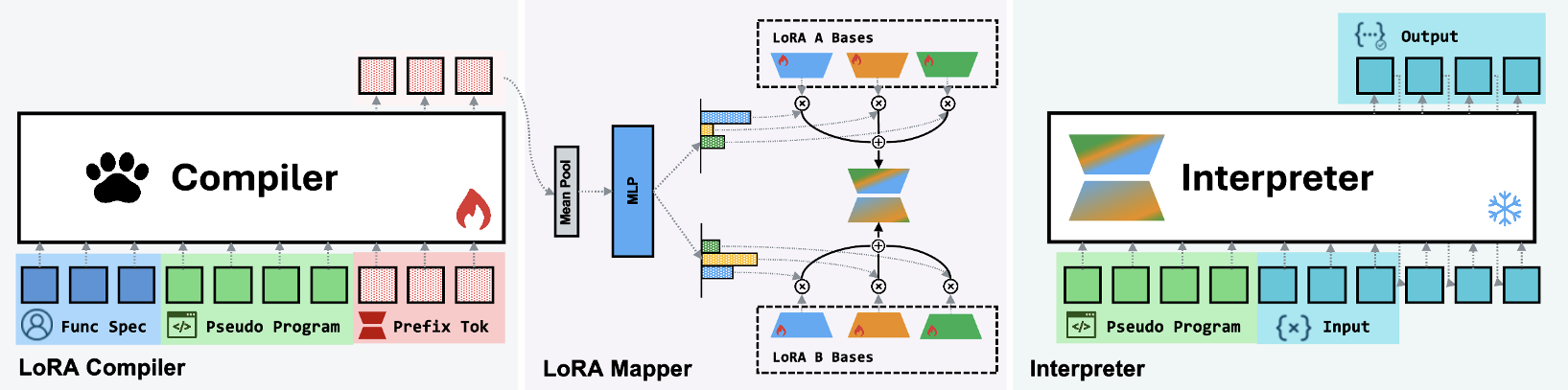 Figure: The Text-to-LoRA pipeline. The compiler consumes the spec and emits weights that are "hot-attached" to the local interpreter.
This LoRA is then "hot-swapped" onto a 0.6B Interpreter (a very small LLM). Because the weights were generated specifically for your task, this tiny model suddenly gains "extraordinary expertise" in that one niche area, allowing it to punch way above its weight class.
Experimental Results: Small Models, Big Impact
The results are staggering. A 0.6B model (about the size of an old GPT-2) running a PAW program hit 73.78% accuracy, beating a naked 32B model (68.70%).
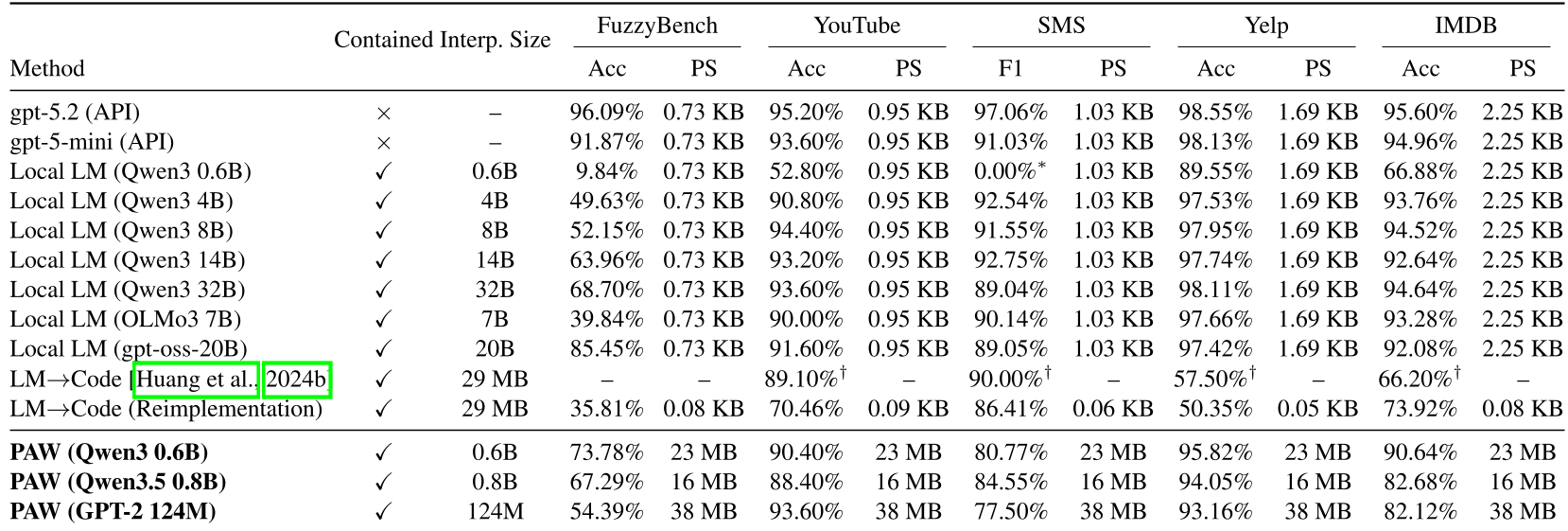 Table: PAW consistently outperforms larger local models across diverse tasks like SMS filtering and Yelp sentiment analysis.
Key Performance Metrics:
- Efficiency: 50x less memory than a 32B model.
- Speed: 30+ tokens/second on a standard MacBook M3.
- Size: Total package is ~480MB, easily fitting on a mobile phone or in a browser via WebAssembly.
Robustness: The "Denoising" Effect
One of the most interesting findings is how PAW handles messy input. If a developer writes a task description with typos and bad grammar, the 4B Compiler acts as a "filter." It generates a clean "pseudo-program" and precise weights, meaning the tiny 0.6B Interpreter never sees the "noise."
In ablation studies, the authors found that using this "Pseudo-program" step increased accuracy on "heavy typo" tasks by 4.5%, proving that the compiler is effectively a sophisticated translator between human messiness and machine precision.
The Future: Large Models Build, Small Models Run
PAW represents a shift in AI architecture. Instead of "One Model to Rule Them All," we are moving toward a "Library of Neural Programs."
Imagine a future where:
- Your IDE has 50 different 20MB "neural binaries" for refactoring, doc generation, and bug hunting.
- All of them are served by a single 500MB runtime that lives in your RAM.
- Zero data ever leaves your machine.
As we hit the limits of API-based scaling, the "Compile-once, Run-locally" philosophy of PAW might just be the blueprint for the next generation of AI-integrated software.
Technical Note: The authors have released FuzzyBench-10M, a massive dataset to help others train their own neural compilers, signaling a major contribution to the "Small Language Model" (SLM) ecosystem.