
Beyond the Slide Rule: How Programmable Calculators Invented Personal Computing
Once Upon a Pocket: Programmable Calculators from the Late 1970s and Early 1980s and the Social Networks Around Them
This paper explores the evolution of programmable calculators (TI-59 and HP-41C) during the late 1970s and early 1980s as the true precursors to personal computing. It examines how grassroots user communities, specialized software modules, and "synthetic programming" shaped a unique socio-technical ecosystem prior to the dominance of the PC.
TL;DR
Before the Apple II or the IBM PC became household names, a revolution was occurring in the pockets of engineers. This paper by Jelica Protić uncovers the hidden history of the TI-59 and HP-41C—devices that weren't just calculators, but the world's first truly portable, programmable personal computers. Driven by passionate global user communities, these machines pioneered the software industries and "hacker" cultures we recognize today.
The "Miracle Year" and the Price of Portability
1975 is often cited as the annus mirabilis of computing with the launch of the Altair 8800. However, for a professional engineer in 1977, an Apple II was a luxury at 300 (approx. $1,080 today) and could be carried in a pocket.
The motivation for these devices was clear: Mainframes were inaccessible, and slide rules were becoming obsolete. The programmable calculator filled this vacuum, offering a dedicated, personal computational space that users could "teach" (program) to solve complex aeronautic, medical, and financial problems.
Methodology: The Rivalry of Architectures (AOS vs. RPN)
The paper highlights a fascinating "language war" between Texas Instruments and Hewlett-Packard.
- Texas Instruments (TI-59): Used the Algebraic Operating System (AOS), matching standard mathematical notation (e.g., ).
- Hewlett-Packard (HP-41C): Utilized Reverse Polish Notation (RPN) based on a four-register stack. This gave HP a "guru" status—amateurs couldn't even find the "=" key, but power users could execute complex math with far fewer keystrokes.
Hardware Innovation: The ROM Module
Perhaps the most significant innovation was the Solid-State Software Module. TI and HP realized that RAM was too limited for complex tasks. By introducing interchangeable ROM modules, they created a precursor to the "App Store," where users could plug in specialized code for navigation, statistics, or even the Winter Olympics.
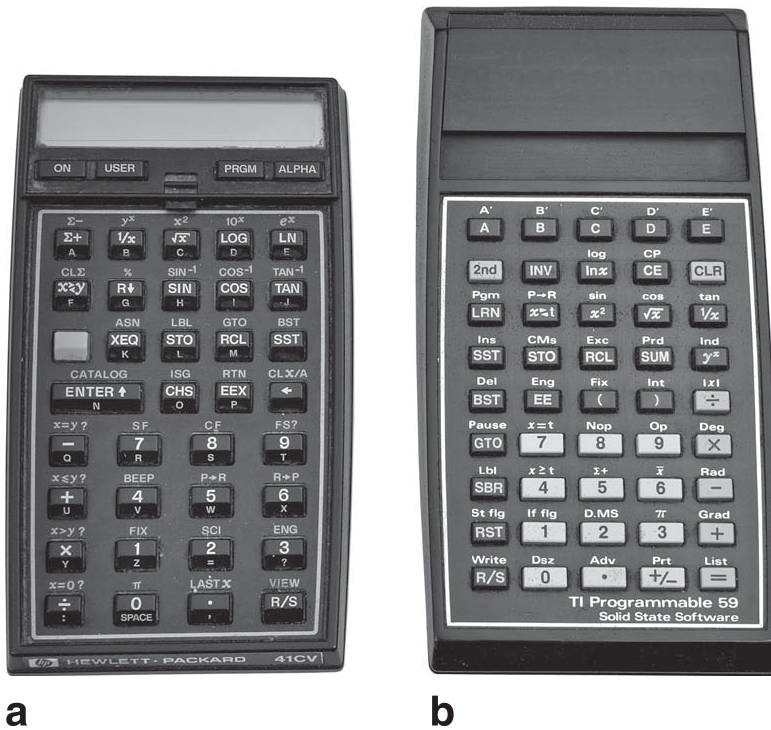 Figure 1: Comparison of the HP-41CV (left) and the TI-59 (right). Though different in input logic, both offered unprecedented portability.
The Dawn of Synthetic Programming
One of the most profound insights in the paper is the rise of Synthetic Programming. Because these systems were "closed," users discovered bugs and undocumented "Hex Codes" to access internal registers.
- TI-59 Fast Mode: Users discovered that executing code from a ROM module was faster than RAM. They eventually found a sequence to "trick" the calculator into running user RAM programs at double speed.
- The "Byte Grabber": HP-41C users developed techniques to enter "illegal" instructions, effectively creating a subculture of machine-language optimization that pushed the hardware far beyond its specified limits.
Experiments and Results: The Power of Community
The paper proves the effectiveness of these communities through the sheer volume of collaborative output:
- Software Exchange: TI's library grew to over 3,000 programs submitted by users.
- The PPC ROM: The HP user group (PPC) independently developed a custom 8-Kbyte ROM containing 122 state-of-the-art programs, a feat that forced HP to rethink their own software development.
- Global Reach: Clubs spread to over 30 countries, with newsletters like TI PPC Notes and PPC Journal publishing over 30,000 pages of technical documentation and code.
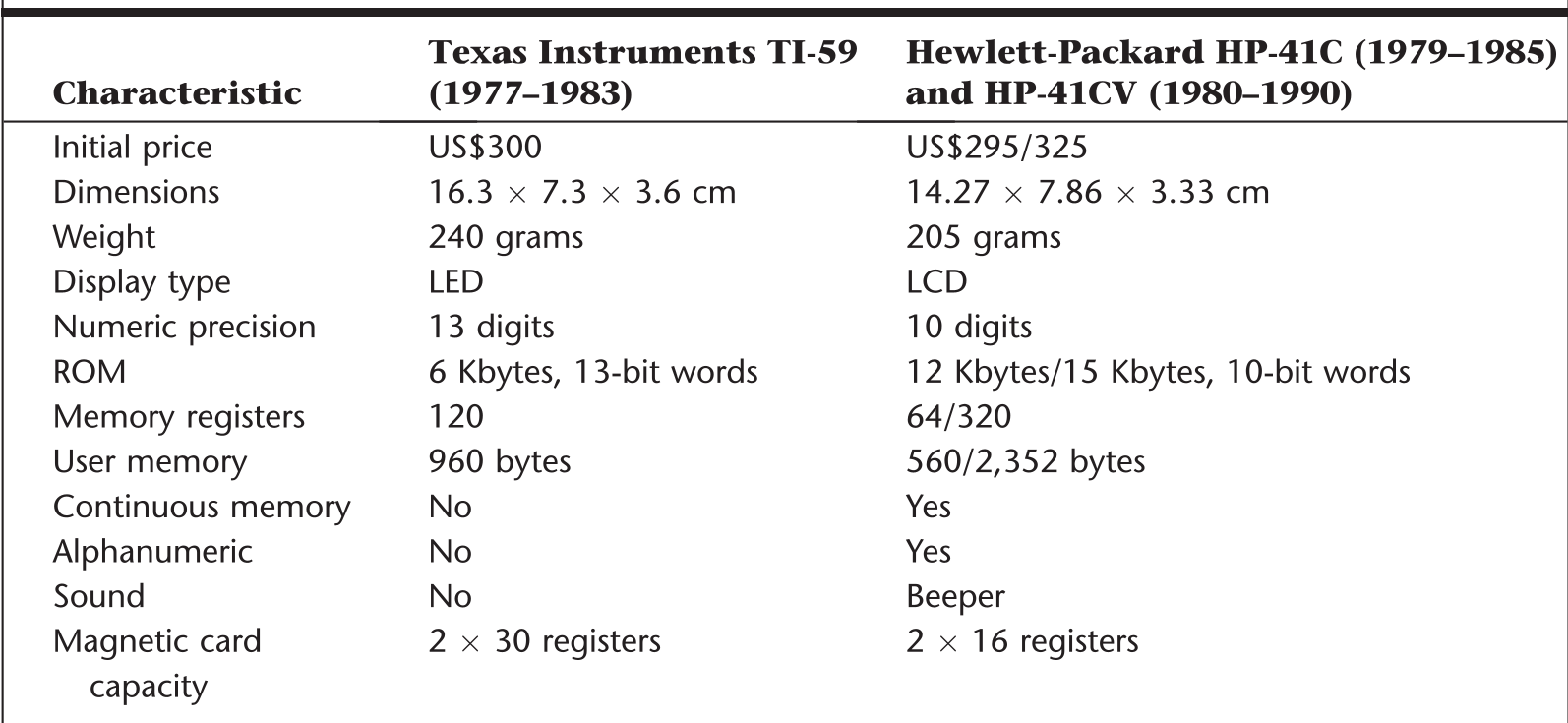 Table 1: Technical specifications highlighting the TI-59's higher numeric precision (13 digits) vs. the HP-41C's alphanumeric capabilities and continuous memory.
Deep Insight: A Legacy of "Hacker Ethics"
The era of programmable calculators ended not because they failed, but because they were eventually outclassed by the rapid decline in cost of graphical PCs and the rise of handheld BASIC computers like the Sharp PC 1500.
Conclusion: The TI-59 and HP-41C era was not a technological dead-end; it was a foundational period that established the Hackers Ethic outside of university labs. It proved that users do not just "consume" technology—they reshape it. Whether it was NASA astronauts using the HP-41C for flight calculations or engineers sharing code in Yugoslavia, these devices were the first true "Personal Information Centers."
Limitations
While the paper expertly covers the social history, it notes that the software of this era was largely non-profit, lacking the payment-by-royalties model that eventually allowed the PC software industry to explode. Today, these communities survive in the form of emulators and digital archives, preserving a time when every byte of memory was a hard-won victory.