
GENIUS-C: Bridging the Gap Between Research and Industry in Spatial Crowdsourcing
A programming framework for Spatial Crowdsourcing
The paper introduces GENIUS-C, a Java-based programming framework for developing Spatial Crowdsourcing Platforms (SCP). It implements a generic architecture (GA) that bridges the gap between theoretical academic models and commercial requirements, providing a reference implementation for managing location-based tasks, workers, and requesters.
TL;DR
While digital crowdsourcing (e.g., Amazon Mechanical Turk) is a solved problem, Spatial Crowdsourcing (SCP)—where tasks require physical presence (e.g., Uber, TaskRabbit)—remains difficult to develop due to complex workflows. This paper presents GENIUS-C, a reference programming framework that provides a generic architecture to build SCPs quickly, emphasizing code reuse and flexible task life cycles.
Problem: The Academic-Industry Divide
The researchers identified a critical flaw in current crowdsourcing literature: most "general" frameworks are either too specialized for sensing (Human-as-a-Sensor) or ignore the requirements of commercial giants. Physical tasks are messy—they involve negotiations, deadlines, cancellations, and varied spatial constraints (points, polygons, or routes). Prior work often failed to provide a technical bridge that could handle these industrial-grade complexities.
Methodology: The State-Machine Heart
At the core of GENIUS-C is a realization: a spatial task is essentially a state machine.
1. The Task Life Cycle Manager
Instead of hard-coding what a task "is," GENIUS-C treats it as a series of transitions triggered by "Actions." A developer can define a workflow where a task moves from Unpublished to Assigned to Accomplished via a Transition Map.
2. Architecture Decoupling
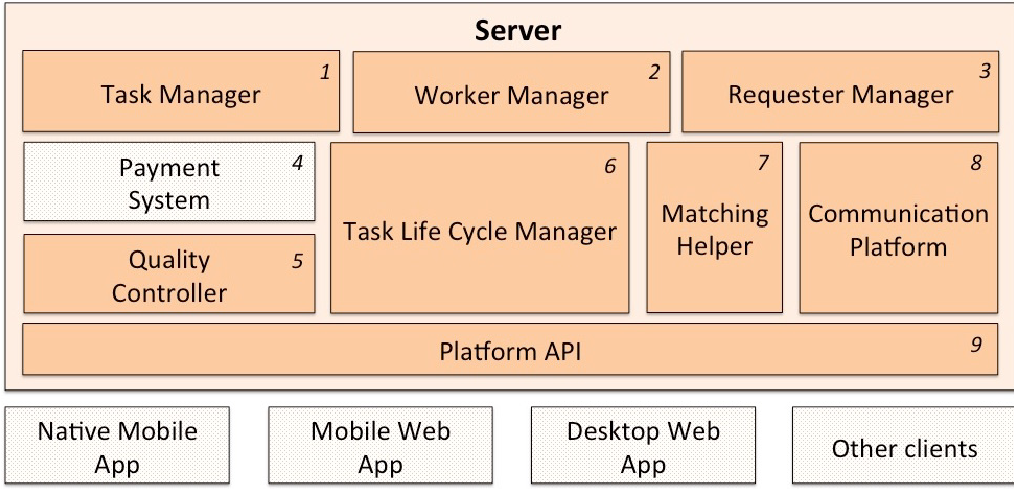
The framework is composed of nine key components:
- Managers: Task, Worker, and Requester registries.
- Observers: Quality Control and Payment Systems that "listen" for state changes.
- Matching Helper: Interfaces for recommendation and utility estimation.
Real-World Validation: ProtoCrowd
To prove the framework's utility, the authors built ProtoCrowd, a mobile application for house-cleaning services.
Key findings during implementation included:
- Workflow Flexibility: By defining a custom
StateFactory, the team implemented an "Offer" system where multiple workers can bid on a task before it enters theAssignedstate. - Observer Power: They implemented a
DeadlineQControlleras aTaskObserver. This module automatically prevents workers from accepting expired tasks without touching the core system logic. - Recomendation Integration: Using the
MatchingHelperinterface, they integrated a TF-IDF weight and cosine similarity engine to suggest tasks based on a worker's past successes.
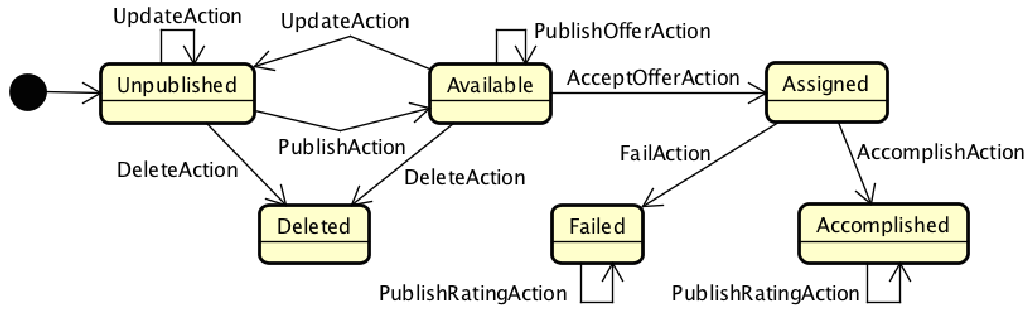 Figure: The specialized task workflow for the ProtoCrowd application.
Critical Analysis & Conclusion
The true value of GENIUS-C lies in its Inductive Bias toward flexibility. By refusing to define exactly how "location" or "payment" works, it allows developers to swap a Point-based location for a Polygon-based one without breaking the system.
Takeaways:
- Reduced Effort: Developers can focus on UI/UX and business logic (like specific worker skills) rather than the plumbing of state management.
- Future Work: The authors admit the framework currently lacks native Privacy Mechanisms—a critical component for future SCPs to protect worker location data.
In summary, GENIUS-C moves Spatial Crowdsourcing from a "niche research topic" to a "standardized software engineering discipline," providing the blueprints necessary for the next generation of location-aware service economies.