
SPRS: Maximizing Audit Efficiency through Stratified Progressive Sampling
5975_Progressive Random Sampling With Stratification.
This paper introduces Stratified Progressive Random Sampling (SPRS), a multi-period retrospective estimation technique designed for social welfare data. It combines stratification with information "carryover" from previous samples to significantly improve the precision of claim amount estimates or reduce required sample sizes.
TL;DR
Researchers have developed Stratified Progressive Random Sampling (SPRS), a technique that allows organizations (specifically in social welfare) to reuse audited data across multiple time periods. By combining the precision of stratification with a "progressive" mechanism that treats previously seen data as known constants, SPRS yields higher confidence bounds and requires significantly fewer manual file reviews than traditional methods.
Background: The Cost of Amnesia in Auditing
Many federal social welfare programs require retrospective sampling to estimate total claims. The "Lower 90% Confidence Bound" is the standard metric: it ensures the claim is statistically valid and avoids penalties under the False Claims Act.
The problem? Most auditors treat each quarter as a disconnected silo. In reality, a recipient appearing in a sample for Quarter 8 likely has relevant data for Quarters 1 through 7 visible in their case file. Traditional Simple Random Sampling (RS) or Stratified Random Sampling (SRS) suffers from "temporal amnesia," wasting resources to re-verify information that should already be on the books.
The Core Insight: Zero-Variance Components
The authors' breakthrough, first with PRS and now enhanced with SPRS, lies in the mathematical treatment of known members. If a population member's claim value is already known from a previous sample, they are moved to a set .
The total claim estimate is split into two distinct parts:
- The Known Component: A simple sum of previously gathered values (), which contributes zero to the sampling variance.
- The Estimated Component: A sample taken only from the remaining population.
By shrinking the population that is actually "subject to randomness," the standard error drops dramatically.
 Fig 1: The SPRS Estimator, combining sampled means from reduced populations with known carryover values.
Methodology: Adding Stratification to the Mix
The paper takes PRS a step further by introducing strata. This is vital when the population is heterogeneous (e.g., recipients getting payments from different primary sources). Using Neyman Optimal Allocation, the method ensures that sample sizes are distributed to the strata where they will have the most impact on reducing overall variance.
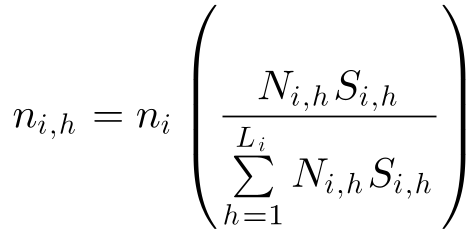 Fig 2: Optimal allocation under the assumption of equal unit sampling costs per stratum.
Experimental Proof: Better Results, Less Work
Using a real-world dataset of social welfare claims, the researchers compared RS, SRS, PRS, and SPRS. The results (visualized in the paper's performance metrics) were striking:
- Efficiency: To reach the same claim recovery level that SPRS reaches with a 5% sample, standard RS would need to audit 12% of the population.
- Reliability: SPRS consistently yielded higher expected cumulative claims (CC) because it "clears the fog" of variance faster than any other method.
- Saturation: In some cases, the combination of a 15% target sample and the accumulated "carryover" data essentially turned the sample into a full census, eliminating sampling error entirely.
 Fig 3: The Cumulative Claim (CC) metric showing SPRS outperforming all traditional benchmarks.
Critical Analysis & Takeaways
The power of SPRS is its cost-efficiency. It doesn't require complex time-series modeling or assumptions about data stationarity. It simply leverages the "free" information already present in audit windows.
Limitations:
- The effectiveness of SPRS is heavily dependent on the carryover proportion. If population members rarely reappear across quarters, the "Progressive" advantage vanishes.
- It requires robust data tracking to uniquely identify and label members across time periods.
Future Outlook: The authors suggest moving toward adaptive stratification, where the boundaries of strata change as information carryover patterns shift. For any industry dealing with recurring audits or longitudinal data—from insurance to environmental monitoring—SPRS provides a blueprint for "sampling smarter, not harder."
Conclusion
SPRS is a masterclass in applying practical engineering intuition to statistical theory. By recognizing that "information on hand" is the best tool for variance reduction, it provides a legally defensible way to maximize outcomes in resource-constrained environments.