
Oraculous: Engineering Social Networks for Cognitive Growth through Social Matching
Promoting learning through social networks supported by a social matching system model
This paper introduces Oraculous, a Social Matching System (SMS) designed to promote knowledge acquisition in social networks by pairing users based on shared interests and learning theories. By integrating models like Kelly’s Personal Construct Psychology and Vygotsky’s Zone of Proximal Development, the system identifies optimal peer matches to facilitate vicarious learning.
TL;DR
The paper presents Oraculous, a Social Matching System (SMS) that goes beyond simple "friend suggestions." By mapping mathematical models to established learning theories (Vygotsky, Kelly, Bandura), it identifies and pairs users who can serve as cognitive models for one another. Experimental results show that this theory-driven approach nearly doubles knowledge acquisition rates compared to traditional social bookmarking tools.
Background & Positioning
In the era of Web 2.0, platforms like Delicious (and today’s Are.na or Raindrop) turned the internet into a giant, collaborative bookmarking repository. However, having access to data isn't the same as gaining knowledge. The authors position this work as a bridge between Social Network Analysis and Educational Psychology, filling the gap where social platforms fail to foster intentional learning.
The Core Problem: Why Social Search is Broken
Most social networks rely on "homophily"—the tendency of individuals to associate with similar others. While this creates comfort, it doesn't necessarily catalyze learning. Prior work often ignored the mechanism of knowledge transfer. The authors argue that for a network to be educational, it must find the Zone of Proximal Development (ZPD): pairing you with someone who knows just enough more than you to pull you forward, but not so much that the gap is insurmountable.
Methodology: The Mathematics of Learning
The Oraculous model treats social matching as a service. It uses Pearson Correlation to measure the degree of similarity between a "Target User" and potential "Other Users" based on their interaction with digital artifacts (sites, notes, and tags).
1. Kelly’s Personal Construct Psychology
The system uses the Commonality Corollary to find peers with similar "personal constructs" (ways of interpreting information). This is modeled by Equation 1:

2. Theoretical Abstraction
The model identifies a set of pairs by intersecting users who reference specific artifacts and those linked to popular related artifacts :

Experiments and Results: Does it Actually Work?
The authors conducted a quasi-experiment focusing on "micro-blogging" as a subject. They split participants into a control group (using standard Delicious) and an experimental group (using Oraculous + Delicious).
Key Findings:
- Network Expansion (H1): Participants using Oraculous actively added peers to their networks, recognizing them as valuable knowledge sources. The control group, despite having the functionality, added zero peers.
- Knowledge Gain (H2): The Oraculous group achieved a significant leap in knowledge.
| Question Type | Control Group Gain | Experimental Group Gain |
|---|---|---|
| Knowledge Increment | 20% of questions | 43% of questions |
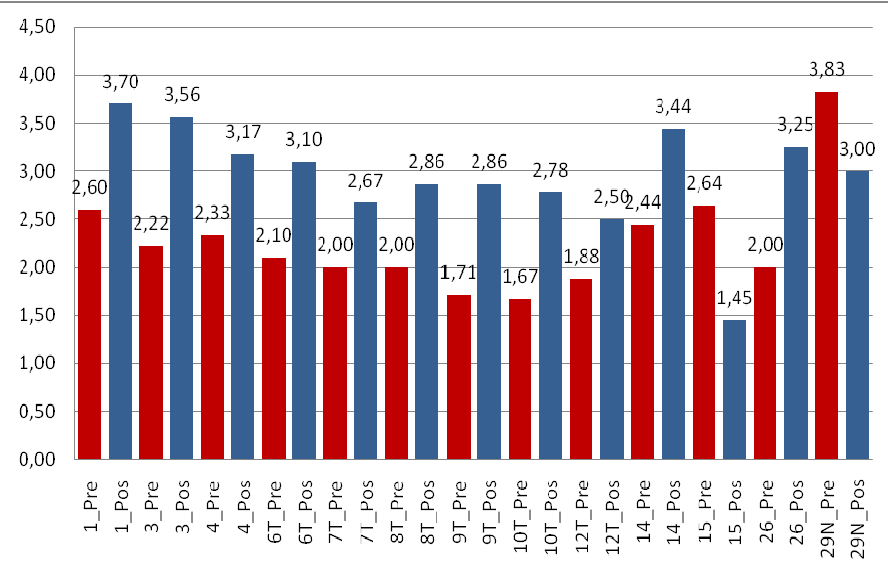 Figure: The experimental group showed markedly higher averages in specific technical questions (e.g., questions 5 and 9T) compared to the control group.
Critical Insight & Conclusion
The true value of Oraculous lies in its Inductive Bias derived from pedagogy. Instead of optimizing for "engagement" or "clicks," it optimizes for commonality and stretch.
Limitations: The study's sample size (n=27) is small, which limits broad generalization. Additionally, the reliance on Pearson Correlation for similarity is a "shallow" metric compared to modern vector embeddings (word2vec, transformers) which could capture deeper semantic relationships between bookmarked items.
Future Outlook: This research paves the way for "Cognitive Social Networks" where the algorithm acts as a digital tutor, strategically connecting us to the people we need to meet to reach our next level of potential.