
The Power of Strategic Bridges: Optimizing Information Diffusion via "Good" Weak Ties
Propagating online social networks via different kinds of weak ties
This paper explores information diffusion in Online Social Networks (OSNs) by analyzing the impact of "weak ties." It introduces a simple mechanism to select specific weak ties to act as bridges between subgroups, demonstrating superior propagation reach across Facebook and blog datasets (Wretch, Tribe) compared to strong-tie-only methods.
TL;DR
Is a close friend or a distant acquaintance more valuable for spreading a viral message? Drawing from Granovetter's classic theory, this paper confirms that weak ties—those low-frequency interactions—are the essential bridges of Online Social Networks (OSNs). By introducing a selection mechanism that targets acquaintances with the fewest mutual friends, the researchers demonstrate a significant boost in "Unique Coverage," allowing information to leap across disconnected social clusters with minimal redundancy.
Background: Beyond the Inner Circle
In the world of OSNs (Facebook, Blogs, etc.), we naturally gravitate toward Strong Ties—people we interact with constantly. While these are reliable for republishing information, they often exist within "echo chambers" where everyone knows everyone else. Weak Ties (the casual acquaintance) are structurally different; they serve as bridges to entirely different social circles.
The authors identify a critical gap: Not all weak ties are created equal. Some simply lead back to the same circle, while others lead to unexplored "subgroups."
Methodology: Identifying the "Good" Weak Ties
The researchers defined tie strength () based on interaction frequency (e.g., the number of comments or wall posts). They compared five strategies:
- P1-P3: Selecting the weakest, strongest-weak, or random weak ties.
- P4: Using only strong ties (Control group).
- P5: The Least Mutually Exclusive Friend strategy. This targets nodes that have the fewest shared connections with the sender.
The Insight
The logic behind P5 is rooted in the Clustering Coefficient. If you and a contact have many mutual friends, you are likely in the same cluster. If you have zero mutual friends, that contact is your ticket to a brand-new audience.
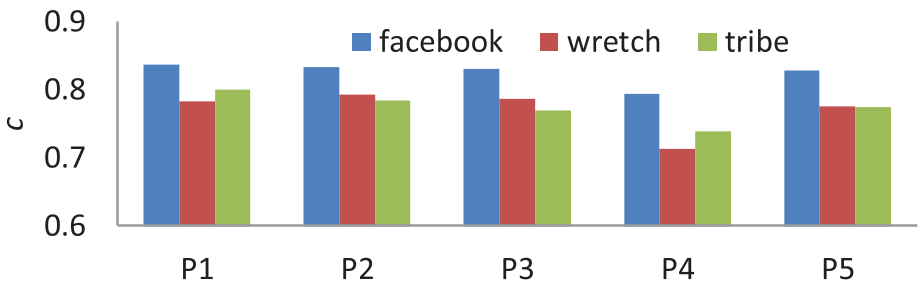 Figure 1: Comparison of coverage efficiency across different mechanisms. Note how mechanisms involving weak ties (P1, P2, P3, P5) consistently outperform the strong-tie-only approach (P4).
Experimental Battleground: Facebook vs. Blogs
The team tested these strategies on three massive datasets: Wretch.cc, Tribe.net, and Facebook.
| Metric | Wretch.cc | Tribe.net | |
|---|---|---|---|
| Clustering Coeff | 0.085 | 0.099 | 0.018 |
| Unique Coverage (P5) | 164.47 | 80.70 | 390.56 |
The results were striking. In Tribe.net, which has a very low clustering coefficient (meaning the network is naturally more fragmented), the P5 strategy was exceptionally dominant. It reached nearly 400 unique nodes per request, proving that the more "broken" a network is, the more critical the selection of the right bridge becomes.
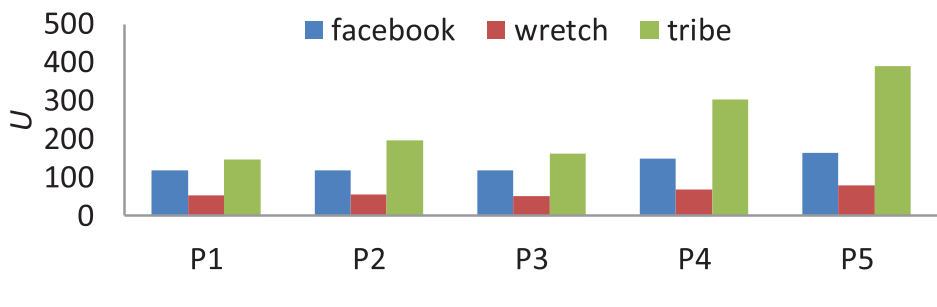 Figure 2: Unique coverage metrics showing that P5 (green bar) consistently reaches the widest audience across all social platforms.
Critical Insight: Efficiency vs. Reach
The paper uncovers a classic engineering trade-off:
- Random Weak Ties (P2): Surprisingly effective. If you don't have the compute power to analyze mutual friends, just picking any acquaintance at random works remarkably well and costs almost nothing.
- Strategic Weak Ties (P5): Reaches the most people but at a higher "Duplication Ratio" (message redundancy). Because it pushes information into new groups, those groups might eventually "hear" the message from multiple entry points.
Conclusion & Future Look
The study reaffirms that for viral growth, acquaintances are your best asset. While strong ties ensure your message is accepted, weak ties ensure it is seen.
Future Outlook: As algorithms on platforms like TikTok move away from "follower graphs" (who you know) toward "interest graphs" (what you like), the definition of a "tie" is shifting. Future research must determine if a "weak tie" in a content-based recommendation system follows the same structural rules as the friendship-based links studied here.
Note: This analysis is based on the paper "Propagating Online Social Networks via Different Kinds of Weak Ties" published in ASONAM '13.