
Spatio-Social Synergy: Orchestrating D2D Replication via Mobility and Propagation Awareness
Propagation- and Mobility-Aware D2D Social Content Replication
This paper proposes a joint propagation- and mobility-aware content replication strategy for Device-to-Device (D2D) social media delivery. By integrating social influence graphs with regional user mobility patterns, the authors develop a distributed optimization algorithm that achieves up to a 4-fold improvement in content delivery fraction compared to traditional baselines.
TL;DR
The surge in mobile social media has rendered traditional centralized content delivery inefficient. This paper introduces a novel D2D replication framework that predicts where a user will go (mobility) and what people in that area will want to watch (social propagation). By aligning these two vectors, the researchers achieved a massive 2-4x increase in successful D2D content offloading.
Problem & Motivation: The Static Edge vs. The Dynamic Social
Modern social media is dominated by "short-tail" unpopular content that is locally relevant but collectively massive. Traditional CDNs or edge servers can't justify caching every niche video. D2D communication—where phones exchange data directly—is a promising solution, but it usually suffers from three critical flaws:
- Inefficient Flooding: Blindly broadcasting data wastes battery and storage.
- Social Blindness: Ignoring the fact that content spreads through social graphs, not just physical proximity.
- Mobility Chaos: Users move, making stable peer connections difficult to maintain.
The authors' key insight is that social propagation and physical mobility are intertwined. If we know your friend in "Region A" just shared a video, and we know you are moving toward "Region A," your device becomes the perfect replication vehicle for that content.
Methodology: Harmonizing Social Influence and Human Movement
The core of the system is a two-pronged predictive engine:
1. The Regional Social Popularity Model
Instead of a global popularity metric (like YouTube view counts), the authors calculate a Regional Social Popularity Index (). This combines:
- Inherent Popularity: The content's general "virality."
- Influential Popularity: The probability that friends of the original sharer, located in specific regions, will request the content.
2. The Migration-Aware Mobility Model
Using Wi-Fi association traces, the authors built a transition matrix. By combining a user's general "Regional Preference" with their current "Migration Index" (the probability of moving from Region A to Region B), they can predict with high accuracy which region a user will inhabit in the next time slot.
The Optimization Framework
The replication problem is formulated as a maximization of "Replication Gain." Since a centralized solution is computationally expensive for millions of users, the authors proposed a distributed heuristic (Algorithm 1). Each device autonomously decides what to cache based on its predicted path and the social "heat" of its destination.
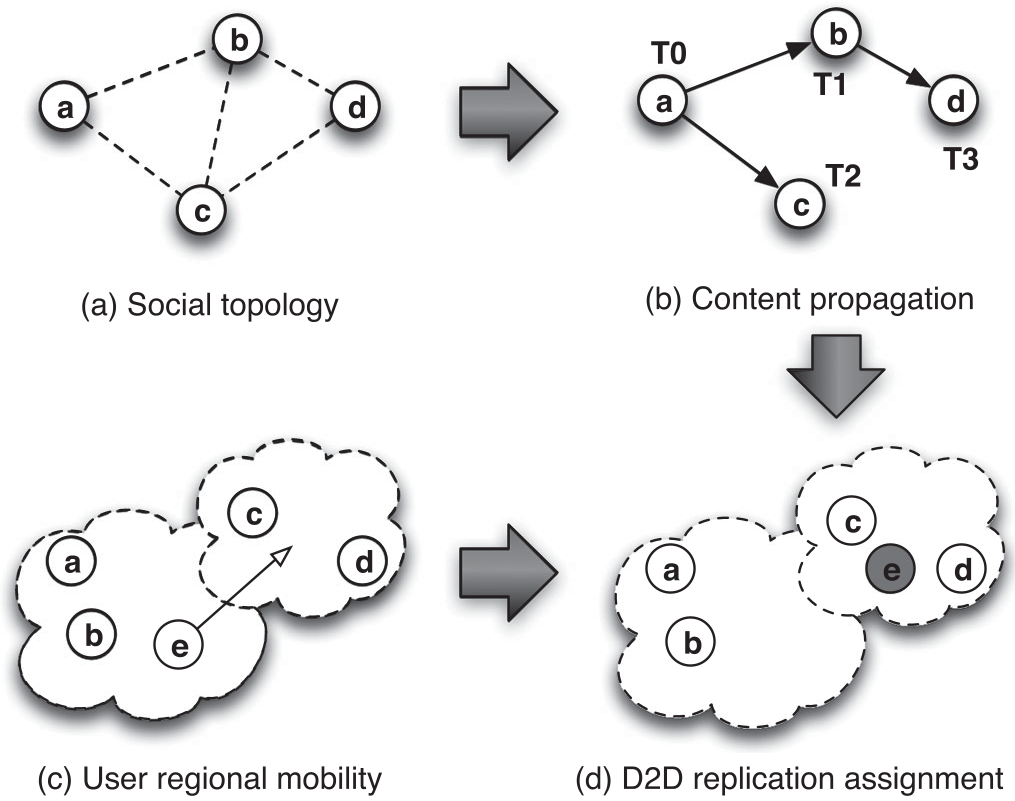 Figure 1: The synergy between social propagation (online) and user mobility (offline) for D2D content delivery.
Experiments & Results: Real-World Validation
The authors validated their model using two massive real-world datasets:
- Tencent Weishi: 450,000 short videos and 240,000 social users.
- NextWiFi: Mobility traces of 300,000 users in a major shopping mall.
Key Performance Breakthroughs
The "Propagation- and Mobility-Aware" (PMA) strategy was compared against strict "Movement-based" (contact-heavy peers) and "Popularity-based" (caching the most-viewed) baselines.
- Indoor Advantage: In dense shopping mall environments, PMA outperformed movement-based strategies by 400%. This is because indoor movement is structured, and social interactions are highly localized.
- Outdoor Performance: In city-scale scenarios, PMA still maintained a significant lead, though the gap narrowed as distances between "friends" increased.
- Efficiency: The system reached 80% of its maximum potential by only tracking a small fraction of the "top" content, proving its scalability.
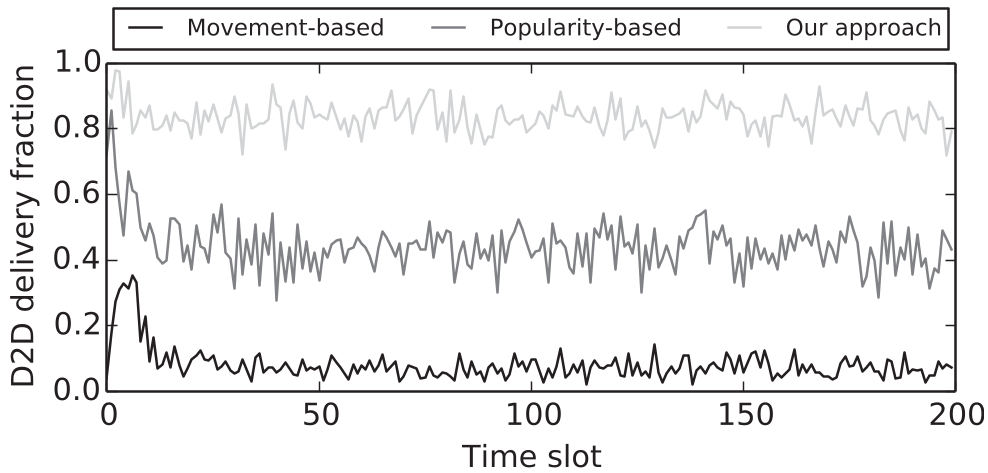 Figure 2: PMA consistently outperforms traditional replication schemes across different time intervals.
Critical Insights & Future Outlook
Takeaways
- Context is King: D2D efficiency isn't just about signal strength; it's about predicting the "information demand" at the user's destination.
- Unpopular is the New Popular: Most social media content is "unpopular" globally but "hot" locally. D2D is perfectly suited for this long-tail distribution.
Limitations
The study relies on a "Coordinate Server" to manage metadata. In a fully decentralized future, this coordination might need to happen via Blockchain or local mesh discovery. Furthermore, user "altruism" (willingness to use battery/storage for others) remains a behavioral hurdle that requires robust economic incentives.
Conclusion
By treating the social graph and the physical map as a unified coordinate system, Wang et al. have provided a blueprint for the next generation of social-aware edge networking. As we move toward 6G and ubiquitous IoT, these "Propagation-Aware" strategies will be essential for keeping our networks from buckling under the weight of hyper-local social media.