
PTLN: Beyond Direct Friends — Unleashing High-Order Social Influence for Better Recommendation
Propagation-Aware Social Recommendation by Transfer Learning
The paper introduces the Propagation-aware Transfer Learning Network (PTLN), a social-aware recommendation framework that leverages high-order social relations via transfer learning. By mining multi-order connections and common knowledge across social and item domains, the authors achieve SOTA performance in ranking accuracy, particularly for cold-start users.
TL;DR
Researchers have long known that our friends' tastes influence our own, but what about the friends of our friends? Most social recommendation systems stop at direct connections. PTLN (Propagation-aware Transfer Learning Network) breaks this barrier by propagating influence through high-order social networks using an ingenious mix of Order Bias and Domain Transfer Learning, achieving double-digit gains in recommendation accuracy for sparse datasets.
The "First-Order" Myopia in Social Recommendation
Data sparsity is the "final boss" of recommendation systems. While social-aware models attempt to solve this by assuming friends share interests, they typically only look at direct (1st-order) edges.
Consider this: You might have a direct friend who follows you for professional reasons but has completely different hobbies. Meanwhile, a "friend of a friend" (2nd-order) might be part of the same niche cycling club. Ignoring these higher-order connections means leaving valuable preference signals on the table. However, simply adding more friends creates a "noise" problem—how do we differentiate the influence of a close friend from a distant contact?
Methodology: High-Order Propagation meets Order Bias
The PTLN architecture addresses these challenges through two primary stages: the Propagation Layer and the Prediction Layer.
1. The Propagation Layer (The "How")
Instead of treating all social connections as a flat graph, PTLN treats the network as a series of circles:
- Attention-based Aggregation: Within each order (e.g., all 2nd-order friends), the model uses an attention mechanism to determine which "friend of a friend" is actually relevant to the target user's tastes.
- Order Bias: This is a critical innovation. The model introduces a learnable bias term for each order . This allows the network to automatically learn that 1st-order friends might generally be more influential than 3rd-order ones, or vice versa, effectively tuning the "attenuation" of influence.
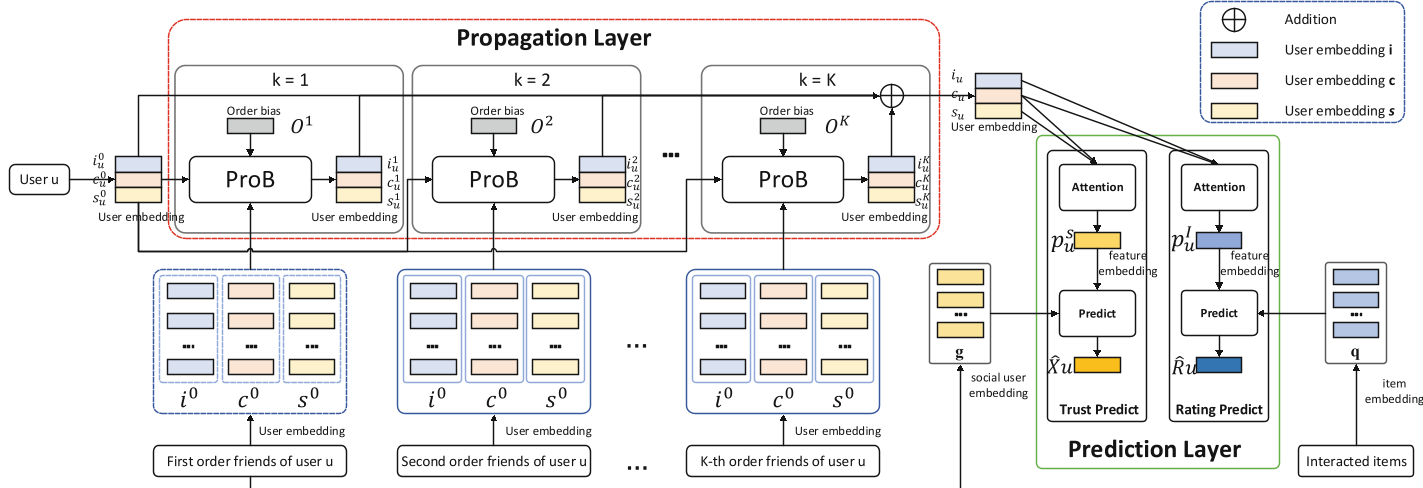 Figure 1: The PTLN framework, illustrating how social propagation flows into the transfer learning prediction head.
2. Domain-Aware Transfer Learning
The model splits user embeddings into three parts: Common Knowledge (shared), Social-Specific, and Item-Specific. To prevent the model from overfitting on sparse data (a common pitfall in social domains), the authors introduced a Novel Regularization term. This term forces the shared latent factors to maintain a meaningful structural relationship with domain-specific factors, acting as a bridge that stabilizes the learning process.
Experimental Results: Slaying the Baselines
PTLN was tested against heavyweights like BPR, NCF, SAMN, and EATNN on the Ciao and Yelp datasets.
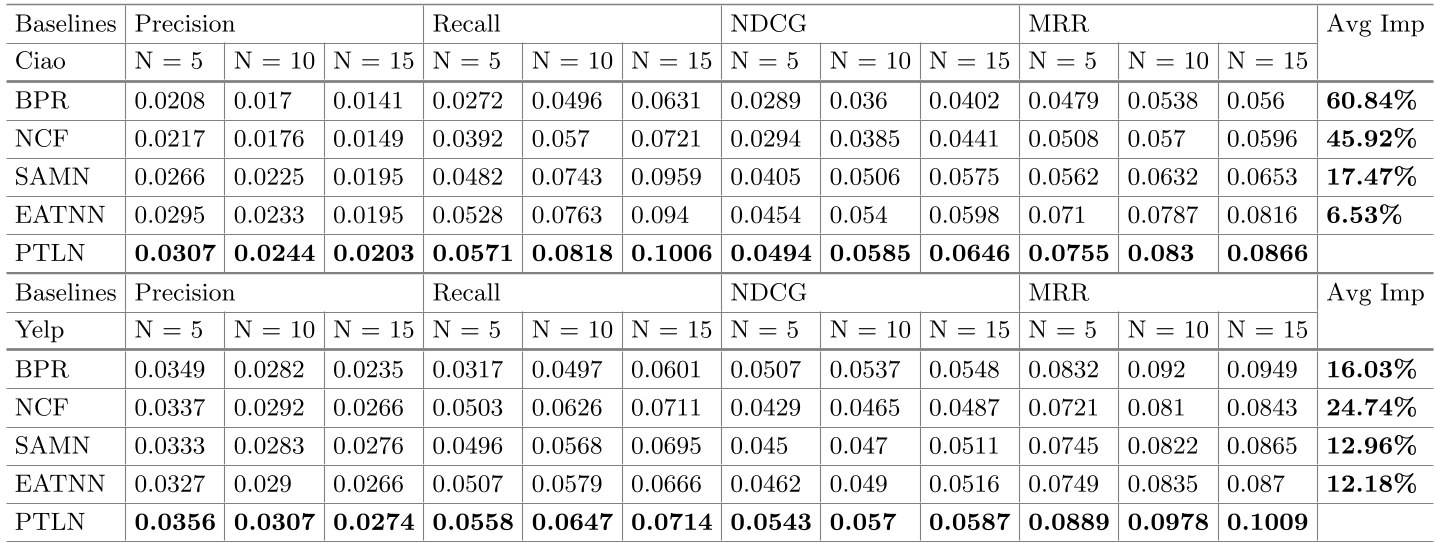 Figure 2: Performance metrics across Ciao and Yelp. PTLN consistently takes the lead.
Key Breakthroughs:
- Propagation Depth: The researchers found that the sweet spot for propagation is . Going to actually introduced too much noise, leading to a performance drop.
- Efficiency: By utilizing a whole-data based training strategy, PTLN balances high-order complexity with computational feasibility.
- Cold-Start Mastery: The model showed significant improvements for users with very few item interactions, proving that higher-order social signals can effectively replace missing historical data.
Critical Insight: Why Order Bias Matters
The most interesting takeaway from the ablation study is the impact of Order Bias. Without it (PTLN-O), the model’s ability to differentiate the "strength" of social circles vanishes. Order Bias provides the inductive bias necessary for the model to understand the physical reality of social networks: influence decays and changes as it travels distances.
Conclusion: A New Standard for Social-Aware Learning
PTLN proves that the "social signal" is much deeper than our immediate friend list. By combining high-order propagation with a sophisticated transfer learning regularization, it provides a robust blueprint for the next generation of social recommender systems.
Future Directions: Could this propagation logic be applied to heterogeneous graphs where "orders" consist of different entity types (e.g., users -> brands -> items)? The framework's flexibility suggests a resounding yes.