
Counteracting the Viral Crisis: Optimal Node Selection for Competitive Information Propagation
The Propagation of Counteracting Information in Online Social Networks: A Case Study
This paper investigates the competitive propagation of negative and positive information within Twitter social networks, specifically focusing on the "United Airlines incident" dataset. It proposes a strategy using Eigenvector and Betweenness centrality for selecting seed nodes to effectively spread counteracting positive information, achieving significantly faster coverage than random selection.
TL;DR
In the digital age, negative news travels fast, but positive counter-information can catch up. This study demonstrates that by using Eigenvector and Betweenness Centrality to pick "seed" users, organizations can effectively neutralize negative information even if they start with a significant time delay. Using a Twitter dataset from the infamous "United Airlines incident," the researchers show that strategic selection can expand the critical "response window" by nearly 4.5x compared to random strategies.
The "Reaction Window" Dilemma
When a PR crisis breaks out on social media, the negative narrative often has a head start (the "lead time"). For organizations, the challenge isn't just what to say, but whom to engage to spread the counter-narrative.
Existing research often treats information spread in a vacuum. However, real social networks are battlegrounds for competing narratives. The authors identify a crucial pain point: Limited Budget and Time. You cannot pay every influencer, and you cannot react instantaneously. The research asks: How long can you afford to wait, and which specific nodes should you activate to ensure the positive message still wins?
Methodology: Mapping the Influence Battlefield
The researchers built a user-to-user connectivity network by scraping roughly 855,000 tweets. They moved beyond simple "followers" and used interaction-weighted edges:
- Replies (Weight 1000): High-intensity interaction.
- Mentions (Weight 10): Lower-intensity link.
To model the spread, they utilized the Independent Cascade Model (ICM). In their "Double Propagation" simulation, negative information starts at from a random source, while positive information starts at from selected seeds.
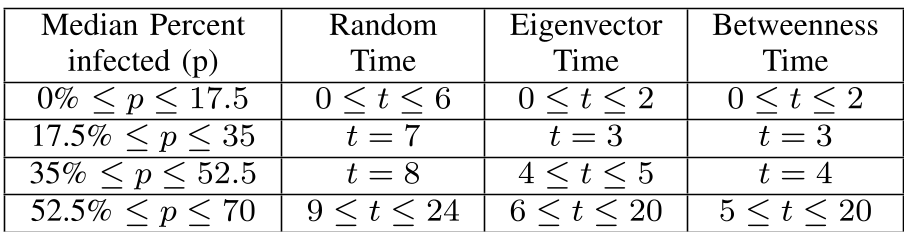 Table 1: Time units required to reach specific infection thresholds. Note how Centrality methods reach 50%+ coverage significantly faster than Random.
Key Insights: Centrality vs. Chaos
1. Speed Matters, but Strategy Wins
As shown in the "Single Propagation" tests, Eigenvector and Betweenness centrality selection outperformed random selection by a "fair margin." While random seeds struggled to gain traction early on, centrality-based nodes triggered exponential growth almost immediately (see Table 1).
2. Buying Time with Better Nodes
The core of the study lies in the Max Positive Start Time. This is the "deadline" for the counter-information to be released while still achieving a higher total infection count than the negative news.
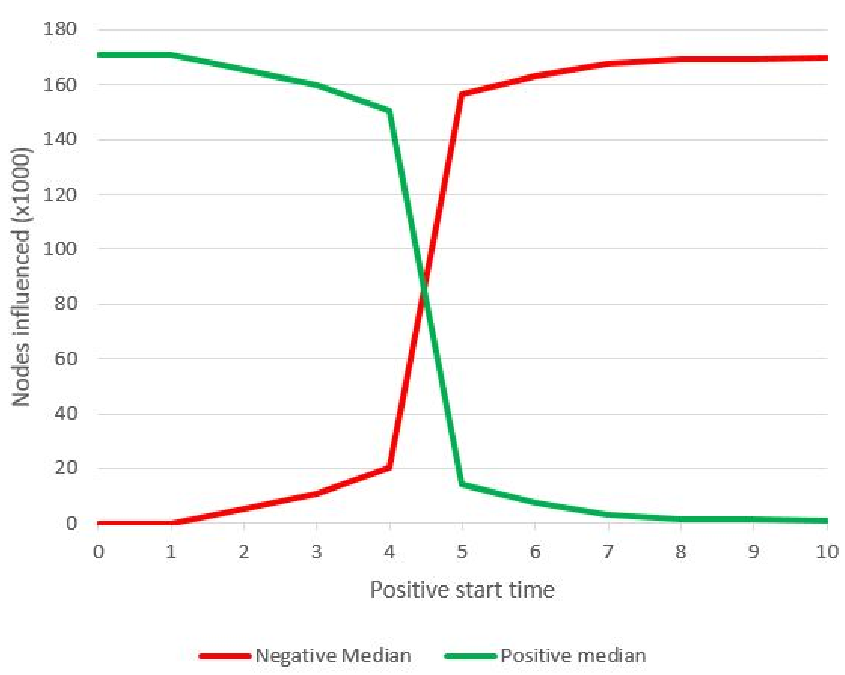 Figure 4: Median infected nodes when positive information is seeded via Eigenvector Centrality. Even with a delay, the positive curve (Blue) can overtake the negative curve (Orange).
- The Power of 10: With a budget of 10 nodes, a Random strategy gives you a window of only . Using Eigenvector Centrality, that window expands to .
- Efficiency: A single top-eigenvector node is more effective (window of ) than 10 random nodes (window of ).
3. The Budget-Window Correlation
The research quantitatively proves that increasing the selection budget (number of seed nodes) linearly increases the allowed response delay. This provides a mathematical basis for marketing and PR departments to allocate resources during a crisis.
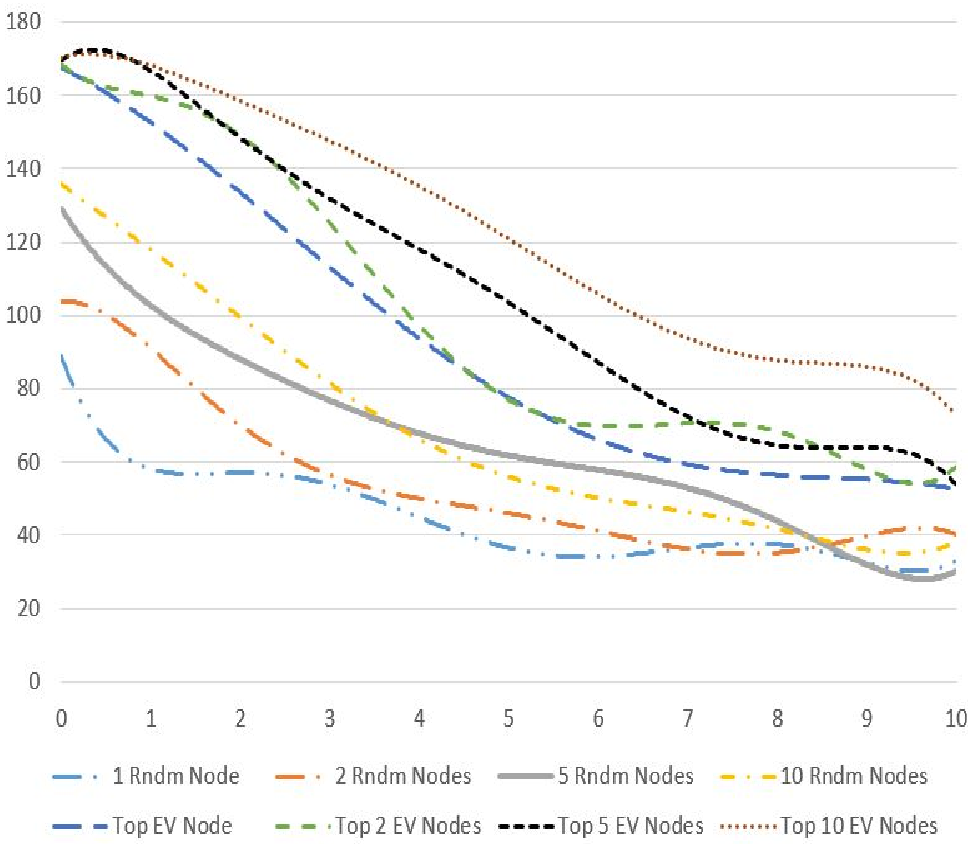 Figure 5: Total positive infections across different delays. Eigenvector methods consistently maintain higher impact as the delay increases.
Critical Analysis & Future Outlook
Takeaway for Practitioners: Don't just "blast" information. In a crisis, the topology of your response network is your most potent weapon. Prioritizing users with high "Betweenness" (those who act as bridges between communities) or high "Eigenvector" scores (those connected to other influential people) is the most efficient way to counteract virality.
Limitations:
- The "One-Off" Assumption: The model assumes once a user "accepts" one side (positive or negative), they never change their mind. In reality, people are influenced by the volume and frequency of both sides.
- Network Staticity: The snapshot is a "frozen" moment. Real-world social networks evolve their edge weights dynamically during a crisis.
Future Work: The authors suggest incorporating "change-of-mind" mechanics based on the ratio of information received. This would move toward a more realistic, "fluid" model of social opinion dynamics.