
SE-Botnets: Decoding the Math Behind Social Engineering Viral Infection
A Propagation Model for Social Engineering Botnets in Social Networks
This paper introduces the concept of the SE-botnet, a high-infection botnet that leverages social engineering attacks (SEA) to spread via social networking services. The authors propose an analytical propagation model using semi-Markov chains that integrates social network topology, human dynamics (waiting time distributions), and cross-platform multi-domain behaviors.
TL;DR
Botnets are evolving from simple automated scans to sophisticated social predators. This paper defines the SE-botnet, a malware strain that spreads via social engineering on platforms like Facebook and Twitter. By modeling human "waiting times" and cross-platform user behavior, the authors developed a propagation model that predicts botnet growth with over 95% accuracy, revealing that these networks can hijack 10,000+ nodes in just 24 hours.
Background: The Human Vulnerability
Most cybersecurity models treat infection like a biological virus—purely a matter of contact and probability. However, Social Engineering (SE) relies on the "Human Factor." An SE-botnet doesn't just scan for open ports; it crafts "Trap Messages" that exploit trust. The effectiveness of such a botnet isn't just about code—it's about the victim's social circle and their digital habits.
The Propagation Logic: Why it Works
The authors break down the SE-botnet lifecycle into a 4-step feedback loop:
- Fabrication: Creating the bait (links or attachments).
- Command: The Botmaster instructs existing bots to spread the bait.
- Impersonation: Bots hijack the user's identity to message friends.
- Response: Friends decide to trust (infect) or drop (immune).
The Mathematical Insight: Waiting Time vs. Multi-Domain Growth
Two critical components set this model apart:
- Human Dynamics: The time a user takes to check a message () isn't random. It follows a heavy-tailed distribution (), meaning while most respond quickly, a long tail of users responds much later, sustaining the infection wave over time.
- The Multi-SN Node: Modern users are "bridges." If you're on both Twitter and Gmail, the bot uses you to leapfrog from one platform's contact list to another.
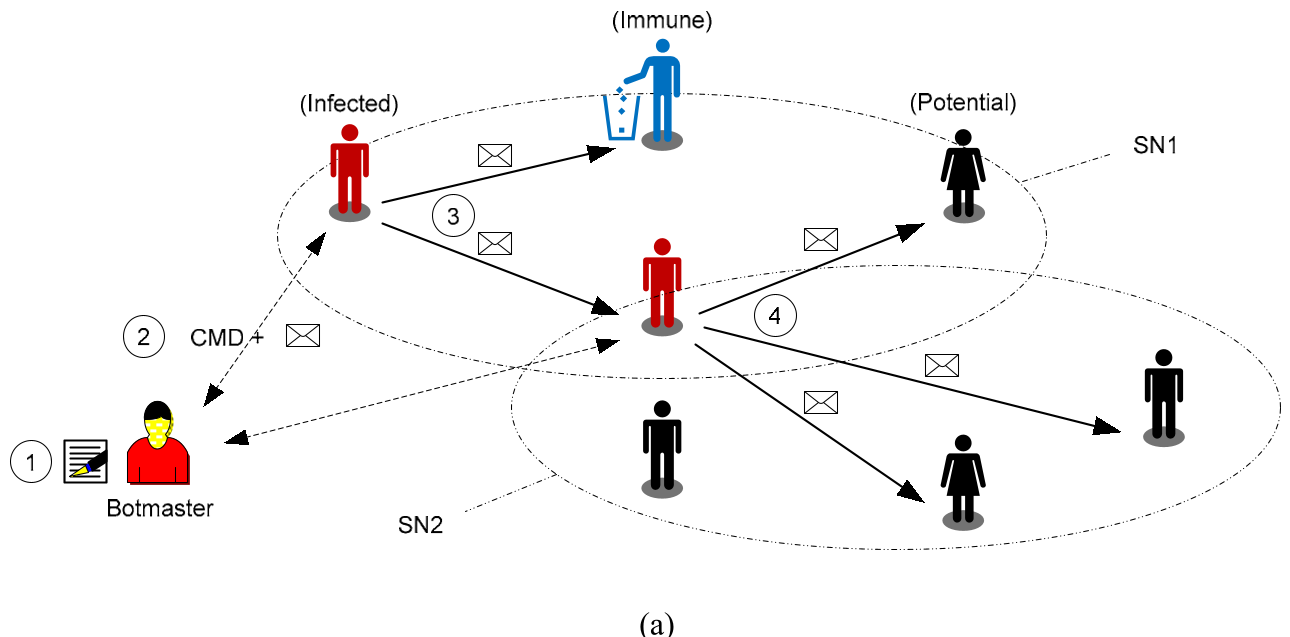 Figure 1: The 4-step social engineering infection process (left) and the heavy-tailed distribution of human response times (right).
Methodology: The Semi-Markov Approach
The core of the paper is the infection probability formula:
eq i} (1 - \alpha_{j i} p_{j, t - t_{wi}})$$ This states that an individual's probability of staying healthy ($1-p_i$) depends on their previous state and the likelihood of ignoring messages from all infected friends ($j$). The variable $\alpha_{ji}$ is the "Relationship Parameter," which acts as a binary switch—if two users are friends and both are online, the bridge for infection exists. ## Experimental Validation To prove their theory, the authors compared their MATLAB mathematical results against **OverSim**, a heavy-duty network simulator. * **Speed of Infection**: The research found that the number of "multi-domain users" is the primary accelerator. Even a small increase in users who bridge multiple social networks leads to an exponential surge in infection speed. * **Accuracy**: The gap between the mathematical model and the simulation was less than 5%, proving that the semi-Markov chain effectively captures real-world botnet behavior. 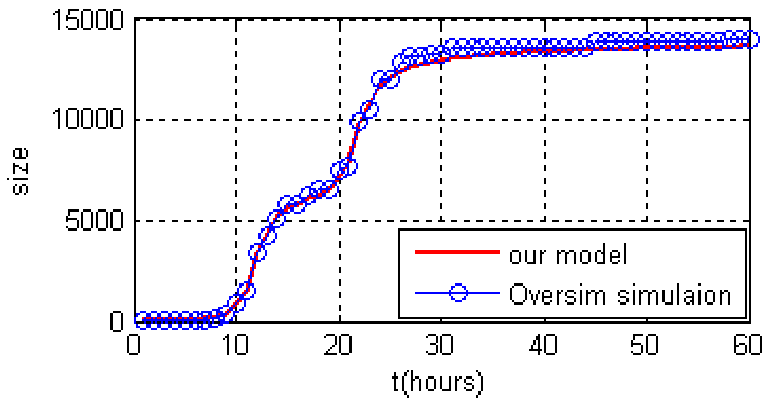 *Figure 2: The high alignment between the mathematical prediction (Equation) and the simulation (OverSim).* ## Critical Insights & Future Outlook This paper serves as a warning for the SNS era. The primary takeaway is that **isolation is the enemy of the botmaster.** As users link more accounts (Social Login, cross-posting), they inadvertently create high-speed "super-highways" for malware. **Limitations**: The model assumes a static infection rate (0.7) and doesn't fully account for varying levels of "security awareness" across different demographics. **Future Work**: The next frontier is **Joint Detection Systems**. If a bot starts spamming on Twitter, the defense mechanism should immediately flag that user's linked accounts on other platforms to preemptively "quarantine" the potential bridge. *** **Takeaway for Professionals**: Understanding the topology of social trust is now as important as understanding the topology of the TCP/IP stack.