
Propagator or Influencer? Unveiling the Emotional Engine of Viral Cascades
Propagator or Influencer? A Data-driven Approach for Evaluating Emotional Effect in Online Information Diffusion
This paper proposes a data-driven framework to evaluate how the fine-grained emotional status of information "propagators" (retweeters) influences online information diffusion. Utilizing 22 million retweets from Sina Weibo, the authors demonstrate that integrating specific emotional categories significantly enhances the prediction of reposting probability, popularity, and speed.
TL;DR
Why do some posts go viral while others die out? This research shifts the spotlight from the original "influencer" to the "propagator"—the person who retweets. By analyzing over 22 million Sina Weibo records, the study proves that fine-grained emotions (like anger, disgust, or surprise) are better predictors of a post's future than just counting a user's followers.
The Missing Link: The Propagator's Voice
In the traditional view of social media, we focus on the "source." We assume a post's success depends on the author's fame or the initial message. However, information spreads through cascades.
The authors argue that the "propagator"—the person who adds their own comment while sharing—acts as a secondary gatekeeper. Their emotional stance (Are they angry? Surprised? Sad?) creates a psychological trigger for the next person in line.
Methodology: Decoding the "Sina Weibo" Emotional DNA
To capture these nuances, the researchers moved beyond simple "Positive/Negative" sentiment analysis. They targeted six basic human emotions: Happiness, Anger, Sadness, Fear, Disgust, and Surprise.
1. The Hybrid Sentiment Engine
They combined a traditional Chinese emotion lexicon with 98 frequently used Weibo emojis. Because silent retweets are common, they applied Emotion Contagion Inference: if you retweet without a comment, you likely share the emotion of the person you retweeted from.
 Note: The study visualizes how propagators bridge the gap between initial posts and widespread cascades.
2. Identifying "High-Infectivity" Emotions
The findings challenge common intuition. While "Happiness" is the most common emotion shared (38.66%), it doesn't always have the highest diffusion capacity.
- Anger (Explicit): Shows the strongest infectivity, making a post highly likely to be reshared.
- Surprise: Helps information spread through longer chains (greater depth).
- Happiness: Often results in "explicit echoes"—meaning people reply with more happy comments but don't necessarily drive the cascade as aggressively as "Negative" triggers.
Experimental Results: Better Predictions
The authors used Gradient Boosting Decision Trees (GBDT) to test their features. By adding fine-grained emotional data to standard features (follower counts, hashtags, time of day), the prediction performance saw a significant boost.
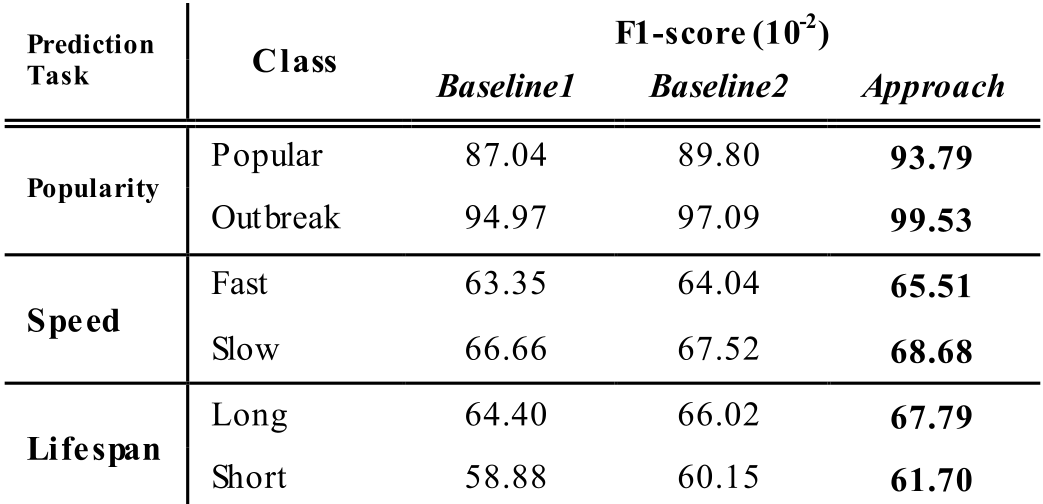
Key Metrics:
- Popularity Prediction: Achieved a 93.79% F1-score for "Popular" posts.
- Outbreak Detection: Reached 99.53% accuracy in identifying posts that would explode in volume.
- Lifespan & Speed: Fine-grained emotions were particularly effective at predicting whether a post would be a "flash in the pan" or have a long-lasting presence.
Critical Insight: Why Does This Matter?
This paper confirms a cynical but vital truth about social networks: Emotions are the currency of attention. Specifically, the way a propagator "repackages" information with an emotional label (e.g., an angry comment) is a primary driver of virality.
Limitations & Future Work
While the study is robust, it primarily focuses on text and emojis. Future research will need to tackle multi-modal content—how does an angry caption on a "happy" video influence sharing? Furthermore, the "Contagion Inference" assumes agreement, but sometimes people retweet to "hate-watch" or disagree, a nuance that requires further linguistic modeling.
Final Takeaway
If you want to understand virality, stop looking at the "Who" and start looking at the "How they feel." The propagator's emotion is the real catalyst that turns a single post into a global trend.