
Artificial Personality (AP): Engineering "MOE" Through Vulnerability and Requests
Proposal and Development of Artificial Personality with Requesting Mechanism
This paper introduces the "Artificial Personality" (AP), a novel approach to human-computer interaction that eschews autonomous learning in favor of a manually designed "requesting mechanism." Built within the context of Japanese "OTAKU" and "MOE" culture, the AP achieves "human-like qualities" by proactively asking users for help, shifting the AI's role from a passive tool to an interactive, relatable companion.
TL;DR
While Silicon Valley races towards "perfect" autonomous AI, researchers at Toyo University are taking a contrarian path. They have proposed Artificial Personality (AP)—a system that abandons autonomous learning for manually designed interactions. Its secret weapon? A "Requesting Mechanism" that makes the AI ask the user for favors, triggering a psychological bond known as "MOE" and creating a more human-like experience than Siri or Pepper ever could.
Problem: The Efficiency Trap of Modern AI
The hallmark of modern AI (like Siri or Pepper) is its goal to be a "substitute" for human capabilities. However, this focus on efficiency often results in a "machinery" feel. The paper cites a sobering statistic: nearly 50% of Siri users barely use the service. Why? Because these systems are reactive and cold. They lack the "imperfection" and "vitality" that define human relationships.
The authors argue that autonomous learning algorithms actually hinder human-like qualities by generating awkward, repetitive, or context-deaf responses that break the illusion of personality.
Methodology: Designing Personality (AP vs. AI)
The researchers shift the paradigm from "AI as a servant" to "AP as a companion." The architecture is built on two pillars:
1. The Perfect Response Dictionary
Instead of relying on a learning model that might hallucinate or sound robotic, the AP uses a library of 1000+ handcrafted reaction words validated by 71 "OTAKU" consultants. This ensures that the response matches the "perfect" emotional tone for the target demographic.
2. The Requesting Mechanism (The "MOE" Factor)
This is the core innovation. Unlike traditional AI that waits for a command, the AP proactively enters "Requesting Mode."
- The Logic: By asking the user to help—such as creating a reminder for the AP itself—the system creates a sense of pseudo-reliance.
- The Result: The user feels "needed." In Japanese subculture, this trigger of protective affection is called "MOE." As the user fulfills requests, a "reliance point" increases, making the AP's reactions more casual and familiar over time.
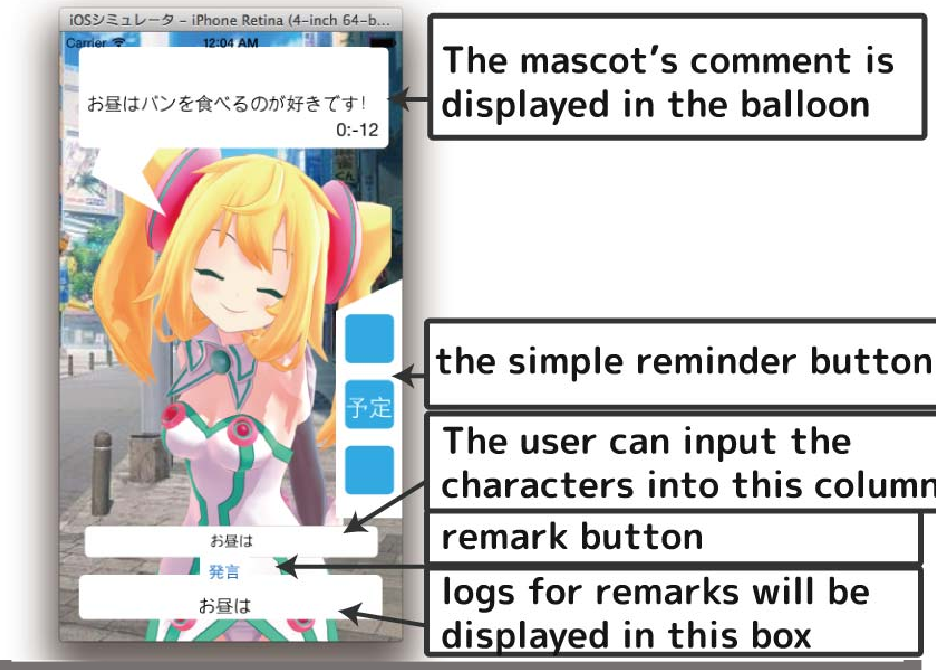 Figure 1: The Main Mode interface featuring an anthropomorphic mascot that uses animation to deepen the sense of humanity.
Experiments: Human-Like Qualities over Math
The authors conducted a survey to see if this "low-tech but high-touch" approach outperformed sophisticated AI.
Key Findings:
- Affection: Over 85% of users (61 out of 71) felt strong affection (MOE) for the AP system.
- Humanity: 91% of respondents (65 out of 71) felt the AP was more "human-like" compared to existing AIs.
 Table 1: Quantitative results showing overwhelming "Strongly Yes" and "Yes" responses for the AP's emotional impact (Q1-Q3).
The "requesting" gimmick fundamentally changed the user's perception of the software from a "tool" to a "persona."
Critical Analysis & Conclusion
The AP approach is a fascinating critique of current AI trends. It suggests that Inductive Bias (in this case, cultural tropes like MOE) can be more important than Model Scale when the goal is emotional companionship.
Limitations:
- Scalability: Manually writing 1000+ responses is labor-intensive (the "manual steps" mentioned by the authors).
- Monotony: Currently, the system only has a few types of requests (mainly reminders), which can become predictable.
Future Outlook:
The researchers plan to expand the AP's utility—adding notepad and mail functions—while maintaining a balance so the requests are "not too challenging" but provide a "feeling of accomplishment" for the user. This work paves the way for a future where AI isn't just a tool we use, but a personality that relies on us, effectively "humanizing" code through calculated vulnerability.
Takeaway: To make an AI feel human, don't make it perfect—make it need a hand.