
Transinopia: Architecting a Post-Capitalist Future via Collective AGI
Proposed Collective ICOM-based post-scarcity/post-capital networked communities
The paper introduces Transinopia, a technology-augmented, post-scarcity/post-capital socioeconomic framework. It proposes a multi-year field trial of networked, self-sufficient enclaves governed by a Collective Artificial General Intelligence (cAGI) based on the Independent Core Observer Model (ICOM) to eliminate poverty and wage-based labor.
TL;DR
Transinopia is a radical proposal to move beyond the "capital-scarcity" trap by establishing technology-augmented, self-sufficient enclaves. Unlike previous utopias, it leverages the Independent Core Observer Model (ICOM) to create a Collective Artificial General Intelligence (cAGI) that acts as a prosocial glue for communities, using advanced tech like 3D printing and synthetic biology to render wage labor obsolete.
Deep Dive into the Motivation: The Neurobiology of Scarcity
The paper argues that H. sapiens behavioral expressions—rooted in evolutionary neurobiology—have trapped us in a cycle of alpha-dominance and resource hoarding. Current political economies assume capital is a fundamental law of nature. However, with anthropogenic trends (climate change, AI automation) reaching an irreversible inflection point in 20-30 years, the author asserts that sticking to capitalism is a recipe for biosphere collapse.
The core insight is that scarcity isn't just a resource problem; it's a structural and cognitive one. To solve it, we need an "off-grid" polity that exists in parallel with capitalism without directly confronting it, thereby avoiding the traditional in-group/out-group resistance.
Methodology: The Transinopia Framework
The backbone of this proposal is the integration of high-level cognitive architectures with physical self-sufficiency.
1. ICOM and cAGI: The Ghost in the Community Machine
The Independent Core Observer Model (ICOM) is not a standard "if-then" AI. It is designed to generate subjective emotional experiences. By using ICOM as the basis for a Collective AGI (cAGI), the system manages enclave resources based on "how it feels" about decisions, aiming for an AI that exhibits empathy and critical thinking rather than cold optimization.
2. The Tech Stack of Self-Sufficiency
To achieve a post-scarcity state, these enclaves utilize a "portfolio of advanced technologies":
- Manufacturing: 3D/4D printing for housing and infrastructure.
- Biotech: Synthetic genomics to create on-demand organisms for environmental remediation.
- Energy/Food: Kinetic energy harvesting, spray-on solar cells, and closed-loop vertical farming (Aquaponics).

Experiments: The Trial Path
The author outlines a rigorous clinical trial approach:
- Phase I: 5-10 enclaves with up to 20 inhabitants to test basic structural viability.
- Phase III: Scaling to 250 inhabitants—the upper limit of stable human social groups (based on the neocortex size constraints).
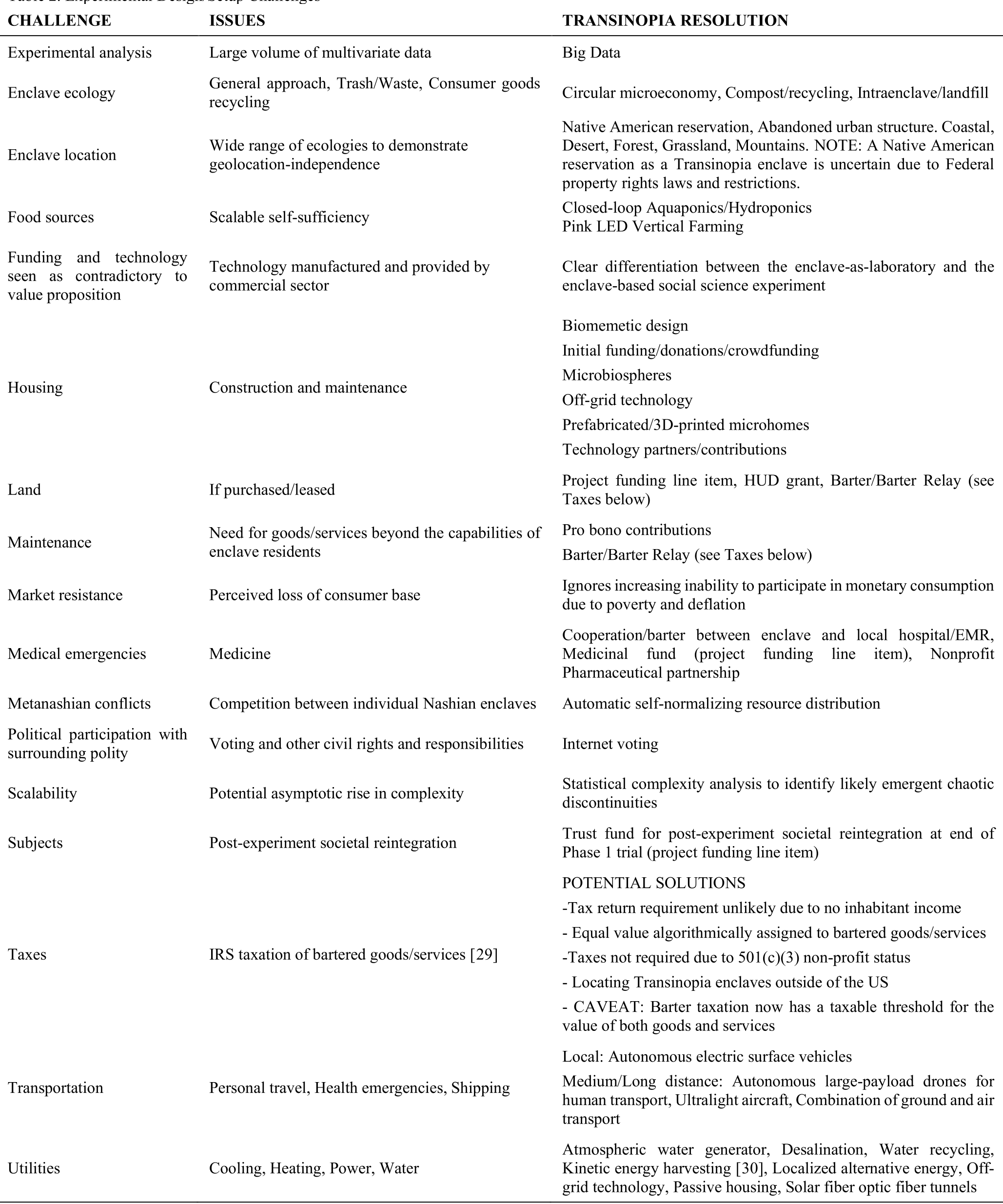
The paper provides a comprehensive "Resolution Table" addressing potential failures like "Metanashian conflicts" (competition between enclaves) and tax implications, suggesting that the IRS cannot tax income if no income exists.
SOTA Comparison: Why This is Different
Compared to the Venus Project or the Technocracy Movement, Transinopia is:
- Clinical: It treats the enclave as a scientific experiment rather than a political movement.
- Parallel: It doesn't call for the abolition of the current state; it simply builds a more efficient alternative "outside" the system.
- AGI-Governed: It acknowledges that human bias is the primary failure point of communes and uses a human-analogous AI to maintain balance.
Critical Analysis & Conclusion
Takeaway: Transinopia represents a bold synthesis of BICA (Brain-Inspired Cognitive Architecture) and socio-economics. It posits that post-scarcity is a technological achievement rather than a legislative one.
Limitations: The reliance on "pro bono" contributions and technology manufactured by the commercial sector (Apple, Google, etc.) creates a "dependency paradox." If the enclave relies on a 4D printer from a capitalist corporation, is it truly post-capital? Furthermore, the psychological profile required for inhabitants is extremely narrow, potentially limiting the "scalability" of the empathy-driven model.
Future Outlook: If the Phase I trials succeed, we might see the emergence of a new "E-governance" model where AI serves not as a surveillance tool, but as a facilitator of human thriving in the face of ecological collapse.