
Protected Chords: Decentralizing Social Networks via Browser-Native P2P
Protected chords in the web: secure P2P framework for decentralized online social networks
This paper introduces "Protected Chords in the Web," a secure, browser-to-browser P2P framework for Decentralized Online Social Networks (DOSNs) using WebRTC. By heavily modifying the OpenChord DHT protocol to work in a browser environment, it enables installation-free, encrypted social interactions including chat, buddy lists, and audio/video streaming.
TL;DR
Researchers Andreas Disterhöft and Kalman Graffi have developed a framework that bridges the gap between the privacy of Peer-to-Peer (P2P) networks and the convenience of web browsers. By integrating a secure version of the Chord Distributed Hash Table (DHT) with WebRTC, they created a decentralized social network that requires zero installation, provides end-to-end encryption, and maintains performance levels suitable for real-time video streaming and messaging.
Motivation: The Centralization Trap
Traditional social networks act as "walled gardens." While they offer ease of use, they centralize power, making user data vulnerable to mass surveillance, censorship, and commercial exploitation. P2P solutions solve this by distributing data across users, but their Achilles' heel has always been friction—users simply don't want to download and install specialized software. The authors' insight is to move the P2P logic directly into the browser, leveraging WebRTC (Web Real-Time Communication) to turn every tab into a network node.
Methodology: Engineering "WebChord"
At the heart of the system is a modified version of the OpenChord protocol, dubbed WebChord. The transition from a standalone application to a browser environment required several architectural breakthroughs:
- Device Independence via ECC: Traditional P2P nodes often rely on IP addresses or local file IDs. WebChord generates an Elliptic Curve Cryptography (ECC) key pair directly from user credentials (username/password). This allows a user to "log in" from any device and maintain their unique DHT identity.
- Secure DHT Entry Types: To prevent data tampering, the authors implemented three levels of data storage:
- Unsigned: Publicly modifiable (rarely used).
- Signed: Verifiable by others; only the author can modify.
- Signed Encrypted: Encrypted by the author’s public key, ensuring absolute privacy for chat histories and contact lists.
- Single-Threaded Adaptation: Since browsers run JavaScript in a single-threaded event loop, the authors had to remove standard threading from the original Chord implementation and replace it with an event-driven callback model using the Google Web Toolkit (GWT).
Performance and Practicality
Can a browser-based P2P network actually handle the heavy lifting of a social network? The authors evaluated the framework across 50 nodes under realistic user behavior models (simulating planet-scale instant messaging traffic).
Key Metrics:
- Response Time: User actions (like sending a message) took about 1.0 second to reflect, which is acceptable for decentralized systems.
- Bandwidth Efficiency: Even with AV streaming and constant DHT stabilization, the total traffic per user was only ~44 KBit/s, a tiny fraction of modern broadband capacity.
- Crypto Overhead: Security didn't break the CPU. Cryptographic tasks only took about 5.8% of the processing time, preventing the "UI freezing" often associated with heavy web-based encryption.
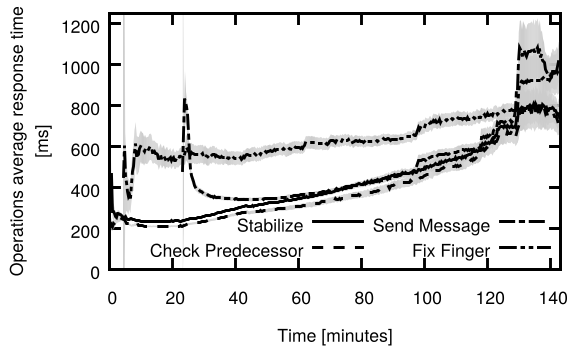 Fig: AV streaming accounts for the majority of traffic (78%), yet remains well within standard bandwidth limits.
Critical Analysis & Conclusion
This paper proves that the "installation barrier" is no longer an excuse for avoiding decentralized social networks. By reimagining the DHT as a browser-first entity, the authors achieved:
- Zero-Installation Deployment.
- Identity-based Security.
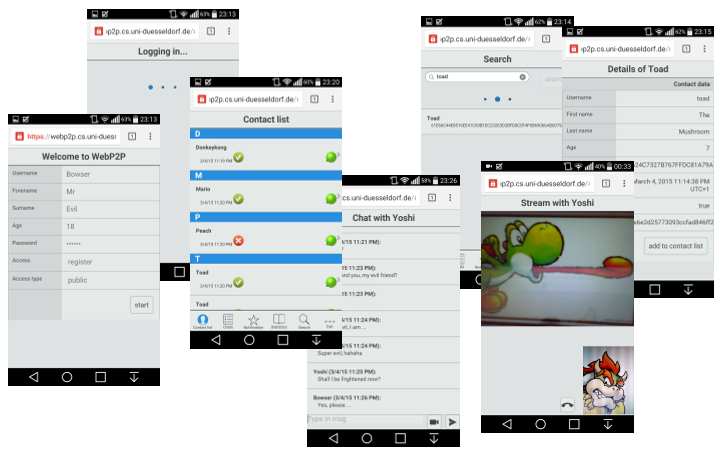
- Cross-platform compatibility (Desktop & Mobile).
Limitations: The current implementation does not support password changes (since the ID is deterministically linked to credentials) and Chord is notoriously sensitive to "churn" (users rapidly joining and leaving).
Future Work: The transition to a more robust overlay (like Kademlia) and the use of Web Workers for background crypto-processing could push this framework from a successful prototype to a viable industry alternative to centralized social giants.
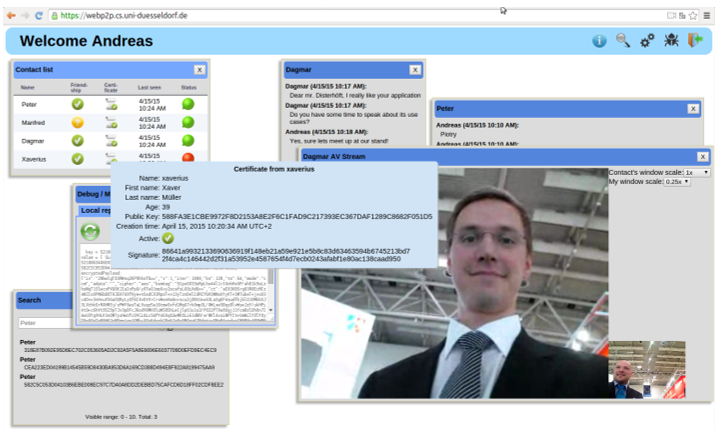 Fig: The researchers successfully implemented functional GUIs for both desktop and mobile platforms.