
Balancing Privacy and Performance: Optimized Task Assignment in Spatial Crowdsourcing
Protecting Location Privacy in Spatial Crowdsourcing
This paper proposes a location privacy protection framework for Server Assigned Tasks (SAT) in spatial crowdsourcing. By integrating peer-to-peer (P2P) spatial K-anonymity with an optimized Maximum Task Assignment (MTA) algorithm, the authors achieve high task completion rates while ensuring worker locations remain cloaked from untrustworthy servers.
TL;DR
Spatial crowdsourcing relies on knowing "where you are" to give you tasks, but revealing your location to a central server is a privacy nightmare. This paper introduces a framework that uses Peer-to-Peer (P2P) Spatial K-anonymity to hide workers in a crowd while using a clever maxT distribution algorithm to ensure that tasks aren't "lost" in overlapping cloaked zones. The result? A system that keeps 90% of the efficiency of a non-private system while keeping the server in the dark about your exact coordinates.
The Conflict: Global Optimization vs. Personal Privacy
In Server Assigned Tasks (SAT) mode, a central server sees every worker and every task, solving a global matching problem. While efficient, the server is often "untrustworthy." If an adversary hacks the server, your movement patterns are exposed.
Prior attempts to solve this used "cloaking areas"—sending a rectangle instead of a point. However, this creates two major technical hurdles:
- Redundancy: Hundreds of overlapping rectangles create massive communication overhead.
- Assignment Ambiguity: If Worker A is hidden in a box that overlaps with Worker B’s box, how does the server know how many tasks to send to that specific region without over-assigning or under-assigning?
Methodology: Cloaking without Chaos
The authors attack this problem with a two-stage pipeline.
1. The V-Cover Selection
Instead of every worker sending their cloaked area to the server, they use a Greedy Algorithm to solve a variation of the Minimum Set Cover problem. They select only the "representative" cloaking areas that cover all workers' spatial regions. This reduces computation drastically.
2. Intelligent Capacity Distribution (Algorithm 1)
This is the "secret sauce." Since a worker's capacity () might belong to multiple overlapping cloaked areas, the paper introduces Task Density (TD)—the average expected tasks in a region.
- They define a surplus parameter .
- If a region has many tasks but few workers (), it's a "thirsty" region.
- Algorithm 1 distributes a worker’s availability to different cloaking areas on a pro-rata basis—sending more capacity to areas that are struggling to fulfill tasks.
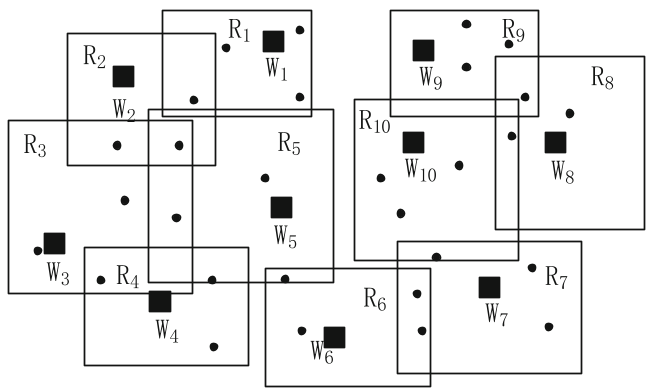 Figure 1: The system architecture showing workers employing P2P K-anonymity before interacting with the SC-server via representatives.
Experimental Validation
Using real-world check-in data from the Gowalla social network (Missouri dataset), the authors compared their SAM (Spatial Assignment Method) against a random distribution approach (SRM) and the theoretical optimal (zero privacy).
- Scaling with Tasks: As the number of tasks increased (from 1,000 to 5,000), SAM's performance remained stable, maintaining roughly 80% of the optimal performance.
- Worker Density: The system actually gets better as more people use it. With more workers, the cloaking areas become tighter and more accurate, increasing the performance from 76% to 84%.
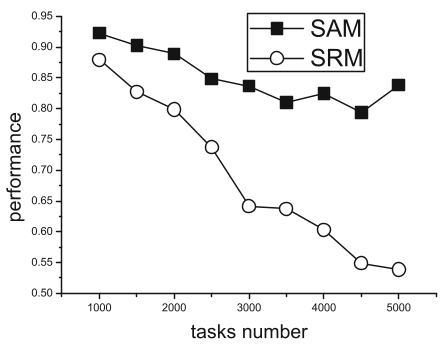 Figure 2: Performance metrics showing SAM (blue) significantly outperforming the random assignment model (red) across various task loads.
Critical Insight
The brilliance of this work lies in recognizing that Privacy is not a binary switch (On/Off). By treating worker availability as a fluid resource that can be mathematically distributed across cloaked areas based on historical task density, the authors overcome the "information loss" inherent in K-anonymity.
Limitations & Future Work
While robust, the current model assumes all tasks are equal. In reality, a "delivery" task is different from a "photo-taking" task. The authors plan to extend this to Heterogeneous Tasks, where assignment logic must account for both location privacy and specific worker skill sets.
Conclusion
This paper provides a blueprint for the next generation of eMarket platforms. It proves that we can have the convenience of spatial crowdsourcing without the "Big Brother" oversight of our every move.