
Beyond Anonymity: Defeating Information Aggregation Attacks in Social Networks
On Protecting Private Information in Social Networks: A Proposal
The paper proposes a holistic framework to define and mitigate "Information Aggregation Attacks" in online social networks. It introduces a "Privacy Monitor" system designed to track unintended data leakage caused by cross-network identity linkage and cumulative information disclosure.
TL;DR
As we navigate between LinkedIn (professional), Facebook (personal), and niche forums (anonymous), we leave a trail of "data crumbs." While each crumb seems insignificant, this paper reveals how an "Honest-but-Curious" observer can aggregate these fragments to reconstruct your entire identity. The authors propose a Privacy Monitor—a strategic dashboard that tracks your real-world data leakage against your personal privacy goals.
The Problem: The "Context" Illusion
Most users operate under a false sense of security called contextual trust. We assume that information shared on LinkedIn stays within the professional context. However, the authors argue that the true context is the Access-Equivalent (AE) Group. If two platforms have the same "Openness Level" (e.g., both are public or both require simple registration), they effectively belong to the same data pool for a motivated observer.
The real danger isn't a single massive leak, but Information Aggregation:
- In-Network: Tracking multiple posts over time to build a profile.
- Cross-Network: Using a "bridge" (like a work email used in a medical forum) to link professional and private identities.
Methodology: Modeling the Leakage
The authors move away from "all-or-nothing" security toward a Discretionary Privacy Model.
1. Defining the Attack Surface
They formalize the attack through Proposition 2 (Maximum Privacy Disclosure). This is a recursive logic: if Set A identifies you and shares an element with Set B, and Set B shares an element with Set C, an attacker now owns the union of A, B, and C.
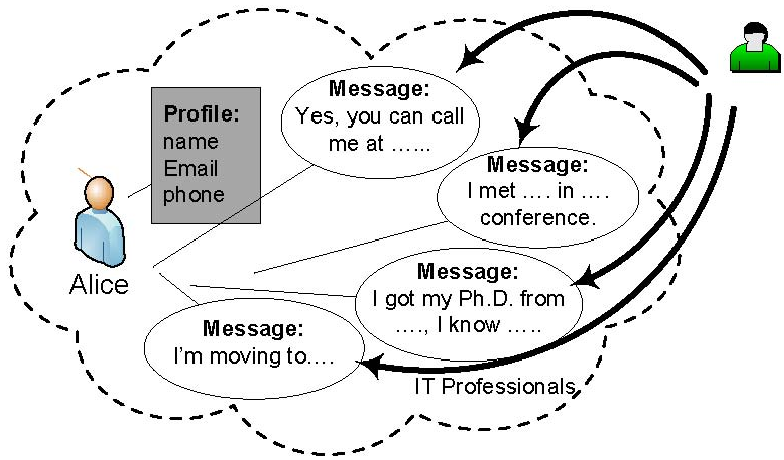 Fig 1. Even small message fragments can be aggregated to reveal a full identity profile.
2. The Privacy Monitor Architecture
The proposed solution acts as a "Personal Privacy Antivirus." It consists of:
- Remote Component: Actively crawls the web and search engine caches to see what an attacker sees.
- Local Privacy Sandbox: Where the user defines their "Privacy Plan"—specifically, which information is allowed to be linked.
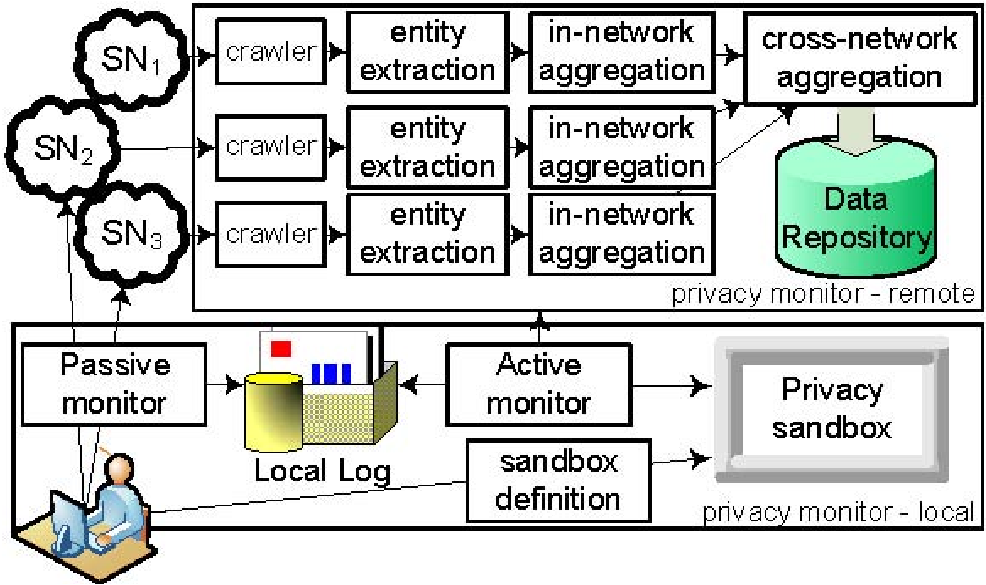 Fig 2. The dual-layered architecture of the Privacy Monitor system.
Critical Insight: The "Honest-but-Curious" Observer
One of the paper’s strongest contributions is the definition of the adversary. Unlike a "hacker" who breaks laws, the Honest-but-Curious observer follows all protocols and terms of service but aggressively mines available data. This highlights a terrifying reality: your privacy can be compromised through perfectly legal means.
Experiments & Results: The Discovery of "Bridges"
The paper demonstrates how identity linkage occurs through common attributes.
- Bridge Discovery: An attacker finds a phone number on a homepage and an email on a medical forum. If they appear together elsewhere, the "bridge" is built.
- Quantifying Disclosure: By calculating the union of connected sets, the authors show that a user’s actual disclosure () is almost always significantly larger than their intended disclosure ().
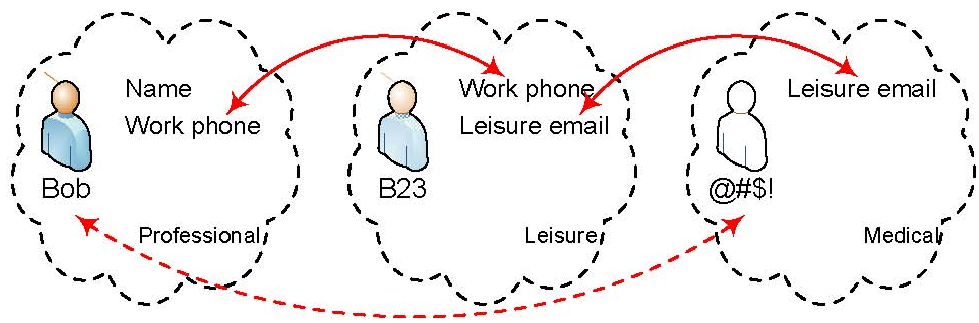 Fig 3. Re-identification across different social contexts via subtle attribute bridges.
Critical Analysis & Takeaways
Summary: This work shifts the focus from "Data Protection" (stopping hackers) to "Privacy Management" (managing self-disclosure). It acknowledges that we must share data to benefit from social networks, but we need tools to understand the cumulative cost of that sharing.
Limitations:
- Scale: Simulating a global "observer" requires massive crawling resources, which might be difficult for a local user tool.
- Ambiguity: The paper assumes exact matching for bridges; however, modern AI can now use "soft matching" (style of writing, interests) to link profiles even without shared emails.
Future Outlook: This 2008-era proposal was far ahead of its time, predicting the current "Identity Layer" crisis. Today, as AI makes re-identification even easier through stylometry and behavioral biometrics, the idea of a "Privacy Sandbox" to monitor our digital footprint is more relevant than ever.