
3LP+: Securing Multi-Dimensional Privacy Against Adversarial Data Mining in Social Networks
Protection of User-Defined Sensitive Attributes on Online Social Networks Against Attribute Inference Attack via Adversarial Data Mining
The paper introduces 3LP+, a multi-layered privacy-preserving technique designed to protect Online Social Network (OSN) users from attribute inference attacks. By extending the 3LP algorithm, 3LP+ offers a coordinated approach to safeguard multiple sensitive attributes simultaneously while maintaining high data utility.
TL;DR
Online Social Networks (OSNs) are a goldmine for attackers using machine learning to uncover your private secrets—even those you never shared. 3LP+ is a sophisticated defense mechanism that strategically hides profile details and modifies social links to baffle inference algorithms. Unlike its predecessors, it handles multiple sensitive attributes at once, ensuring that protecting your "Political View" doesn't accidentally reveal your "Religious View."
The Invisible Threat: Attribute Inference
Even if you hide your "Emotional Status," an attacker can build a predictive model using your "Hometown," "Profession," and the attributes of your friends. This is the Attribute Inference Attack. The core problem is that social data is highly correlated; your public "likes" and connections are strong signals for your private "dislikes."
Existing solutions often fail because they are too aggressive (deleting your entire profile) or too narrow (protecting only one attribute at a time). When you try to protect multiple secrets independently, the recommendations often conflict, leaving you vulnerable.
Methodology: The 3LP+ Coordinated Defense
The 3LP+ (Three Layers of Protection Plus) algorithm operates under the philosophy of Adversarial Data Mining. It essentially "thinks" like an attacker to identify the most predictive features of your sensitive data and then systematically neutralizes them.
The Three Layers of Protection:
- Attribute Suppression: It identifies "regular" attributes (text fields in your profile) that high-confidence decision rules use to categorize you. It suggests hiding the one that appears most frequently in these sensitive rules.
- Friendship Hiding: Using an Adamic-Adar-style metric, it calculates how much your friends' profiles contribute to the inference. It suggests hiding connections with friends who have the lowest social degree to minimize impact on your social experience while maximizing privacy.
- Friendship Addition: As a final resort, it recommends adding new links to "dilute" the predictive signal of your existing network.
The Innovation: The Conflict Matrix
The "Plus" in 3LP+ refers to the coordinated approach. The system maintains a Friendship Matrix () that tracks every modification. If a previous step protected Attribute A by hiding Friend X, the system ensures that protecting Attribute B won't accidentally suggest re-adding Friend X.
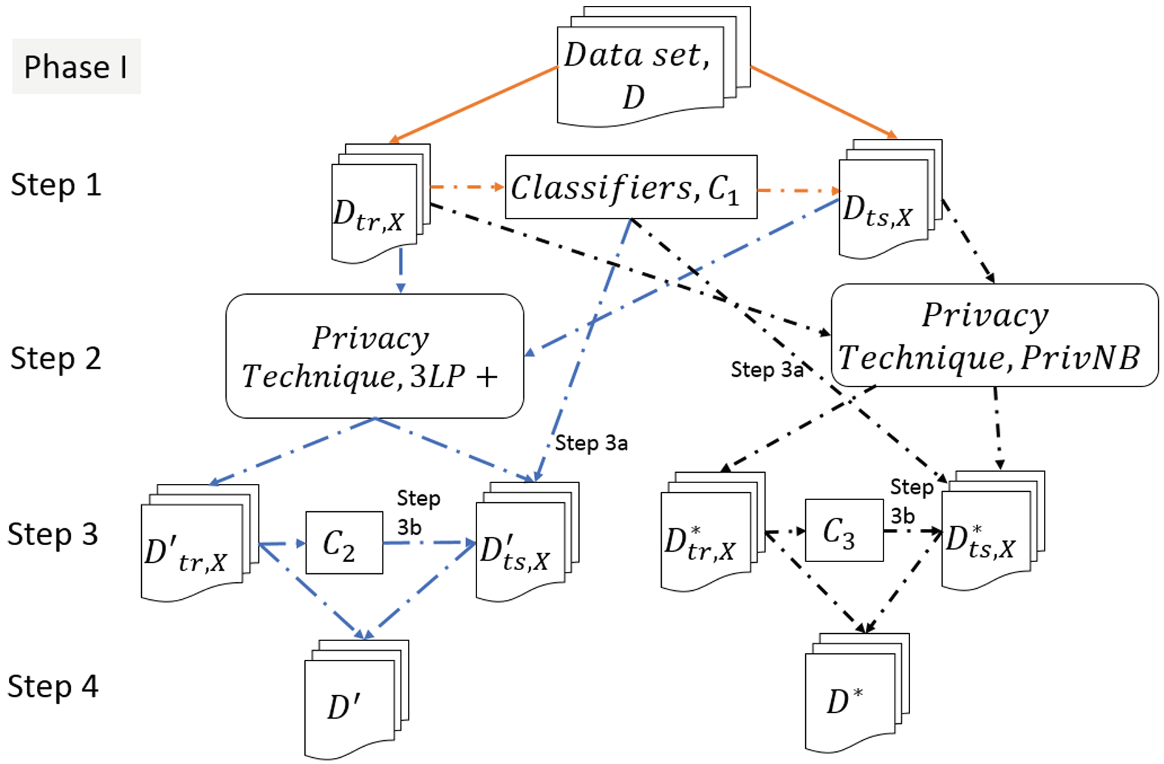 Figure: The multi-phase experimental setup ensuring protection across different sensitive attributes (X, Y, Z).
Performance and Utility
In comparative tests on real-world Facebook datasets, 3LP+ proved its dominance over the baseline PrivNB (Private Naïve Bayes).
- Higher Privacy: Against Support Vector Machines (SVM) and Random Forests (RF), 3LP+ consistently reduced the "Attack Success Rate" more effectively than prior methods.
- Lower Cost: Privacy often comes at the cost of utility. However, 3LP+ required significantly fewer profile suppressions. In Dataset 1, the baseline method required nearly 300% more suppressions to achieve lower levels of security.
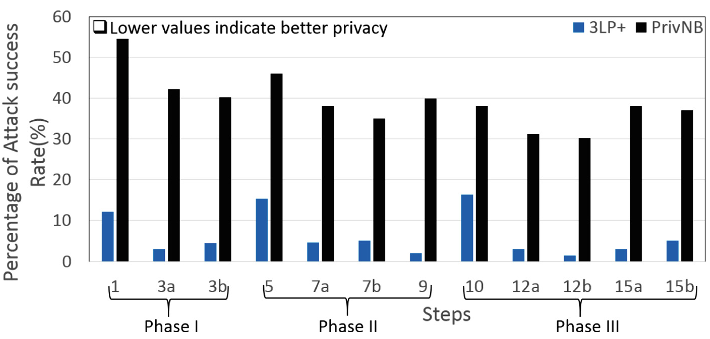 Figure: Prediction accuracy (lower is better for privacy) showing 3LP+ outperforming PrivNB across various experimental steps.
Critical Insight: Why it Works
The success of 3LP+ lies in its use of the SysFor algorithm—a systematically developed forest of decision trees. By using an ensemble of trees rather than a single classifier, the protection covers a wider range of "logical rules" that an attacker might exploit. This creates an inductive bias in favor of the user, making the protected profile "unpredictable" to almost any standard machine learning model.
Conclusion & Future Look
As social networks evolve into the Metaverse and more complex multi-modal platforms, the risks of inference only grow. 3LP+ provides a blueprint for "Smart Privacy"—a system that doesn't just block data but intelligently reshapes your digital footprint to preserve your secrets without disconnecting you from the world.
The next frontier? Scaling this to handle Deep Learning attackers who can infer attributes from profile photos and sentiment analysis of posts.