
Precise PPI Extraction: Balancing Structural Insight with Feature Shrinkage
Protein-Protein Interaction Extraction from Text by Selecting Linguistic Features
The paper proposes a novel feature-based machine learning method for Protein-Protein Interaction (PPI) extraction. By utilizing a hybrid feature set (lexical, syntactic, and dependency-based) and a unique structural partitioning approach called 3subCV-FSShrink, the method achieves SOTA performance on benchmarks like HPRD50 and BioInfer.
TL;DR
In the field of biomedical text mining, identifying how proteins interact (PPI) is critical for understanding biological processes. This paper introduces a refined feature-based method that partitions sentences by their grammatical structure and applies "shrink coefficients" to recalibrate feature importance. This approach effectively beats complex kernel methods in both speed and accuracy on the HPRD50 and BioInfer benchmarks.
Problem & Motivation: The Computational Trap
Extracting relationships from scientific literature usually falls into two camps: Kernel-based (measuring similarity between trees) and Feature-based (statistical vectors). While kernels are mathematically elegant, they suffer from quadratic computational complexity—making them slow for large-scale mining.
Conversely, existing feature-based methods often produce massive, sparse vectors that ignore the "physical" layout of the sentence. The author’s core Insight is that the significance of a linguistic feature (like a preposition or a dependency path) changes depending on where the "action keyword" (e.g., binds, inhibits) is located relative to the proteins.
Methodology: Divide, Select, and Shrink
The proposed method, 3subCV-FSShrink, creates a highly specialized pipeline:
- Structural Partitioning: Sentences are split into three subsets based on the position of the interaction keyword:
- VAB: Verb appears before protein A and B.
- AVB: Verb appears between proteins (the most common pattern).
- ABV: Verb appears after both proteins.
- Diverse Feature Extraction: The model uses 47 features across Lexical, Syntactic (Parse Trees), and Dependency levels. A key addition is a "positive/negative" edge count in the dependency tree to capture the directionality of biological relations.
- Feature Shrinkage: Instead of binary feature selection (keep/delete), the authors use and coefficients to "shrink" the values of feature groups. This allows the model to retain marginal information while prioritizing high-impact features for a specific sentence structure.
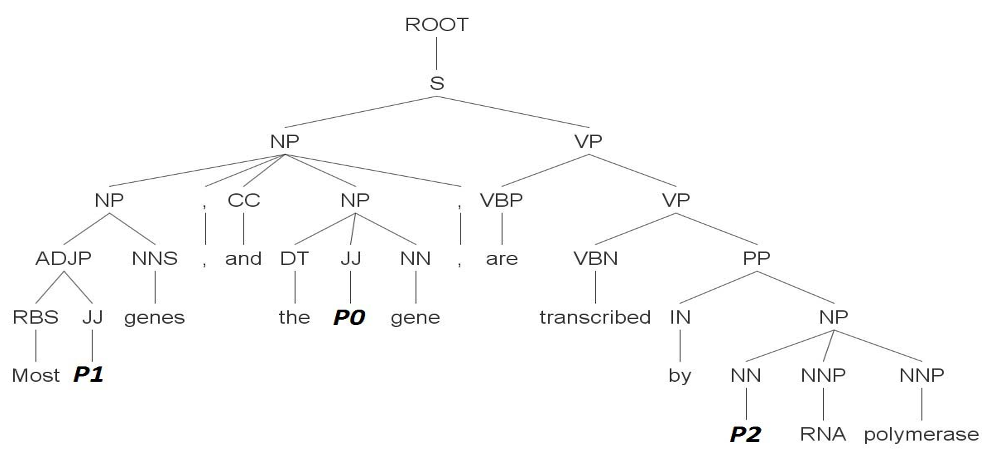 Figure 1: Example of a parse tree used for height-based features.
Experiments: Superior Efficiency
The researchers tested their approach on five gold-standard corpora: LLL, HPRD50, IEPA, AImed, and BioInfer.
- Accuracy: On the BioInfer corpus, the F-score reached 72.8%, outperforming traditional cosine and edit-distance kernels.
- Speed: While previous SOTA feature models (Van Landeghem et al.) required up to 6 hours to train on AImed, this method achieved results in 25 minutes. This 14x speedup is vital for processing the millions of abstracts on PubMed.
- Cross-Corpus Robustness: The method showed high stability when trained on one dataset and tested on another, a common failure point for PPI tools.
 Table II: Performance across different subsets (3subCV-FSShrink vs. standard approaches).
Critical Analysis & Conclusion
Takeaway
The paper proves that "less is more" if the "less" is intelligently selected. By reducing a massive feature space down to 47 highly relevant features and partitioning the problem space structurally, we can achieve high-performance PPI extraction without the overhead of quadratic kernels.
Limitations
A significant hurdle remains: Data Preprocessing. The paper notes that different interpretations of protein pairs in datasets like AImed make "straightforward comparisons" between methods difficult. Furthermore, while manual feature selection works well here, it may not scale to more complex, multi-protein events without the introduction of automated deep learning embeddings (like BERT).
Future Work
The next frontier for this work is likely the integration of Semantic Ontologies. Merging hard-coded linguistic features with bio-ontologies could allow the model to understand that "phosphorylates" and "activates" share similar interaction "physics," even if their dependency paths differ.