
Breaking the Infrastructure Chain: A Real-World Social Network in Multi-hop MANETs
Prototype of a social networking application in a multi-hop autonomous ad hoc network
The paper presents a functional prototype of a social networking application built for autonomous multi-hop Mobile Ad Hoc Networks (MANETs). Using Motorola e680 handsets, the authors demonstrate peer-to-peer messaging, content sharing, and real-time VoIP/video streaming without any existing infrastructure, achieving seamless range extension via multi-hop relaying.
TL;DR
Long before the ubiquity of modern mesh networks, researchers at Motorola sought to prove that mobile phones could form their own social ecosystems without cell towers or Wi-Fi routers. This paper showcases a robust prototype capable of VoIP, video streaming, and peer-to-peer messaging over an autonomous multi-hop Ad Hoc network, proving that "Range Extension" is a practical reality for consumer devices.
The Motivation: From Abstract Theory to Tangible Reality
Most research in Ad Hoc networking is buried in the mathematical intricacies of the MAC and physical layers. To the average user, the concept of a self-organizing, infrastructure-less network remains "conceptually murky."
The authors recognized that to move the needle on MANET (Mobile Ad Hoc Network) adoption, they needed a "Killer App." The goal was to demonstrate that an ad hoc network could not only exist but also handle the "heavy lifting" of modern social interactions—real-time voice, video, and content sharing—while dynamically extending the network's reach through peer-relay.
Methodology: The Architecture of Autonomy
The prototype was built on Motorola e680 handsets running an embedded Linux platform and 802.11b radios. The system architecture was strategically split into two components:
- Consumer Experience UI: A touch-screen interface designed for intuitive social interaction.
- Application Core: The "brain" responsible for the networking heavy-lifting, including beacon management, presence detection, and TCP/IP session maintenance.
Proximate Presence Detection
How do you know who is nearby when there is no central server? The authors implemented a multi-hop beaconing protocol. Handsets periodically broadcast their identity. When a neighbor receives this beacon, it rebroadcasts it (with hop count restrictions), allowing a handset to "see" users multiple hops away.
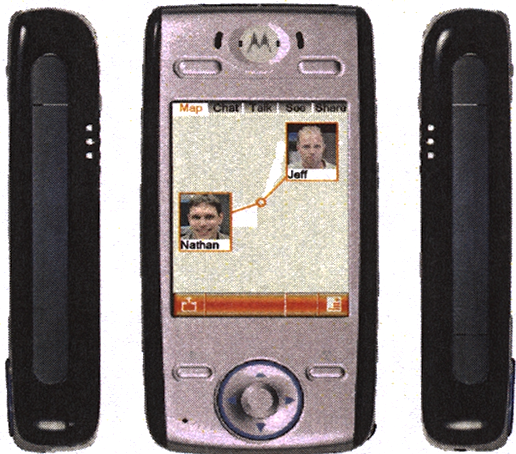 Fig 1. The Motorola e680 handset and the intuitive Social Networking UI.
Core Features & Real-Time Performance
The most impressive feat of the prototype was its ability to handle high-bandwidth, latency-sensitive data:
- Multi-Way Chat & Content Sharing: To ensure "guaranteed delivery," the core used serialized unicast rather than standard IP multicast, which is notoriously unreliable in ad hoc settings.
- Bi-Directional VoIP: The system managed 8 KHz 16-bit PCM voice frames. This served as the ultimate test for the multi-hop relay system, as any significant delay in the relay would make communication impossible.
- Near-Real-Time Video: The handsets could stream video from their integrated cameras across the mesh while simultaneously running a VoIP session—a high-stress test for the network's Quality of Service (QoS).
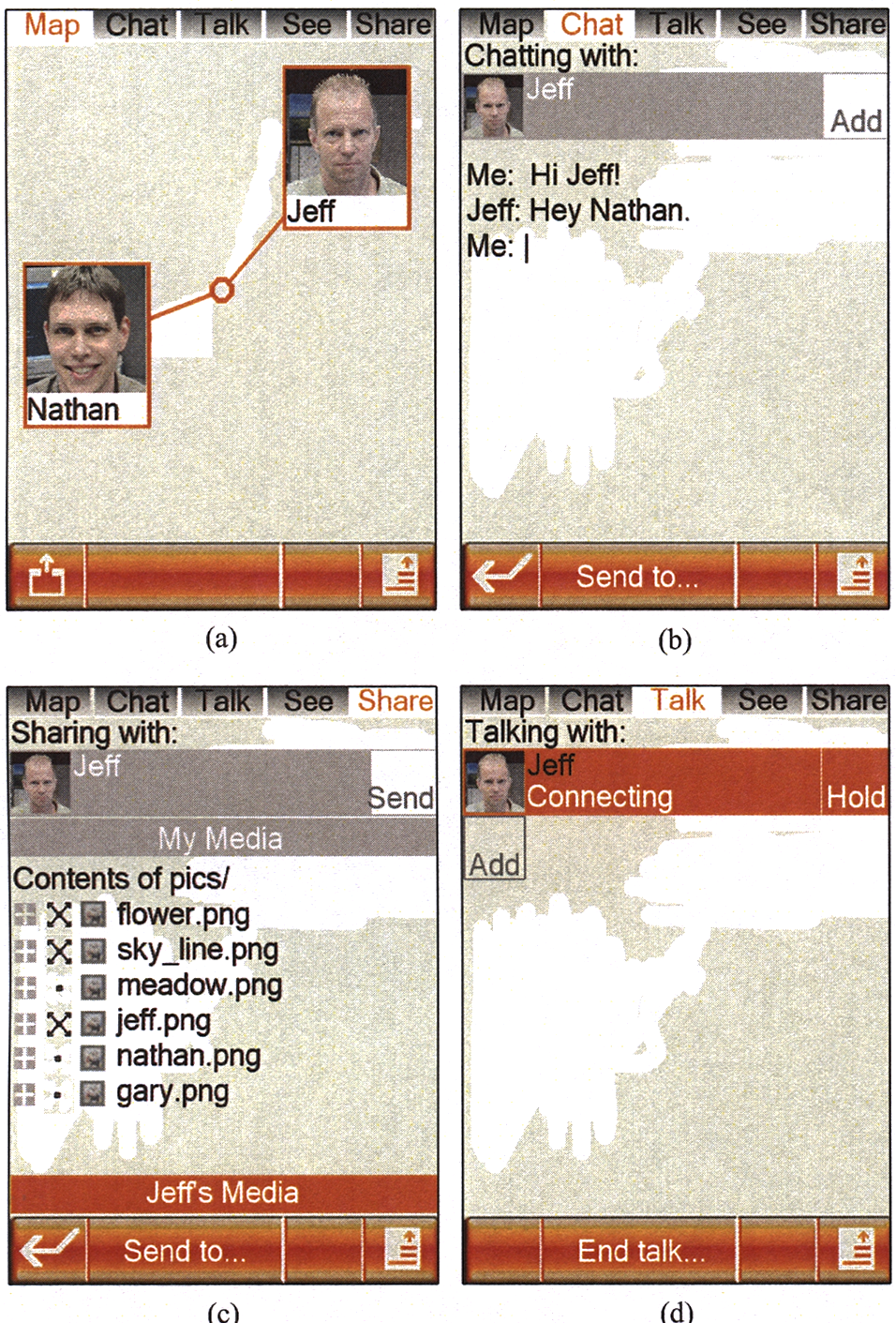 Fig 2. User interfaces for Presence Detection, Chat, Content Sharing, and VoIP.
Range Extension: The "Healing" Network
One of the most critical ad hoc concepts is Range Extension. In a typical star topology (like a standard Wi-Fi router), if you move too far from the center, you lose connection. In this multi-hop prototype, a third handset acts as a "bridge."
If Node A and Node C are out of radio range, Node B can be placed in the middle. The system uses routing tables to relay packets from A to B to C. This demonstrates the "self-healing" potential of MANETs; as the environment changes, the network can reorganize to maintain connectivity.
Critical Analysis & Conclusion
Takeaways
This work successfully bridged the gap between academic network theory and consumer-ready engineering. It proved that:
- Standard 802.11b hardware is sufficient for multi-hop multimedia.
- A "Store-and-Forward" approach or relaying does not necessarily break real-time voice/video QoS.
- Presence detection in decentralized networks can be handled efficiently via scoped beaconing.
Limitations
While the demo was successful, it utilized static routing tables and artificial signal attenuation to "force" multi-hop scenarios for the demonstration. In a chaotic real-world environment, the overhead of dynamic routing protocols (like AODV or DSR) could introduce additional latency that wasn't fully explored here.
Future Outlook
This prototype laid the groundwork for modern decentralized applications. Today, as we look toward 6G and decentralized web (Web3) infrastructures, the lessons from this 802.11b experiment—prioritizing unicast for reliability and local beaconing for presence—remain highly relevant.