
Educational Data Warehousing: Moving from Transactional Records to Strategic Insights
A Prototype System for Educational Data Warehousing and Mining 1
The paper presents a prototype Educational Data Warehouse (EDW) and mining system developed for the Informatics Department at Aristotle University of Thessaloniki. It utilizes a star-schema dimensional modeling approach to support OLAP operations and applies advanced survival analysis to predict student graduation timelines.
TL;DR
This research introduces a custom-built data warehouse designed specifically for the Informatics Department at Aristotle University of Thessaloniki. By moving beyond simple operational databases, the system enables complex multi-dimensional analysis (OLAP) and utilizes Survival Analysis to predict student graduation patterns, revealing that female students tend to complete their degrees significantly faster than their male counterparts.
Context & Motivation: The "Current Status" Trap
Most university departments operate on standard relational databases meant for daily administrative tasks—registering a student, recording a single grade, or updating a profile. However, these systems suffer from a fatal flaw in the context of research: historical amnesia. When a record is updated, the previous state is often overwritten and lost.
For university administrators and legislators, this is a major bottleneck. Without historical snapshots, one cannot calculate the "velocity" of student progress or identify systemic academic hurdles. The authors propose a Data Warehouse (DW) solution to act as a permanent, time-variant repository for longitudinal study.
Methodology: High-Resolution Dimensional Modeling
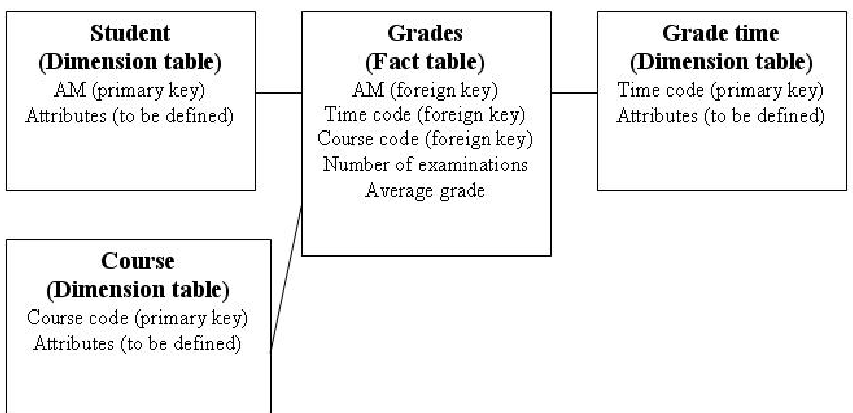
The team utilized a Star Schema approach, focusing on two primary business processes: Grades and Graduation.
1. The Grades Process
To maintain maximum flexibility, the system stores data at the highest level of detail (atomic level). Every single grade ever achieved by a student is a row in the Fact Table.
- Dimensions: Student, Course, Grade Time.
- Hierarchies: Allow "Drill-down" from an entire quinquenniad (5-year period) down to a specific semester or course type.
2. The Graduation Process
This focuses on the "terminal event" of the student lifecycle, tracking the diploma degree and the time elapsed since registration.
From Data to Insight: Statistical Mining
The study doesn't stop at data storage; it applies advanced statistical modeling to find correlations. One of the most striking findings was the inverse relationship between the time taken to graduate and the final grade:
This suggests that "procrastination" or delayed graduation is statistically linked to lower academic performance.
The Survival Analysis Innovation
Traditional statistics like ANOVA often ignore students who haven't graduated yet (discarding them as "missing values"). The authors argue this is a waste of valuable data. By using Survival Analysis (SA), they treat "graduation" as a terminal event and "non-graduation" as censored data.
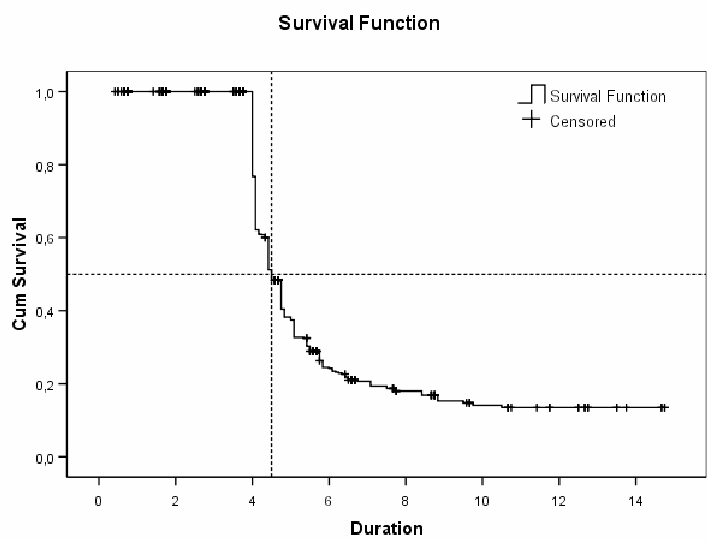
The Kaplan-Meier estimate (shown above) revealed that the median survival time (the point where 50% of the students have graduated) is 4.5 years.
Critical Insight: The Gender Gap in Graduation
Perhaps the most actionable insight provided by the system was the disparity in graduation speed between genders. While both genders achieve similar final grades, the "Survival Curve" for females is much steeper, indicating they exit the system with a degree much faster than males.
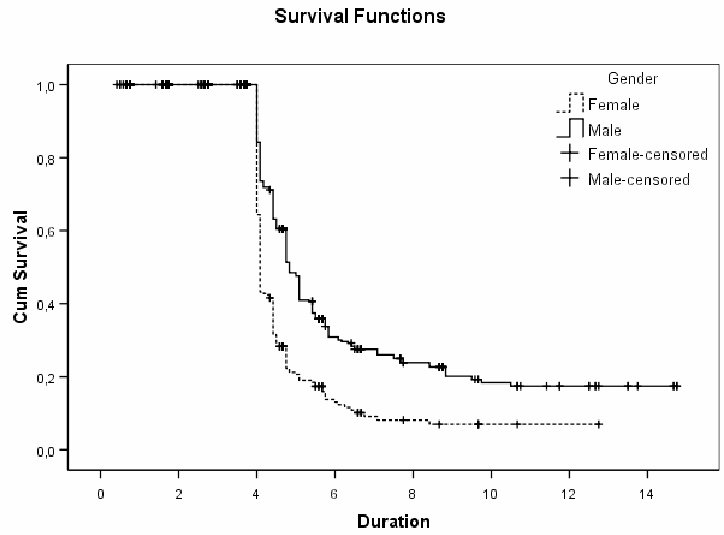
- Females: Median graduation at 4.08 years.
- Males: Median graduation at 4.83 years.
Conclusion & Future Outlook
The prototype proves that a customized Data Warehouse can provide university departments with a "macro" view of student success that traditional databases simply cannot. By integrating OLAP for reporting and Survival Analysis for predictive modeling, institutions can identify at-risk students and demographic trends in real-time.
Limitations: The current system relies on manual exports to Excel before ingestion. Future iterations should aim for automated ETL (Extract, Transform, Load) pipelines to provide a truly live dashboard for academic advisors.