
To Grok Grokking: Unveiling the Mathematical Mechanics of Delayed Generalization
To Grok Grokking: Provable Grokking in Ridge Regression
The paper provides the first end-to-end provable analysis of "grokking" (delayed generalization) in a classical over-parameterized ridge regression setting using gradient descent with weight decay. It rigorously demonstrates that the model sequentially overfits training data, persists in poor generalization, and eventually achieves near-perfect test performance.
The phenomenon of grokking—the sudden, late-onset generalization that occurs long after a model has perfectly overfit its training data—has long been treated as one of the "mysteries" of deep learning. Since its coinage in 2022, researchers have wondered if it represents a unique phase transition in neural network representations.
In the paper "To Grok Grokking: Provable Grokking in Ridge Regression", the authors strip away the complexity of non-linear architectures to show that grokking isn't just a deep learning quirk. It is a fundamental property of optimization dynamics in over-parameterized linear models.
TL;DR: The Core Discovery
This work provides the first rigorous, end-to-end proof that grokking occurs in simple ridge regression. By analyzing the interaction between gradient descent and weight decay, the authors derive explicit "grokking time" bounds. Their key insight: grokking is a competition between different convergence rates in orthogonal weight subspaces.
The Mystery: Why Does Generalization Wait?
In the standard machine learning narrative, overfitting is a "dead end." Once a model fits the noise in the training set, we expect its performance on new data to plateau or worsen. However, grokking suggests that if we keep training beyond that point, the model eventually "figures it out."
Prior theories attributed this to transitions between the "lazy" (kernel) and "rich" (feature learning) regimes. But this paper argues that even without feature learning, the transition from "ridgeless" to "ridge" regimes is sufficient to trigger grokking.
Methodology: The Geometry of Over-parameterization
The authors analyze a student linear model training on an over-parameterized dataset ().
The Subspace Speed Gap
The mathematical "magic" happens when we decompose the weights into two parts:
- (The Data-Aligned Component): These weights live in the span of the training features. They converge extremely fast to minimize the training error.
- (The Null-Space Component): These weights are orthogonal to the training data. Because the data provides no signal here, these weights are only affected by Weight Decay ().
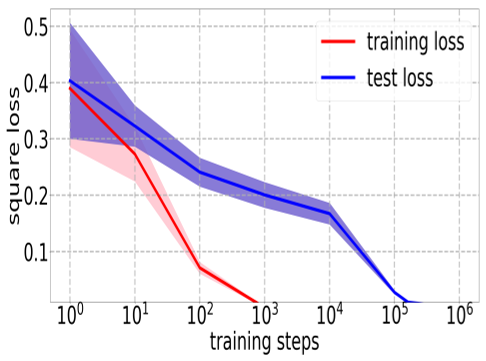 Figure 1: Comparison between Ridge Regression (Left) and a 2-layer ReLU network (Right). Both exhibit the same delayed generalization signature.
The Training Loss drops at a rate controlled by the eigenvalues of the feature map (fast). The Generalization Loss stays high until the components—which act as over-parameterization noise—are suppressed by the weight decay at a rate of (slow).
Key Results: Predicting the Grokking Time
The paper offers a definitive formula for the "Generalization Delay." By setting thresholds for overfitting () and generalization (), they show:
- Weight Decay Control: The delay is inversely proportional to the weight decay . As , the grokking time becomes infinitely long.
- Initialization Scale: Larger initial weights () increase the grokking time logarithmically.
- Sample Size: Smaller sample sizes actually amplify the grokking effect by speeding up the initial overfitting phase.
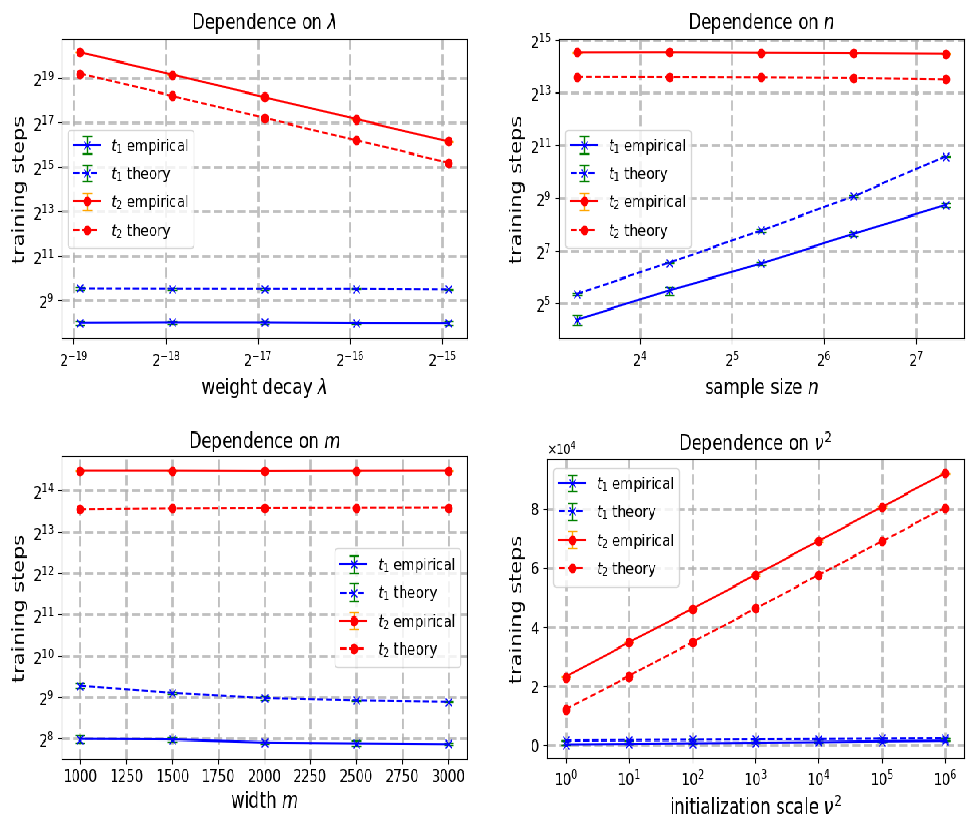 Figure 2: Empirical validation of theoretical bounds. Note how grokking time () scales inversely with (Left Upper).
Deep Insights: Beyond Linear Models
Perhaps the most striking contribution is the empirical evidence that these linear bounds qualitatively match the behavior of non-linear neural networks (Figures 3 and 4 in the paper). This suggests that much of what we see in "deep grokking" is actually the underlying weight decay slowly pruning the model's complexity in the subspaces that don't matter for the task.
Critical Analysis & Takeaways
This paper serves as a "Occam's Razor" for grokking. It suggests:
- Grokking is not a failure mode: It's a natural phase of training in high-dimensional spaces with small regularization.
- Architecture isn't everything: You don't need Transformers or ReLU to see grokking; you just need more parameters than data and a bit of weight decay.
- Limitations: The proof focuses on the "realizable" case (where a perfect solution exists). In noisy, "agnostic" settings, very small weight decay might impede generalization entirely, suggesting a more complex trade-off in real-world applications.
By demystifying grokking in the transparent setting of ridge regression, this work provides a rigorous foundation for future studies into more complex adaptive optimizers and large-scale model training.