
FINLAnd: Breaking Scalability Barriers in Latent Feature Inference
Provably Fast Inference of Latent Features from Networks with Applications to Learning Social Circles and Multilabel Classification
The paper introduces FINLAnd (Fast INference of LAtent features), a method for efficiently learning binary latent features from networks that explain observed structures through homophily. It proposes a probabilistic generative model and the first provably rapidly mixing Markov chain for latent feature inference, achieving State-of-the-Art performance in speed and accuracy for social circle detection and multilabel classification.
TL;DR
Researchers have long sought to uncover the "hidden interests" (latent features) that drive connections in social networks. However, most models either fail to scale or ignore the fact that overlapping social circles are often denser than the circles themselves. This paper introduces FINLAnd, an MCMC-based approach that is the first to provide provable polynomial-time mixing for this task. It is not just a theoretical toy; it runs 2,400 times faster than previous Bayesian methods while maintaining high accuracy in real-world applications like Twitter social circle discovery.
The "Denser Overlap" Paradox
In many traditional models, the probability of an edge decreases as we consider the intersections of communities. Real-world data suggests the opposite: if two people share more interests (features), they are more likely to connect. This is homophily.
The technical challenge is that finding the best set of latent features to explain a graph is an NP-hard problem (specifically, a version of Overlapping Correlation Clustering). Prior work used expensive Bayesian sampling or local heuristics that frequently got stuck in local optima.
Methodology: Provably Fast Mixing
The core contribution of this work is a Metropolis-Hastings chain designed to maximize the log-likelihood of a generative model where is a non-decreasing function of shared features.
The Algorithm
The algorithm, FINLAnd (Fast INference of LAtent features), iteratively updates the binary feature vector of a randomly selected vertex. The probability of accepting a move depends on a mixing parameter .

Why it works: The Path Coupling Insight
The authors use Path Coupling to prove that the state space (all possible feature assignments) can be traversed quickly. By defining a coupling where two chains are "forced" to stay as close as possible, they prove that the expected distance between states shrinks over time. This leads to a mixing time of , making it viable for large-scale networks.
Experiments: Speed and Robustness
The authors compared FINLAnd against ILA (Infinite Latent Attribute), BigClam, and CFinder.
- The Speed Gap: On a 40-vertex graph, FINLAnd finished in 0.02 seconds, while ILA took 49.1 seconds. For larger graphs (600+ nodes), ILA failed to finish in days, while FINLAnd completed in seconds.
- Noise Tolerance: Even when deleting 15-20% of edges (simulating noisy real-world data), FINLAnd maintained >90% precision and recall in recovering latent features.
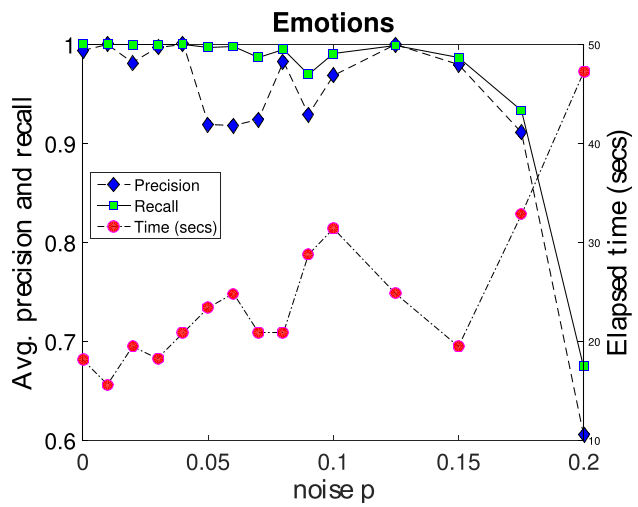 Figure: The algorithm maintains nearly 1.0 Precision/Recall even as the graph size increases (x-axis), with a near-linear growth in execution time.
A Rule-of-Thumb for Sparse Graphs
Most real-world networks are sparse (). In these cases, the "non-edge" terms in the likelihood function can overwhelm the "edge" terms. The authors propose a weighted objective: This weight normalizes the importance of edges and non-edges, allowing the model to perform effectively on sparse Twitter ego-networks.
Critical Analysis & Future Outlook
Strengths:
- Theoretical Rigor: First mixing time proof for latent feature model inference.
- Scalability: Orders of magnitude faster than existing Bayesian approaches.
- Simplicity: Easy to implement (Matlab/C++) and parallelize.
Limitations:
- The number of features is assumed to be known or provided. In practice, estimating remains a separate, difficult heuristic problem.
- The model focuses on assortative features (homophily). Adapting this for disassortative structures (e.g., predator-prey or bipartite roles) would require a different transition logic.
Conclusion
FINLAnd bridges the gap between the speed of simple graph heuristics and the mathematical rigor of latent variable models. It proves that we don't have to sacrifice theoretical guarantees for practical performance in complex network mining.